
Too busy to read? Listen to the article instead.
AI search traffic grew by 527% between 2024 and 2025, and this shift has made Answer Engine Optimization 2026 a critical priority for every business. Users now expect instant, direct answers from AI tools, not long lists of links. This is why brands must understand what is AEO and how to adapt their content for AI-driven discovery.
The best answer engine optimization strategies for AI-driven platforms include content clarity, correct user intent, brand authority, and organized data structure. These core elements are needed to perform well across ChatGPT, Perplexity, Google AI Overviews, and other answer engines.
What Is AEO (Answer Engine Optimization)?
AEO stands for Answer Engine Optimization. It’s an optimization process that helps your content show up as a direct answer in AI-generated answers and results. Instead of just trying to rank for keywords like traditional SEO, AEO focuses on creating AI-friendly content, off-site authority, and structured data. When your content is AEO optimized, Google’s AI Overviews, voice assistants, and AI chatbots (like ChatGPT) can easily pull answers from it.
Why AEO Matters for Business Success?
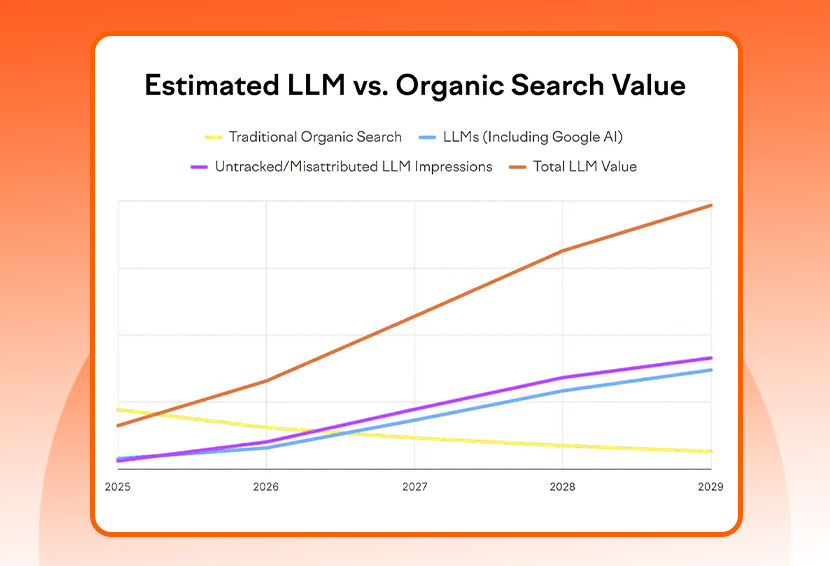
AI search is rapidly transforming how people find information. Experts predict that by 2028, AI search traffic will surpass traditional search visitors. This is why Answer Engine Optimization in 2026 has become a critical strategy for brands that want to stay visible.
Here are some key stats that highlight the explosive rise of AI search:
- Huge year-over-year growth: Semrush reports a 527% surge in AI search traffic from 2024 to 2025, proving how quickly people are shifting toward AI tools for answers.
- AI influences purchasing decisions: A McKinsey study shows that 40–55% of buyers now rely on AI search to help them choose products or services.
- Zero-click AI answers dominate: Google states that AI Overviews reach 2 billion users across 200 countries and 40 languages, dramatically reducing traditional website clicks.
As users turn to AI for answers, brands that optimize content for answer engines will gain more visibility, trust, and revenue.
What Is the Difference Between AEO and SEO?
Unlike traditional SEO, which targets search rankings and links, AEO aims to have your content selected, cited, or summarized by AI models directly in their answers.
In the traditional SEO model, visibility meant ranking high on search engines like Google. In the AI era, there is an additional but crucial area of brand visibility: being cited, mentioned, and trusted by AI platforms.
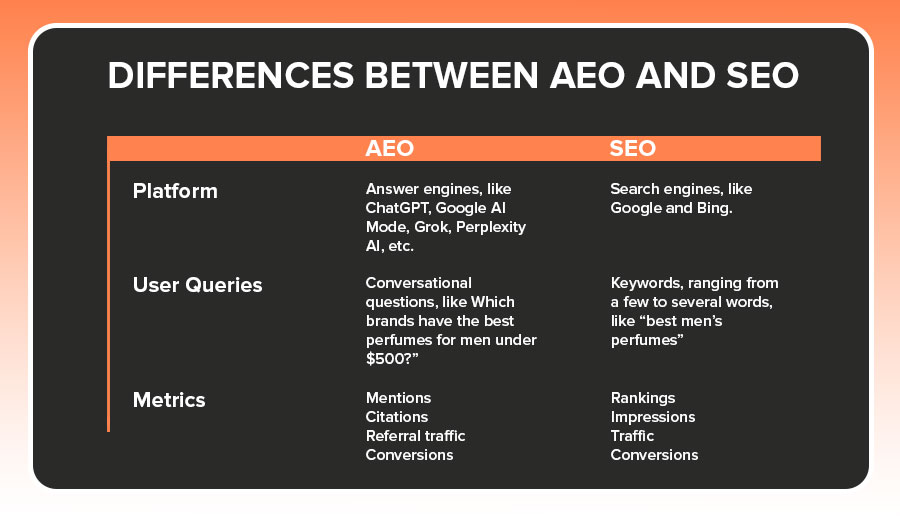
AEO and SEO differ in their target platforms, query formats, and success metrics, but both aim to increase online visibility. Understanding the differences and similarities between SEO and AEO helps you build a strategy that works across traditional search and AI-driven platforms.
Differences Between AEO and SEO
1. Platform focus
AEO targets answer engines such as Google AI Mode and Overviews, ChatGPT, Perplexity AI, Microsoft Copilot, etc. These systems generate responses by pulling information from multiple sources and presenting it as a synthesized answer.
SEO targets search engines such as Google, Bing, and DuckDuckGo. These platforms present ranked lists of websites, and users click through to find the information they want.
2. Users Search Queries
- AEO focuses on conversational, natural-language questions. Example: “Which brands have the best perfumes for men under $500?”
- SEO focuses on keyword-based queries. Example: “best men’s perfume.”
This difference changes how you structure content, because answer engines extract direct answers, while search engines look for keyword relevance and page quality.
3. Success metrics
AEO measures performance through:
- Mentions inside AI-generated responses
- Citations from answer engines
- Placements within summaries
- Traffic driven by AI platforms
These metrics show how often AI systems select and trust your information.
SEO measures performance through:
- Rankings in search results
- Organic impressions
- Website traffic
- Conversions
- Domain authority
These metrics show how well your pages compete in traditional search environments.
Key Similarities Between AEO and SEO
It’s important to know that AEO is supported by strong SEO, rather than replacing it. And although there are some key differences, AEO and SEO also share some core strengths and techniques.
- Both aim to increase visibility and help users discover reliable information. Whether it is a Google search result or an AI-generated summary, the goal is to meet users in the spaces where they search.
- Both rely on similar tactics, such as producing high-quality content, attracting reputable backlinks, and targeting relevant phrases. Strong E-E-A-T, clear organization, and accurate information support success in both environments.
- Both require overlapping skills, including content strategy, audience research, technical analysis, and data interpretation.
These shared skills make it practical and efficient to practice SEO and AEO together.
What Are the Best Strategies for Answer Engine Optimization in AI-Driven Platforms?
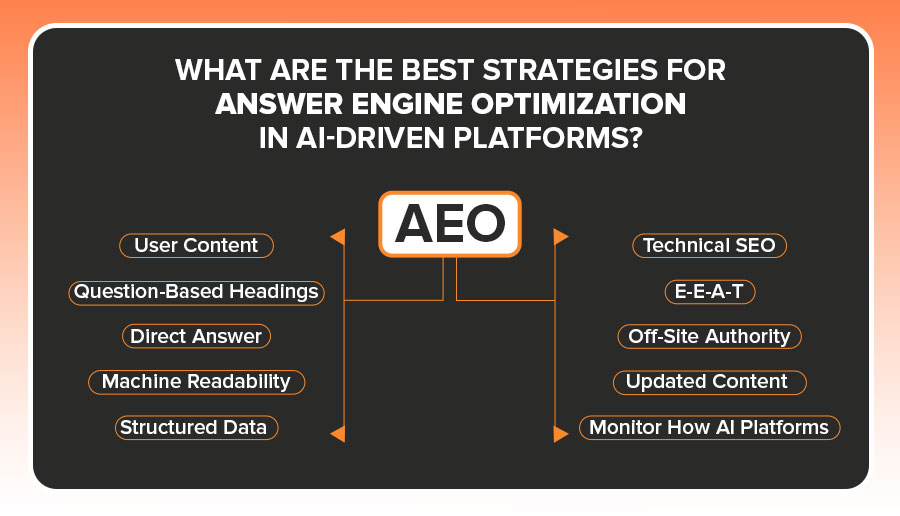
The best strategies for Answer Engine Optimization in AI-driven platforms focus on giving clear, direct answers and structuring content so machines can understand it instantly. Effective AEO requires leading each section with a concise answer, using question-based headings, and formatting information in short paragraphs, lists, and scannable blocks.
Implementing structured data such as FAQ, QAPage, and HowTo schema helps answer engines interpret your content correctly. To optimize content for answer engines in 2026, research not only traditional keywords but also conversational, natural-language queries, since AI systems rely heavily on intent-driven questions when generating responses. The following are the key best practices for answer engine optimization:
1. Map User Intent Accurately
Understanding user intent is essential for answer engine optimization in 2026, because AI platforms retrieve answers that match the purpose behind a query. Focus on the real questions users ask and the actions they want to take. Review customer emails, support chats, comments, and on-site searches to capture natural user language. Use tools like Semrush, Ahrefs, and People Also Ask explorers to identify common question patterns.
Group intent into clear types such as informational, action-focused, or problem-solving. For example, “Why is my Shopify site slow?” shows diagnostic intent, while “How to speed up a Shopify store” shows instructional intent.
2. Use Question-Based Headings and a Human-Friendly Structure
Using question-style headings signals a clear intent to both readers and AI systems, which is a core requirement when you optimize content for answer engines. Question-based formatting improves clarity and guides AI platforms to the most relevant answer blocks.
For example, instead of vague headings like “Product Image Quality Tips,” use “How can you improve the quality of your product images ?” Then begin with a direct response, followed by examples, supporting insights, and next steps. This structure strengthens clarity, intent, and user engagement, which is the best answer engine optimization strategy for AI-driven platforms.
3. Start Every Section With a Clear, Direct Answer
Beginning each section with a concise answer, usually within the first 100–200 words, is essential for strong Answer Engine Optimization in 2026. Because AI engines extract top-level statements before scanning supporting text, this structure increases the likelihood your page will be cited directly in AI results.
For example, if a section has the heading “What is Answer Engine Optimization?”, start with: “Answer Engine Optimization is the practice of structuring content so AI search engines can detect, understand, and cite your answers directly.”
This clarity helps you optimize content for answer engines by making the answer immediately accessible. After delivering the core statement, expand with examples and context to support a deeper understanding. This technique aligns with the best practices for answer engine optimization, as it mirrors the way ChatGPT, Gemini, and Perplexity analyze content for quick extraction.
4. Design Your Content for Machine Readability
Machine readability is crucial to optimizing content for answer engines because AI systems rely on structured formatting to extract key information.
- Use medium-length sentences, short paragraphs, and bullets to improve clarity.
- Numbered steps are ideal for tutorials like “How to create an Amazon seller account,” making it easier to extract steps in a sequence.
- Use clean HTML with minimal JavaScript around core text, and scannable formatting.
These best practices for answer engine optimization improve visibility across AI platforms.
5. Add Structured Data Such as FAQPage, QAPage, and HowTo Schema
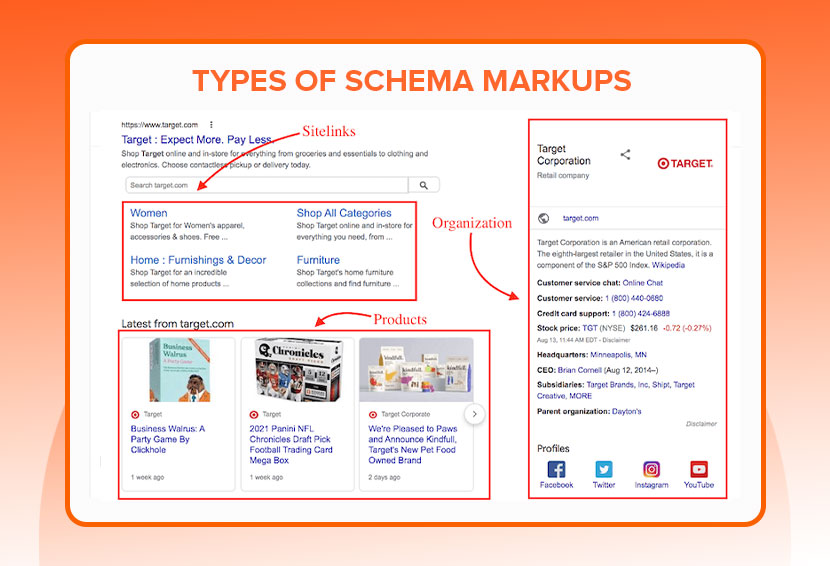
Schema markup gives AI models clear clues about where answers, steps, and definitions appear. To optimize content for answer engines, incorporate FAQPage for multi-question sections, QAPage for direct single-question answers, and HowTo schema when creating step-by-step guides.
Machine-readable labeling significantly improves your chances of being cited by AI models, especially when combined with the best practices for answer engine optimization. Structured data removes ambiguity, allowing engines to interpret your content with precision.
Organization, local business, article, and product markups also help AI platforms efficiently discover your organization.
6. Maintain Core Technical SEO: Speed, Mobile optimization, Crawlability
Technical performance remains foundational to Answer Engine Optimization for 2026, because AI systems cannot interpret or cite content that is slow, blocked, or difficult to crawl. Fast loading speeds, mobile-friendly layouts, clean HTML, and logical site architecture all make your content easier to analyze.
Technical SEO ensures your content is discoverable before it can be ranked or selected. For example, a page that loads in under two seconds is more likely to be fully crawled, and mobile-optimized layouts improve how voice and conversational queries are handled. Maintaining this foundation is essential when you optimize content for answer engines.
7. Strengthen E-E-A-T (Expertise, Experience, Authority, and Trust)
Building visible expertise supports nearly every aspect of Answer Engine Optimization for 2026, because AI systems favor authoritative and trustworthy content. Here’s a quick overview of what E-E-A-T stands for in AEO and traditional SEO:
- Experience: Demonstrate real-world proof with first-hand tests, original media, and personal stories.
- Expertise: Show expert credibility with detailed author bios, verified profiles, and clear professional qualifications.
- Authoritativeness: Build industry authority through consistent digital PR, high-quality citations, and mentions from trusted publications.
- Trustworthiness: Strengthen trust with transparent business info and a clean, connected schema that validates authors and content.
8. Build Off-Site Authority With Genuine Citations and Mentions
Off-site authority remains a major factor when you optimize content for answer engines, because AI models prioritize information supported by credible third-party sources. Semrush and Ahrefs highlight that backlinks, citations, and community mentions matter even more in AI-driven search than in traditional search.
Publishing expert contributions, joining industry roundups, and earning citations on platforms like Reddit, Stack Overflow, and respected blogs strengthen credibility. Also, ensure that your business information remains consistent across business directories, like Clutch, and review sites, like Trustpilot. These sources are often used as training data for AI platforms.
9. Keep Content Fresh With Updated High-Value Content Frequently
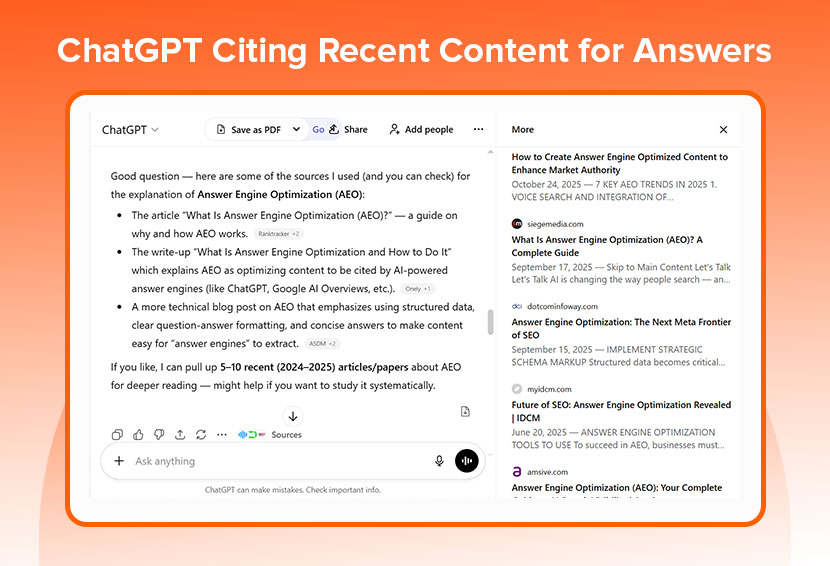
Freshness is essential for answer engine optimization, especially for topics involving software, security updates, platform changes, or evolving best practices. It’s recommended to refresh major pages every 90 days to stay aligned with what users and AI systems expect.
Updating screenshots, examples, and workflows helps ensure your content remains accurate. For instance, replacing old “Facebook Pixel setup steps” with updated “Meta Pixel setup steps.” Keeping information current optimizes content for answer engines and prevents AI platforms from relying on competitors with more up-to-date answers.
10. Monitor How AI Platforms Cite and Mention Your Brand
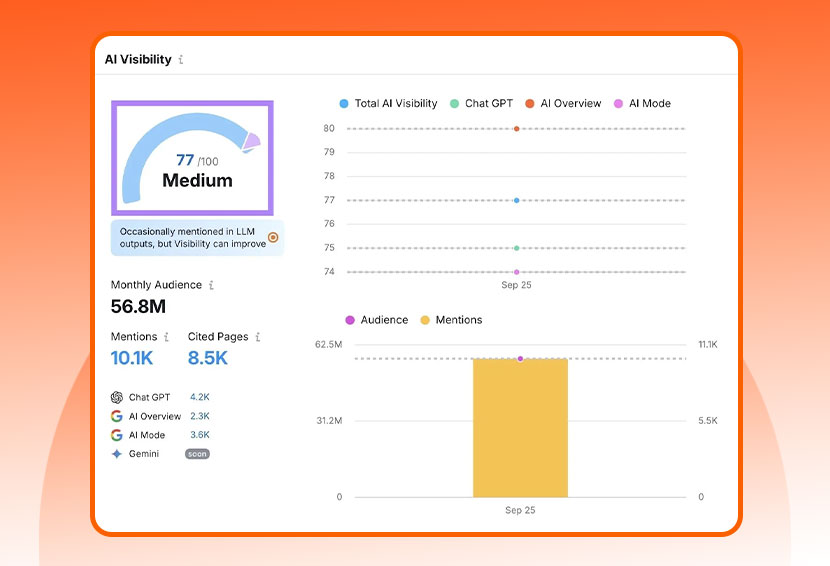
AEO is an ongoing process, and monitoring AI visibility is a core component of managing answer engine optimization effectively. Search your target questions across ChatGPT, Perplexity, and Google AI Overviews to see whether your content appears as a cited source, whether summaries accurately reflect your information, and where competitors may have an advantage.
Use AI visibility tracking tools like Semrush to monitor your AI visibility score, brand mentions, citations, and AI share of voice to measure your performance on AI platforms. Treat AI visibility like traditional rank tracking. When gaps appear, refine structured data, improve answer clarity, and strengthen authoritativeness. This ongoing tracking and optimization helps you optimize content for answer engines more effectively.
What Services Do Answer Engine SEO Agencies Typically Offer?
Answer engine optimization (AEO) agencies help brands get their content selected for AI overviews, voice assistant responses, and chatbot answers, not just traditional search results. These services expand on classic SEO and focus on turning your content into clear, extractable answers that AI systems trust. Many brands now rely on a top-rated answer engine optimization service to increase visibility across all major AI platforms.
Here’s a breakdown of key services that answer engine SEO agencies typically offer:
1. Strategic planning and auditing
AEO agencies start by reviewing how well your current content performs in AI-driven search. Their work usually includes:
- AI visibility audits to see how often your content appears in AI answers
- Query and prompt research to identify the natural questions users ask AI tools and voice assistants
- Strategy development that ties AEO actions to your broader marketing goals
This planning phase helps agencies decide which content to improve first based on business impact.
2. Content creation and optimization
Agencies then create or refine content so AI models can understand it instantly. Common actions include:
- Q&A-style content, with each section starting with a short, direct answer
- Conversational writing that uses plain language and a confident, helpful tone
- Structured formatting, such as question-based headings, bullet points, lists, and tables for easier extraction
This approach turns each page into a clean, scannable knowledge block.
3. Technical AEO
Technical updates help AI systems crawl, read, and trust your content. Agencies often perform:
- Schema markup setup, including FAQPage, HowTo, Article, and Speakable schema
- Crawlability and indexability fixes to ensure AI bots like GPTBot can access every important page
- Performance updates, such as faster load times and improved mobile design
These improvements make your site easier for both search engines and AI models to interpret.
4. Authority building and monitoring
AEO success depends on strong trust signals across the web. Agencies support this by:
- Building citations and authority with digital PR, high-quality backlinks, and community engagement on platforms like Reddit and Quora
- Monitoring AEO performance, such as featured snippet wins, AI answer citations, and voice assistant usage
- Ongoing optimization as AI retrieval patterns evolve
This long-term work helps brands remain visible even as AI systems change, a key reason many businesses rely on top-rated answer engine optimization services.
Final Thoughts
Answer Engine Optimization 2026 is no longer optional. AI platforms decide which brands get cited, trusted, and recommended in the next generation of search. The winners will be the businesses that structure content for direct answers, show real expertise, build authority, and optimize their pages for machine understanding, not just human reading.
By applying the best answer engine optimization strategies for AI-driven platforms, you position your brand to gain visibility, trust, and conversions in every major AI system. AEO is the new competitive edge, and the brands that invest now will own the future of AI-powered search.