
Too busy to read? Listen to this article instead.
Are you spending hours writing blog posts that seem to vanish into the void? Or maybe you’re building a solid following on Instagram, but watching your conversion rate sit at zero? If either of these sounds familiar, you’re not alone, and the problem usually isn’t the channel you’ve chosen. The real issue is that most businesses treat content marketing and social media marketing as separate strategies, picking one and hoping it carries the whole load. It never does.
In this guide, we’re breaking down the differences between content marketing and social media marketing, showing you exactly how they feed each other, and giving you a practical framework to use both together. From real-world examples to the best tools and social media content creation tips, this guide gives the full picture.
What Is Content Marketing and Why Does It Matter?
Content marketing is the practice of creating and distributing valuable, relevant content to attract and retain a clearly defined audience and ultimately drive profitable customer action. It’s pull marketing. You create; people find you.
Why Is Content Marketing Important?
Because it works at every stage of the funnel, done right, content builds trust with cold audiences, drives organic traffic passively, generates leads around the clock, and positions your brand as the authority in your space.
And the content marketing statistics back it up. Content marketing generates over 3x as many leads as outbound marketing and costs 62% less, which is a huge structural advantage.
Content Marketing Examples
Strong content marketing examples span many formats: blog posts, how-to guides, eBooks, case studies, podcasts, YouTube tutorials, infographics, and email newsletters. One of the best real-world examples? HubSpot grew to over $1 billion in revenue on the back of a relentless blogging and SEO strategy, producing thousands of free, high-value articles that brought in organic traffic and converted it into customers. Websites with active blogs have over 434% more indexed pages than those without, which directly translates to search visibility.
Also Read: How to Grow Your Brand’s AI Visibility with GEO Strategies?
What Is Social Media Marketing and Where Does It Shine?
Social media and content marketing are often confused for the same thing, but social media marketing is its own area. Social media marketing is a distribution channel and a part of your broader content marketing strategy. While they serve different primary functions, they work together to achieve your marketing goals.
It’s the use of platforms like Instagram, TikTok, LinkedIn, Facebook, and YouTube to build awareness, engage audiences, and drive action through organic posts, paid ads, stories, reels, influencer collabs, and UGC campaigns.
It’s push + community marketing, and you show up where your audience already is.
The scale is staggering. As of 2025, over 5.41 billion people worldwide use social media, roughly 65.7% of the global population. The average user actively engages with 6.8 different platforms each month. That’s an enormous, diverse audience waiting to discover your brand.
Quick Platform Cheat Sheet
Here’s where each platform wins for social media for content marketing:
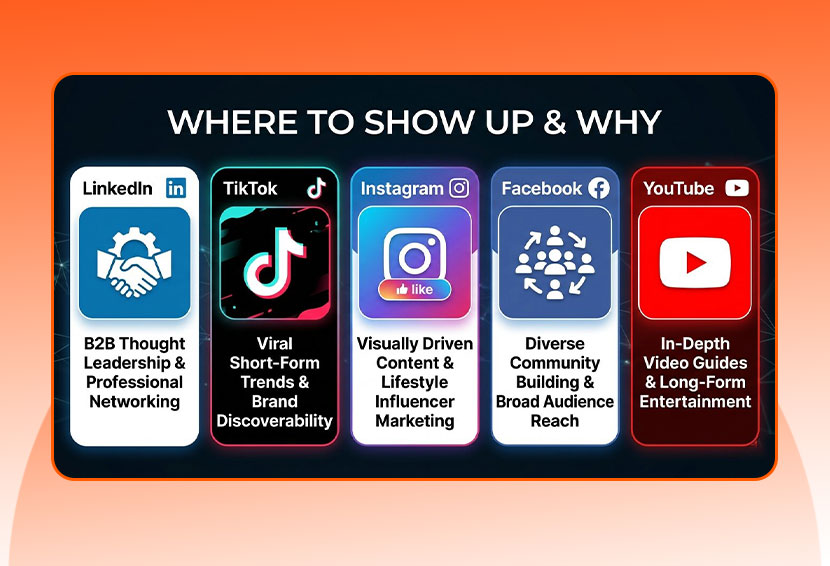
- LinkedIn: B2B thought leadership, decision-makers, long-form carousels
- TikTok: Discovery, Gen Z, short-form entertainment-first content
- Instagram: Visual brands, Reels for reach, Stories for loyalty
- Facebook: Communities, local businesses, retargeting ads
- YouTube: Long-form education, SEO-friendly video, tutorials
Content Marketing vs. Social Media Marketing: The Real Differences
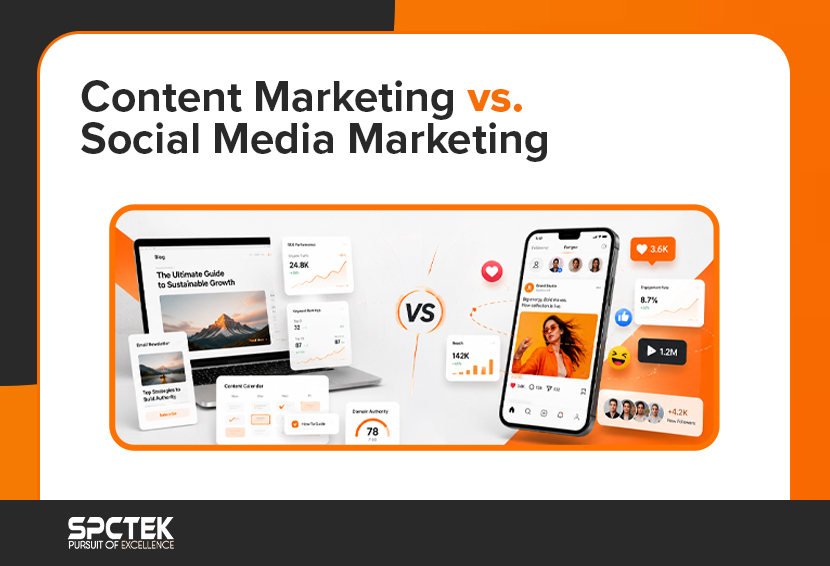
Content marketing plays the long game. It lives on your website and blog, builds authority over time, and compounds through SEO for months or even years. Social media marketing moves fast; it meets your audience where they already are, generates quick reach and engagement, but fades within hours. One is slow and lasting; the other is immediate but fleeting. Together, they cover what neither can do alone.
Here’s a clean breakdown of how the two strategies compare:
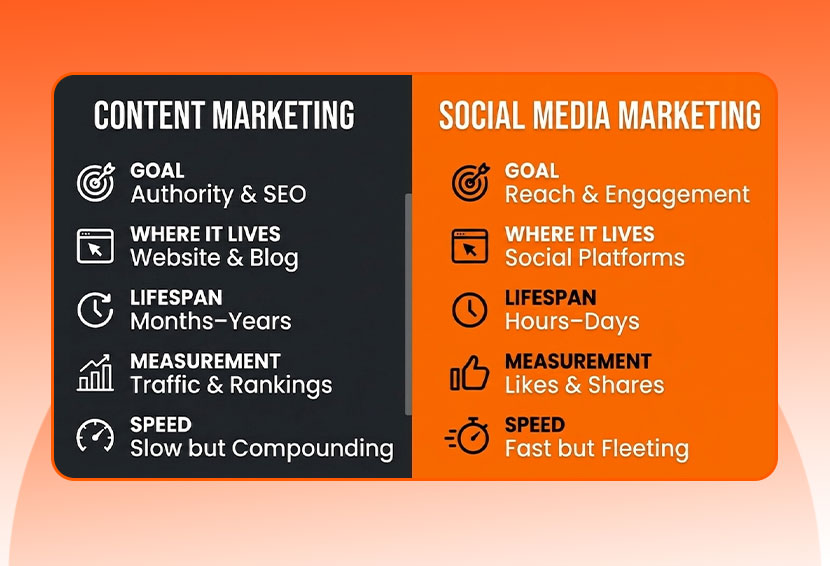
The key insight is that content marketing and social media marketing aren’t rivals. They’re operating on different timelines and serving different needs, and you need both.
The Real Truth: Why You Can’t Have One Without the Other
Without content, social has nothing worth saying. Without social media, content has no audience. Strong content fuels your social channels, social amplifies your content’s reach, and the engagement you get back tells you what to create next. The winning cycle is simple:
1. Content Fuels Social
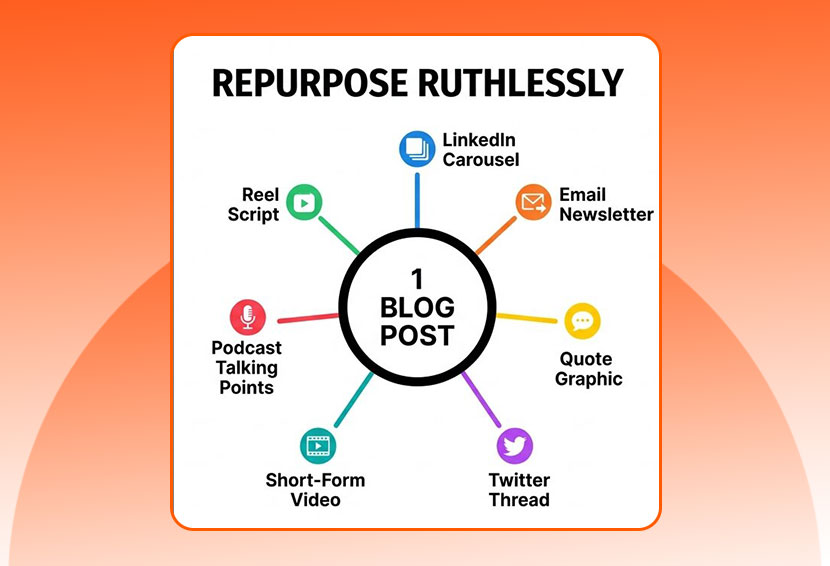
Without strong content, your social media posts are shallow. A single well-researched blog post becomes 10 social captions, 3 Reel scripts, 1 email newsletter, and a LinkedIn carousel. Social media content creators working without a content strategy are constantly scrambling for ideas. A content library solves that permanently.
2. Social Amplifies Content
The best blog post in the world is invisible without distribution. You can write a masterpiece and watch it sit at zero page views for months. Social media is the engine that gets content in front of audiences who wouldn’t have found it through search alone. 90% of marketers use social media to share content, and for good reason.
3. Social Informs Content
Comments, DMs, trending questions, poll responses, and social media are the world’s largest free focus group. It tells you exactly what your audience wants to read next. The brands winning with social media content creation aren’t guessing at topics. They’re listening.
The Content Machine Loop
Most brands create content and hope for the best. The ones that actually grow treat it as a system.
Here’s the framework:
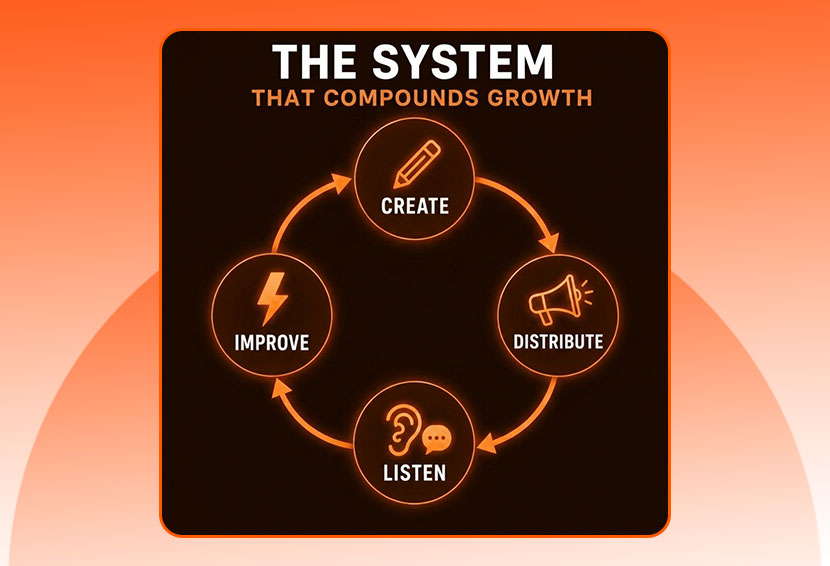
Start by creating valuable long-form content: a blog post, a guide, a video.
- Distribute it across every relevant social channel, repurposing it into formats that fit each platform.
- Listen to what happens next: which posts sparked comments, which topics drove clicks, which questions kept showing up in your DMs.
- Improve your next piece based on what the data and your audience are telling you.
Each cycle makes the next one sharper. Your content gets more targeted, your social posts get more engagement, and your audience grows more loyal because you’re creating what they actually want, not what you assumed they did.
This is the loop that turns content marketing and social media from two disconnected efforts into one compounding growth machine. Run it consistently, and the results will multiply.
Does Social Media Help Your Google Rankings?
Social signals like likes, shares, and comments are not a direct ranking factor, but they drive the things that are. More shares mean more eyes on your content. More eyes mean more people linking back to your site. More backlinks mean better domain authority. 81% of marketers believe social media has contributed to increased exposure, traffic, and leads for their brand.
The chain looks like this:
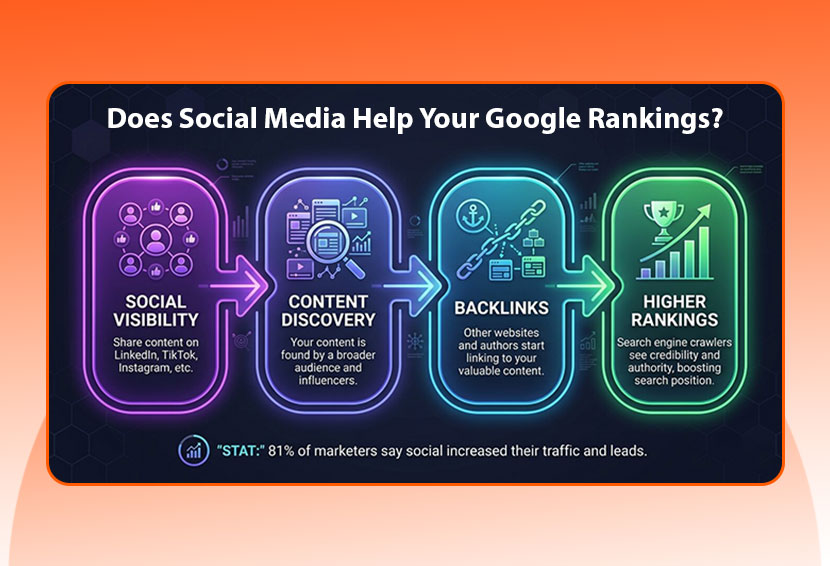
A piece of content shared virally on LinkedIn can earn a backlink from Forbes. That backlink does carry ranking weight. Social was just the distribution mechanism that made it happen. CognitiveSEO analyzed 23 million social shares and found a clear correlation between strong social activity and higher search visibility. It’s indirect, but it’s real.
How to Plan Social Media Content That Actually Works?
Start by auditing what you already have, then map it to the funnel awareness content for Reels and TikTok, consideration content for carousels, and testimonials for decision-stage audiences. Build a calendar tied to business goals, repurpose every piece across formats, and lean into video since short-form drives the highest ROI among all video formats. Then track what works and double down on it.
Knowing you need both is one thing. Here’s how to build the system:
Step 1: Audit your content library: What blogs, videos, and guides do you already have? That’s your raw material.
Step 2: Map content to the funnel: Awareness-stage content goes to Reels and TikTok. Consideration-stage content becomes carousels and shared blog posts. Decision-stage content is testimonials and case studies.
Step 3: Build a content calendar: Tie weekly themes to business goals. Don’t post randomly.
Step 4 Repurpose ruthlessly: One blog post can become 5–7 pieces of social media content creation, a short-form video, a quote graphic, a carousel, a thread, and an email.
Step 5: Use the right formats: Short-form social videos drive the highest ROI among all video formats for B2B marketers. Don’t default to text posts when video is where attention lives.
Step 6: Measure and adjust: Track engagement rate, click-throughs, saves, and website traffic from social. These tell you what’s working before you double down.
Also Read: How UGC and AI Videos Are Reshaping Content Creation?
The Best Tools for Content Marketing and Social Media Marketing
For content marketing, SEMrush or Ahrefs covers research, Surfer SEO optimizes for search, Canva handles visuals, and Mailchimp or Klaviyo manages email. For social, Buffer or Later schedule your posts, CapCut edits your videos, Claude or ChatGPT speeds up drafting, and Sprout Social tracks performance. Simple rule: plan in Notion, publish on WordPress, and measure in Google Analytics.
Content Marketing Tools
- SEMrush / Ahrefs: Keyword research and competitor analysis
- Surfer SEO: Content optimization for search
- WordPress: Publishing and blog management
- Canva: Visual content creation
- Mailchimp / Klaviyo: Email distribution
Social Media Content Creation Tools
- Buffer / Hootsuite / Later: Scheduling and publishing
- CapCut / Adobe Express: Short-form video editing
- Notion / Trello: Content calendar management
- ChatGPT / Claude: AI-assisted drafting and ideation
- Sprout Social: Analytics and social listening
What to Look for in a Social Media or Content Marketing Agency?
Before you hire, know what great actually looks like. A strong agency doesn’t just post content, they build integrated systems where social media and content marketing work as a single engine.
Here’s what to ask:
- Do they lead with strategy, or just execution?
- Can they show you data, not just impressions, but leads and revenue?
- Do they understand your platform natively, not just generically?
- Is their content and social work connected, or siloed into separate teams?
The best agencies treat content marketing and social media marketing as one discipline with two expressions. If they’re pitching you content in one proposal and social in another, that’s a red flag.
At SPCTEK, the approach is integrated by design from SEO and content strategy to influencer and UGC marketing; every channel is built to support the others. That’s what end-to-end actually means.
Conclusion
Content marketing and social media marketing are two different areas, but they are tied together. One provides long-term authority and search traffic, while the other offers faster visibility and community building. Integrating both channels in an effective content strategy amplifies their benefits as they complement each other.
The brands winning in 2026 aren’t better at one or the other; instead, they’re running them as one integrated system. And together, they create the loop that builds real, sustainable growth.