
MAP pricing is the lowest price a brand permits you to advertise its product for. It arrives as a document attached to a distribution agreement, or as an email from a brand manager about a listing that drifted below the floor, and most sellers read it once and file it without understanding what it actually restricts.
That gap causes real problems. Sellers assume MAP controls what they can charge, so they leave margin on the table they were entitled to take. Others assume it is unenforceable because it is not a contract they signed, then lose a supply relationship over a repricer that was never configured properly.
Nearly everything published about MAP is written for the brand enforcing it. Those pages explain how to draft a policy, how to monitor violations, and how to discipline resellers. Almost nothing is written for the seller on the receiving end, which is a strange gap given that resellers are the ones who have to operate inside these policies every day.
This guide explains what MAP pricing means, what it restricts and what it leaves open, whether it is legal, what happens when you breach it, how it behaves on Amazon where the usual workarounds fail, and the mistakes that cost sellers their supply.
What Is MAP Pricing?
MAP pricing stands for minimum advertised price. It is the lowest price at which a brand permits its resellers to publicly advertise a product. MAP governs the advertised price only, not the price you actually charge, which is the distinction that defines how the entire mechanism works.
That difference gets blurred constantly. Some sources define MAP as the minimum price a reseller may charge, which it is not.
MAP pricing is the advertised price floor a brand sets for its resellers, enforced by withholding supply rather than by contract. Three things follow from that definition:
- The brand sets the number unilaterally and applies it to all resellers equally
- It binds only resellers who receive the policy, which means unauthorized sellers are outside it
- It restricts public price display, leaving the transaction price open
MAP exists because visible price erosion damages everyone holding the product. When one seller advertises below the rest, competitors match, margins compress across the channel, and the brand loses the price positioning it built. A MAP floor slows that spiral without the brand dictating what anyone ultimately sells for.
What Is a MAP Price and What Does It Actually Restrict?
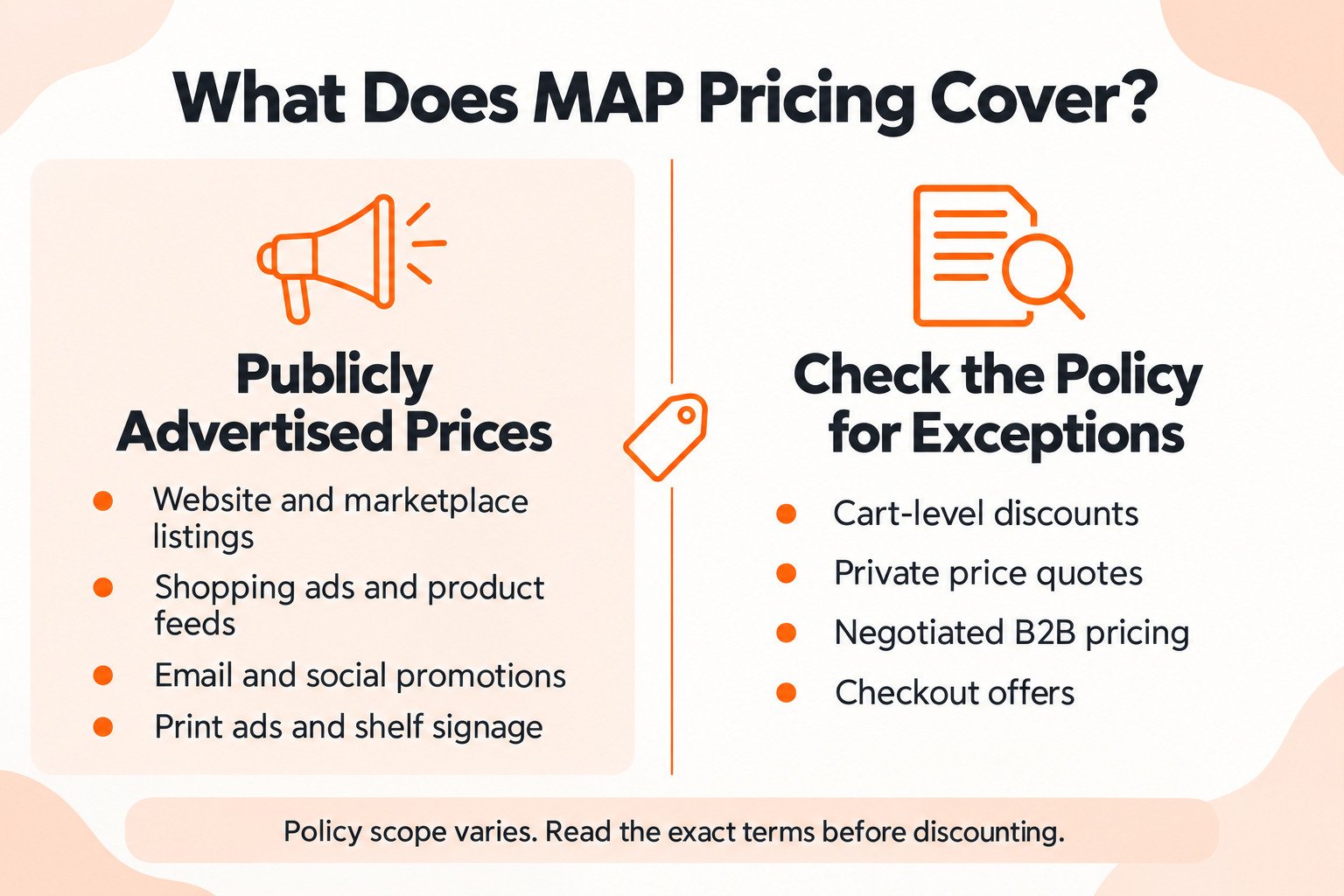
A MAP price restricts the number a shopper can see before they commit to buying. Anything displayed publicly as the price is covered. Anything revealed only after the shopper takes an action toward purchase generally is not.
Typically covered:
- Product listing prices on your website and on marketplaces
- Paid search ads, shopping feeds, and comparison engines
- Email promotions and newsletter pricing
- Print advertising, catalogs, and in-store signage
- Social posts that state a price
Typically not covered:
- The price shown in the cart after a shopper adds the item
- Prices quoted by phone or in direct negotiation
- The final register price in a physical store
- Negotiated business-to-business pricing
This is why “add to cart to see price” exists across so much of retail. It is not a dark pattern. It is a compliance mechanism that lets a retailer sell below MAP while advertising at or above it. Read the specific policy though, because scope varies and some brands write cart pricing into the restriction explicitly.
What MAP Means in Retail
In physical retail the distinction is easy to work with. Shelf tags and circulars respect MAP while the register applies a discount, and nothing about that arrangement is unusual or hidden.
Online it gets tighter, because the listing price is almost always the advertised price. Most ecommerce platforms give you cart-level discounting, automatic promotions, and coupon codes that apply after the price is displayed, and those are the levers that keep you compliant while remaining competitive. One marketplace removes them almost entirely, which is covered further down.
What Is a MAP Pricing Policy?
A MAP pricing policy is the document in which a brand states its minimum advertised prices, which products they cover, what counts as advertising, and what happens when a reseller breaches them. It is published to resellers rather than negotiated with them.
A well-drafted policy specifies the covered products and their floors, the channels in scope, any exclusions such as cart pricing or clearance stock, the consequence sequence for violations, and the effective date. Vague policies cause more disputes than strict ones, because nobody can tell what was actually breached.
Why You Should Not Sign a MAP Agreement
This is the single most useful thing a reseller can understand about MAP, and no page written for brands will tell you.
A MAP policy is supposed to be unilateral. The brand announces its terms and decides independently whether to keep supplying anyone who ignores them. Section 1 of the Sherman Act reaches agreements between parties, not unilateral conduct, so a policy with no agreement attached sits outside its reach. That protection comes from United States v. Colgate & Co., decided in 1919, and it is why these documents are written as announcements rather than contracts. Antitrust firm Bona Law has a clear breakdown of the difference between a Colgate policy and a resale price maintenance agreement if you want the legal detail.
The moment you sign it, it stops being unilateral. A signed MAP document is an agreement between a supplier and a reseller about price, which is resale price maintenance. Since the Supreme Court decided Leegin in 2007, federal courts analyze those agreements under the rule of reason rather than treating them as automatically illegal. Several states did not follow. Maryland passed a repealer in 2009 specifically rejecting Leegin. California treats such agreements strictly under the Cartwright Act, though its courts have accepted the Colgate doctrine for genuinely unilateral policies. New York’s attorney general has policed resale price maintenance aggressively since Leegin, even as New York courts have generally leaned the other way.
Law firm K&L Gates has a useful summary of how states responded to Leegin and why unilateral policies remained the preferred structure afterward.
So if a brand asks you to sign a MAP policy, that request tells you something. Either their counsel has not reviewed it, or they do not understand that signature undermines the protection the document was built to provide. You can comply with a policy without executing it, and complying without signing is the safer position for both sides.
Is MAP Pricing Legal?
In the United States, yes, when it is structured as a unilateral policy and limited to advertised prices. The legal foundation is the Colgate doctrine: a manufacturer may announce the terms on which it will do business and refuse to deal with anyone who does not meet them. A policy is not an agreement, and the antitrust provision at issue targets agreements.
Two things break that protection:
- Converting the policy into an agreement, whether by signature, negotiation, or a reseller promising compliance in exchange for something
- Horizontal coordination, meaning competing brands aligning their MAP policies with each other, which is price fixing regardless of how the documents are written
There is also a version that goes further than MAP. A unilateral pricing policy, often shortened to UPP, restricts the actual selling price rather than the advertised one. Both MAP and UPP are forms of resale price maintenance, and both can be lawful when implemented unilaterally under Colgate.
Two separate things determine the risk, and they are easy to confuse. The first is what the document controls, where restricting advertised prices only is the more conservative position. The second is how it is implemented, where a unilateral policy is far safer than an agreement. A unilateral policy controlling sale prices is on firmer ground than a signed agreement controlling advertised prices, because the agreement is what antitrust law reaches.
Work out which one you are actually looking at before assuming the cart workaround applies, because under a UPP it does not.
MAP Outside the United States
The position changes at the border and published guidance on this is inconsistent, so treat any single source carefully.
In the European Union and the United Kingdom, competition law treats restrictions on resale pricing far more strictly than US law does. Arrangements that function as minimum advertised pricing face serious scrutiny and are frequently treated as unlawful, which is why brands selling into those markets usually structure pricing guidance differently or abandon it.
If you sell across borders, do not assume a US policy travels. This is general information rather than legal advice, and anything with real money attached belongs with counsel who practices competition law in the relevant jurisdiction.
Can You Sell Below MAP?
Under a standard US MAP policy, yes. The policy restricts what you advertise, not what you charge, so a price revealed only in the cart or at the register generally does not breach it. Check your specific policy, because some are written to cover transaction pricing and that changes the answer completely.
Compliant ways to go below the floor:
- Show MAP on the listing and apply the real price in the cart
- Run cart-level or order-level discounts rather than per-item advertised reductions
- Issue coupon codes that apply after the advertised price is displayed
- Bundle the product with another item where the bundle price is not a per-unit advertised price
- Offer loyalty credit, store credit, or free shipping instead of a price reduction
Where it fails: any channel that displays the price before a shopper acts. Shopping feeds, comparison engines, paid ads, and most marketplace listings all show the price up front, which means the price you list is the price you advertised.
If your own site is where you want pricing flexibility, the platform matters, because cart-level discounting and automatic promotions are not equally capable across systems. Our Shopify store management services cover configuring that properly.
How to Enforce MAP Pricing, and What That Looks Like From Your Side
Enforcement does not run through courts in most cases. It runs through supply.
Detection is automated and fast. Brands monitor advertised prices continuously across marketplaces, retailer sites, and feeds, capturing evidence at the moment a listing drops below the floor. A price test you run for an afternoon is usually logged within hours, so treating MAP as something nobody checks is a bad assumption.
The consequence sequence is usually documented in the policy itself and escalates predictably:
1. A first notice identifying the listing, the advertised price, and the date
2. A second notice with a compliance deadline attached
3. Suspension of supply, reduced allocation, or loss of promotional support
4. Termination of the reseller relationship
Termination is the real remedy. Because the policy is unilateral rather than contractual, a brand generally cannot sue you for damages over a MAP breach. What it can do is stop selling to you, and for a reseller whose business depends on that product line, losing supply is worse than any penalty a contract would have imposed.
One detail worth knowing: violations count on any channel. Advertising below MAP on eBay can trigger enforcement even when your Amazon and website pricing are perfectly compliant. Policies apply across your whole operation, not per platform.
What to Do If You Receive a MAP Violation Notice
1. Check the claim against your own listing data before responding, since automated monitoring produces false positives
2. Fix the price immediately if the notice is accurate, then confirm in writing with a timestamp
3. If a repricer caused it, say so and state the floor you have now set, because intent matters to how the brand responds
4. If the price came from a coupon or promotion applying at cart level, explain the mechanism, since many brands misread cart pricing as an advertised price
5. Audit every other channel you sell on before replying, so you are not fixing one listing while another is still in breach
6. Do not sign anything new as part of resolving it
How MAP Pricing Works on Amazon
Amazon is where MAP policies break down most visibly, and sellers need to understand why before they get caught in it.
1. Amazon Does Not Enforce MAP
Amazon is not a party to any brand’s MAP policy and does not police advertised price floors. There is no complaint channel for MAP violations, and a report claiming a seller breached a brand’s policy will be declined on that basis. Enforcement remains entirely with the brand, through its supply relationships.
2. The Cart Workaround Does Not Exist Here
On Amazon, the listing price is the advertised price. There is no mechanism to show MAP publicly and charge less at checkout, which removes the main compliance tool sellers rely on everywhere else. On Amazon, MAP effectively becomes a floor on what you charge even though the policy only restricts what you advertise.
3. Repricers Cause Violations Nobody Decided To Make
A large share of Amazon MAP violations are automated rather than deliberate. A repricer with a floor set below MAP will walk a listing under the line chasing the Featured Offer, without anyone choosing to breach anything. Two sellers configured that way can drive a listing down substantially in a single morning.
The fix is configuration. Set the minimum price on every MAP-restricted listing to whichever is higher, the MAP floor or your cost-based floor. Use match rules rather than undercut rules, so the repricer competes without going below the minimum. Many policies now treat a repricer floor set below MAP as a violation in itself, regardless of whether a sale occurred at that price.
4. You Will Lose the Featured Offer to Violators
Holding the MAP floor while someone else drops below it means losing the Featured Offer to them until enforcement catches up, which can take days or weeks. That is the cost of compliance, and it is real. Factor it in before carrying MAP-restricted products in competitive categories.
5. Unauthorized Sellers Are Outside the Policy Entirely
Sellers who acquired inventory through liquidation, diversion, or gray market channels never received the policy and are not bound by it. They can price wherever they like, and the brand’s only route against them runs through tracing the supply leak rather than enforcing MAP. Do not treat their pricing as your benchmark, because matching it puts you in breach while they stay untouched.
6. The Squeeze Between MAP and Fair Pricing
Amazon’s own Marketplace Fair Pricing policy works in the opposite direction from MAP. It targets prices Amazon considers too high and can suppress the Featured Offer or deactivate a listing on that basis. MAP sets a floor and Amazon sets an informal ceiling, and on competitive listings the gap between them can get uncomfortably narrow. Our guide to pricing strategy in a crowded marketplace covers operating inside that band, and if you sell across multiple marketplaces, our comparison of Walmart and Amazon is worth reading alongside it.
MAP vs MSRP vs RPM
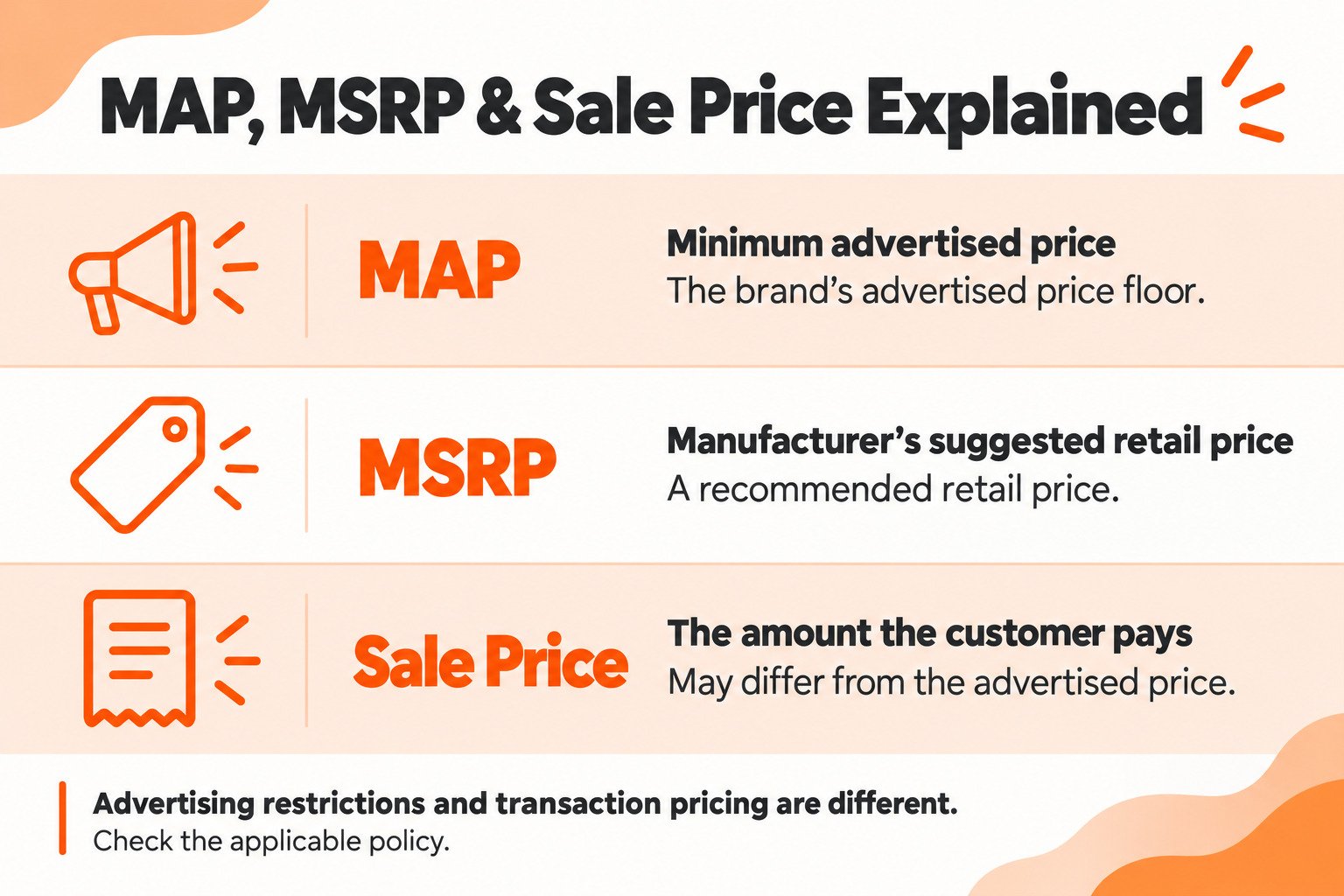
These three get used interchangeably and mean different things. The differences determine what you are actually allowed to do.
| MAP | MSRP | UPP | RPM agreement | |
|---|---|---|---|---|
| Full name | Minimum advertised price | Manufacturer’s suggested retail price | Unilateral pricing policy | Resale price maintenance by agreement |
| What it controls | The advertised price only | Nothing, it is a suggestion | The actual selling price | The actual selling price |
| How it is set | Announced unilaterally | Recommended | Announced unilaterally | Agreed between the parties |
| Binding on you | Yes, as a condition of supply | No | Yes, as a condition of supply | Yes, contractually |
| Can you sell below it | Yes, if not advertised | Yes, freely | No | No |
| If you ignore it | Loss of supply | Nothing | Loss of supply | Loss of supply, possible contract claim |
| US legal standing | Lawful under Colgate | Always lawful | Lawful under Colgate | Rule of reason federally, stricter in some states |
If a brand document restricts what you can sell for rather than what you can advertise, you are looking at a unilateral pricing policy and not MAP, whatever the heading says. The practical consequence is that cart-level discounting stops being available to you. Read the operative language rather than the title.
MAP Pricing Mistakes Resellers Make
These are the patterns that cost sellers margin or supply.
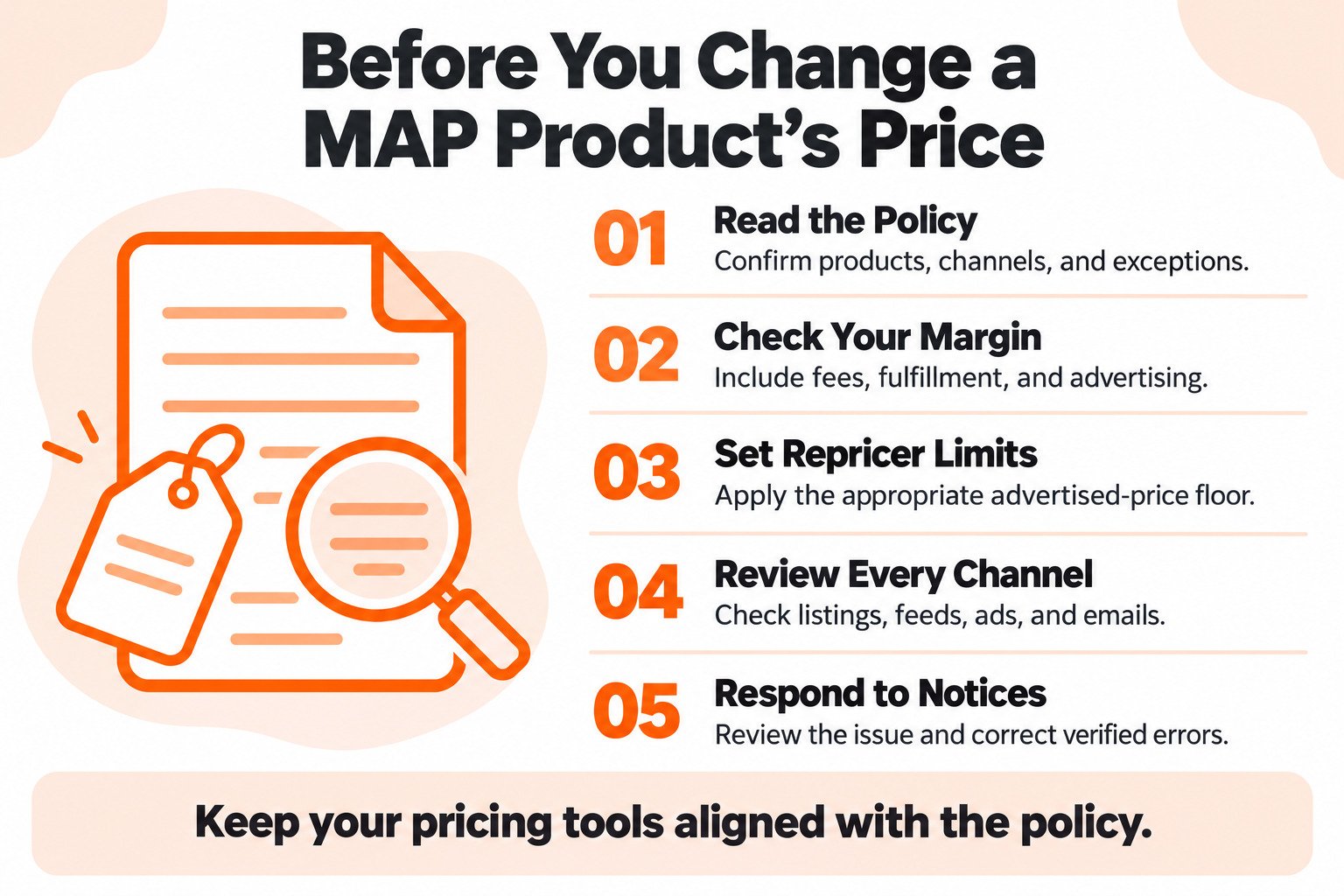 1. Signing the MAP policy: You can comply without executing it. Signing converts a unilateral policy into an agreement about price, which is a worse legal position for the brand and no better for you.
2. Running a repricer with no MAP floor: Automated pricing causes more violations than deliberate discounting does. Set the minimum to whichever is higher, MAP or your cost floor, on every restricted listing.
3. Assuming MAP controls the sale price: Off Amazon, it usually does not. Sellers who never use cart-level discounting leave margin and competitiveness on the table for no reason.
4. Forgetting a channel: Comparison feeds, email promotions, and paid shopping ads all display price publicly. Fixing a website listing while a feed still shows the old number keeps you in breach.
5. Matching an unauthorized seller: They are not bound by the policy, and you are. Matching their price puts you in violation while they continue unaffected.
6. Ignoring the first notice: First notices are usually procedural rather than hostile. Responses are what keep a relationship intact, and silence is what escalates it.
7. Carrying products the MAP floor cannot support: If the margin at MAP does not survive platform fees, fulfillment, and advertising, the product does not work for you. That is a sourcing decision, not a pricing problem.
Working Within MAP Pricing
MAP pricing is less restrictive than most sellers assume and more enforceable than the rest assume. It governs what shoppers see before they commit, is backed by supply rather than litigation, and leaves real room to compete on transaction price almost everywhere except marketplaces that display price up front.
The sellers who handle it well do three things. They read the actual policy language rather than assuming what MAP covers, they configure repricers and feeds so no system can breach the floor without a human decision, and they build pricing strategy around what the floor permits rather than treating it as an obstacle to work around quietly.
The ones who struggle treat MAP as either meaningless or absolute. Neither reading is correct, and both cost money in different directions.