
Every week, sellers using Amazon’s default tools make dozens of manual decisions: adjusting bids, harvesting search terms, pacing budgets, sorting match types, and rebalancing campaigns across dozens of ASINs. None of this is automatically connected to actual product profitability. The console optimizes for ACoS at the campaign level, with no native automation tied to margins, inventory levels, or TACoS.
For sellers managing 20+ ASINs, this translates to significant hours of manual work per week with no profitability guardrails built in. Ad spend grows. Profit doesn’t always follow.
Third-party PPC tools exist to fix this. But not all automation is equal:
- Some are black boxes that make unexplainable decisions
- Some require expert-level rule configuration just to get started
- Some charge a percentage of ad spend, penalizing you for scaling
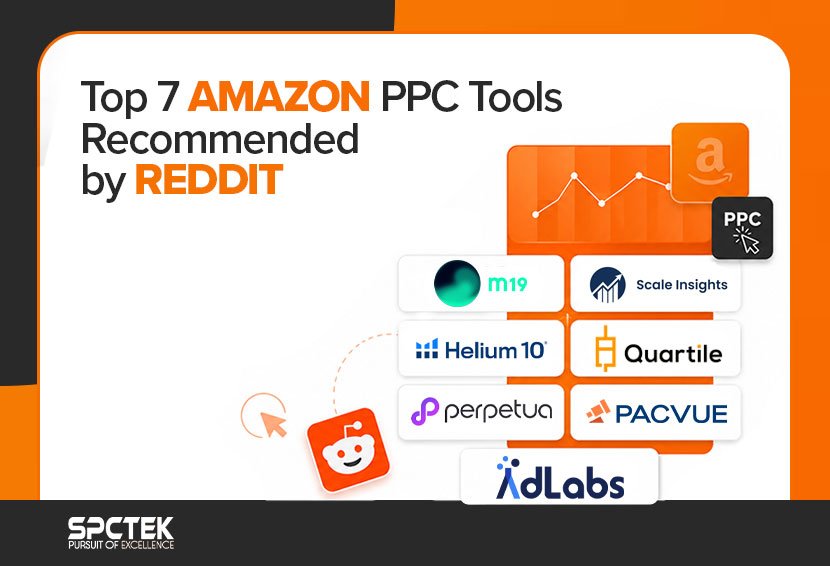
This guide synthesizes discussions across r/AmazonFBA, r/PPC, r/FulfillmentByAmazon, and r/AmazonSeller, combined with verified tool documentation and third-party reviews to help you choose the right tool in 2026. Not just the most popular one, the right one.
1. m19: Intelligent Product-Level Automation
Overview
m19 takes a product-centric approach to Amazon PPC: instead of enforcing rigid campaign structures, it lets sellers set business goals at the product level, such as ACoS target, TACoS target, or monthly budget. Its AI then builds, optimizes, and scales Sponsored Products, Sponsored Brands, and Sponsored Display automatically.
Unlike black-box tools, m19’s automation is explainable. Unlike rules-based tools, it requires zero manual rule configuration to deliver results.
Pros
- Profit-first AI: goals are set at the ASIN level; the AI optimizes toward business profitability, not just campaign ACoS. m19 is one of the few platforms that natively supports TACoS targeting, giving sellers a direct line between ad spend and total business profitability
- High Ease of Use: manages setup, bidding, budgets, and targeting across ad types with minimal manual input
- Predictable pricing: start from $59 per month; no long-term contract, 30-day free trial available
- Fast setup: live within 24 hours, ~1 hour onboarding, no PPC expertise required
Cons
- Amazon-only: m19 is purpose-built for Amazon Ads; sellers looking to manage Walmart, Instacart, or other retail media networks from a single platform will need a separate solution.
- Standard AMC reporting: m19 provides attribution data via AMC integration; sellers requiring custom AMC audience segmentation, lifetime value reporting, or full-funnel media mix analysis may want to evaluate platforms with deeper AMC query capabilities.
What m19 Does Differently
m19 is built around a product-first philosophy: set your TACoS or profitability target at the ASIN level, and m19’s AI handles everything else, including campaign creation, keyword discovery, bid management, and budget reallocation. Continuously and autonomously.
One particularly useful feature: m19 detects keywords where the product already ranks organically and automatically reduces paid bids accordingly, preventing spend on clicks that organic ranking would capture for free.
Best for: Sellers and agencies who want automation that actually works from day one: no rules to configure, no PPC expertise required, and no specialist needed to keep it running.
2. Scale Insights: Rule-Driven PPC for Maximum Control
Overview
Scale Insights empowers sellers with deep rule logic: define precise conditions for bidding, keyword adjustments, budgets, placement control, day-parting, and more. It’s automation, but only on your terms.
Pros
- Full Transparency: every action is predictable, traceable, and auditable
- Rule customization: multi-condition logic chains across performance signals
- Analytics depth: SKU-level insights, bid efficiency charts, and restock forecasting
Cons
- Learning curve: best suited to experienced PPC pros who thrive on rule engineering
- Rule maintenance bottleneck: rules don’t adapt to market changes unless you manually update them; it becomes increasingly time-intensive as your catalog grows
Best for: Advanced sellers or agencies that want full control and have the PPC expertise to build and maintain rule logic at scale.
3. Helium 10 Adtomic: Hybrid Automation for Rapid Setup
Overview
Adtomic blends pre-built rules with AI recommendations as part of the Helium 10 ecosystem, combining PPC management with product research, keyword tracking, and market intelligence in one dashboard.
Pros
- Included in base plans: AI PPC automation is accessible from the Platinum tier with no extra subscription cost
- Ecosystem integration: keyword research, trend data, listing analytics, and PPC all in one dashboard
- Expanded controls at Diamond: rules-based automation, keyword recommendations, and dayparting controls
Cons
- Less advanced than dedicated PPC tools: functional but not as deep as Scale Insights or Perpetua for pure ad management
- Ecosystem dependency: delivers best value when combined with Helium 10’s other tools
Best for: Sellers already paying for the Helium 10 ecosystem who want a low-friction automation starting point.
4. Quartile: Heavy AI Automation with Managed Support
Overview
Quartile targets high-spend advertisers with an AI engine that actively builds campaigns, shifts budgets, and refines keyword targeting. It uses a hybrid pricing model combining tiered flat fees with a percentage of managed ad spend.
Pros
- High automation throughput: handles large, complex accounts with minimal human input
- Managed support: dedicated account managers available on higher-tier plans
- Multichannel reach: supports Amazon, Walmart, Instacart, Google, and more
Cons
- Black box logic: highly automated AI gives limited visibility to sellers who want hands-on control
- Pricing complexity: the platform uses a hybrid model (tiered flat fee from $895–$9,995/month + percentage of ad spend); each additional marketplace adds $500/month. Total costs can be difficult to predict
- Contract concerns: inflexible cancellation policies have been flagged by users; at least one verified user reported being billed an additional month after submitting a cancellation notice
- High cost floor: may not be cost-efficient for sellers with less than $10,000/month in ad spend
Best for: Enterprise accounts with high ad spend and a dedicated team to manage the vendor relationship.
5. Perpetua: Full-Stack AI for Brand Growth
Overview
Perpetua provides multi-marketplace AI optimization, incorporating Sponsored Ads and DSP. Its interface is polished and designed to support high-growth brands expanding across markets.
Pros
- Clean, goal-based UI: guided workflows reduce cognitive load for non-technical users
- DSP integration: supports upper-funnel and retargeting campaigns alongside Sponsored Ads
- Cross-marketplace reach: Amazon, Walmart, Instacart, and Google Ads from one platform
- Deep AMC integration: path-to-purchase attribution, new-to-brand audience analysis, customer lifetime value modeling, and media mix insights; custom AMC queries available for higher-tier users
Cons
- Opaque decisions: AI logic is not readily explainable at the action level
- Pricing transparency: starts at $695/month flat for up to $10k ad spend; above $10k, an additional percentage-of-spend fee applies. The exact rate is not publicly disclosed, which makes the total cost harder to forecast as accounts scale
- High cost floor: may not be cost-efficient for sellers with less than $10,000/month in ad spend
Best for: Growth-focused brands prioritizing DSP integration and cross-marketplace expansion with a budget above $695/month.
6. Pacvue: Commerce Operating System for Enterprise
Overview
Pacvue has evolved well beyond a traditional PPC tool. In 2026, it positions itself as a Commerce Operating System, unifying retail media buying, commerce operations, and advanced measurement across 100+ retail media networks and 30+ global markets. Recent moves signal an aggressive push into AI-driven workflows and non-retail media channels.
Pros
- Commerce Intelligence layer: cross-retailer data consolidation gives a unified view across Amazon, Walmart, Target, Instacart, and more; real-time analytics for smarter budget allocation
- Expanding channel reach: now covers 100+ retail media networks plus Reddit and ChatGPT Ads; one of the few platforms actively bridging retail media and discovery commerce
- Enterprise AI workflows: Pacvue Agent automates campaign execution at scale, reducing manual workload for large teams
- Agency infrastructure: built for teams managing multiple large accounts simultaneously across markets
Cons
- Not built for Amazon-only sellers: complexity and cost structure are designed for brands treating Amazon as one channel within a larger retail media strategy
- Requires dedicated resources: breadth of features creates operational overhead without a specialized team
- Custom pricing only: no public pricing; costs are negotiated based on account size and channel scope
Best for: Large brands and agencies managing multichannel retail media who want a single operating system across Amazon, Walmart, Reddit, and emerging channels like ChatGPT Ads.
7. AdLabs: Semi-Automated Tools Built for Efficiency
Overview
AdLabs focuses on UI efficiency, bulk editing, and workflow acceleration, ideal for PPC analysts who want manual control enhanced by smart tooling, not full automation.
Pros
- Exceptional bulk actions: save time on repetitive tasks across large campaign sets
- Clear visual analytics: SKU-level reporting makes manual decisions faster
- Transparent by design: every action is analyst-initiated and visible
Cons
- Not full automation: suitable only if hands-on control is the goal
- Scales with analyst hours: efficiency ceiling is your team’s capacity, not the platform’s
Best for: Analysts and agencies focused on manual PPC expertise who need better tooling to execute at scale.
Also Read: Amazon PPC 101: Everything You Need to Know for a Strong Start in 2026
Final Recommendations
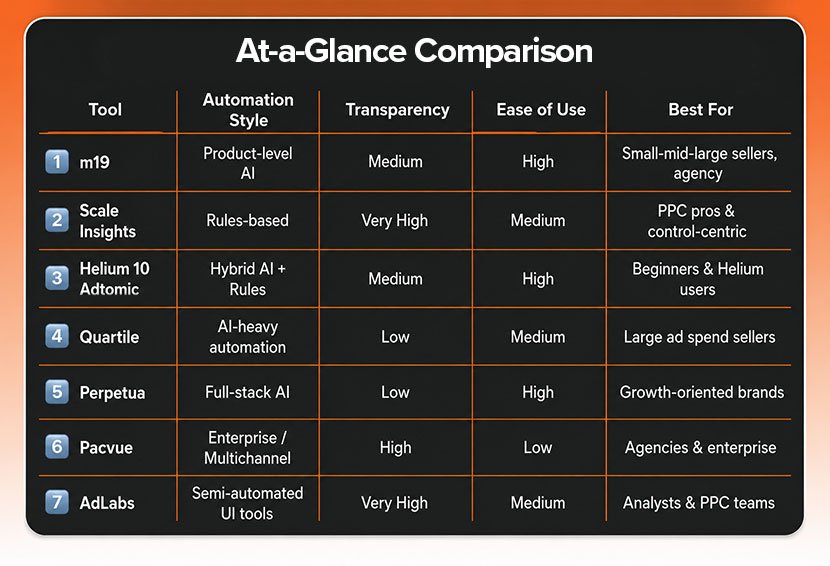
Profit-first automation without PPC expertise, m19 is the strongest fit. You set a TACoS or ACoS target at the product level, and the AI handles everything else, campaign structure, keyword discovery, bid management, and budget pacing. No rules to write, no PPC background required, live within 24 hours.
If you want full control over every automation decision, Scale Insights or AdLabs are the right tools. Scale Insights lets you build multi-condition rule logic across every performance signal; AdLabs gives you a faster, cleaner interface for manual optimization at scale. Both are best suited to experienced PPC managers who want automation on their terms.
If you are already inside the Helium 10 ecosystem, Adtomic is the lowest-friction starting point. It is now included in base plans, and its hybrid AI-plus-rules approach works well for sellers moving away from fully manual management for the first time.
If you are a large brand or agency managing significant ad spend across multiple retailers, the choice comes down to depth of need. Perpetua is the better fit for brands prioritizing DSP, full-funnel AMC reporting, and cross-marketplace growth. Pacvue is the better fit for teams that need a full Commerce Operating System, unifying Amazon, Walmart, Reddit, and now ChatGPT Ads in one platform. Quartile works well for high-spend Amazon accounts that want heavy AI automation with managed support.