
Too busy to read? Listen to this article instead.
Prime Big Deal Days is one of Amazon’s biggest opportunities for sellers to capture early Q4 demand and build momentum before Black Friday and Cyber Monday. However, running a successful deal requires more than offering a discount. Sellers need to carefully plan pricing, inventory, fulfillment costs, and advertising strategies to ensure increased sales actually translate into profit.
With changing fulfillment fees, promotional deadlines, and separate Q4 deal requirements, a promotion that looks profitable at first can quickly lose margin if the numbers are not calculated correctly.
This guide covers everything Amazon sellers need to know about Prime Big Deal Days 2026, including deal submission timelines, fee changes, inventory deadlines, pricing considerations, and strategies to prepare for a profitable Q4.
What Is Prime Big Deal Days (PBDD)?
Prime Big Deal Days is a two-day, Prime-member-only sales event that Amazon runs each October, separate from the summer Prime Day event. It opened the fall shopping season for the first time in 2022 and has held a consistent early-October slot since:
- 2023: October 10-11
- 2024: October 8-9
- 2025: October 7-8
- 2026: October 6-7
Amazon has announced that the 2026 Prime Big Deal Days event will be held on October 6 and 7. This matters more than it sounds. A deal, an ad campaign, and an inventory shipment all get scheduled against a specific date. Building your calendar around an assumed date that turns out to be off by a day can mean ads going live too early or too late relative to the actual event, and inventory arriving with less buffer than planned.
Where Things Stand Right Now for Sellers
This part is confirmed, straight from Amazon’s own seller announcements.
Deal Submissions
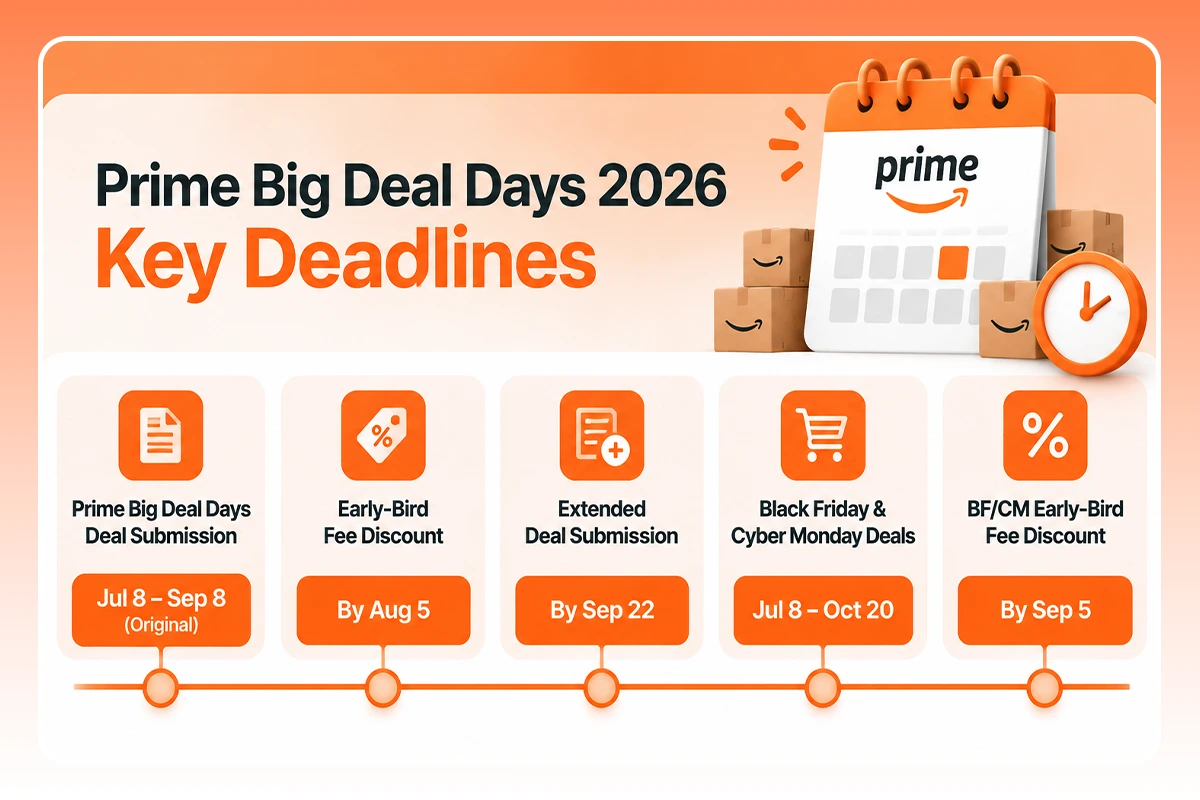
The original window ran July 8 through September 8 for Prime Big Deal Days deals, and July 8 through October 20 for Black Friday Week and Cyber Monday deals. Amazon has since extended the Prime Big Deal Days submission window to September 22, so if you haven’t submitted yet, you still have time. The two events are separate submissions with separate deadlines. Submitting for one does not carry over to the other, so treat them as two distinct action items on your calendar, not one combined Q4 task.
Early-Bird Fee Discount
Submitting a Prime Big Deal Days deal by August 5 saved $50 on the upfront promotion fee. That window has closed. The equivalent discount for Black Friday Week and Cyber Monday deals required submitting by September 5, which has also passed as of this writing. Any deal submitted now pays the standard fee, which still leaves plenty of time to secure a deal slot even though the discount is gone.
Promotion Fees
Fees for Best Deals, Lightning Deals, and Prime Exclusive Price Discounts are unchanged from Prime Day: a $100 upfront fee per promotion, plus a variable fee of 1.5% of promotional sales, capped at $5,000. There are no new eligibility requirements this year. One thing worth double-checking before you submit: some sellers have reported seeing a different fee structure (around $50 per day plus 1.5%) displayed inside Seller Central when registering a deal, which doesn’t match what Amazon published in its own announcement. Confirm the fee shown in your own dashboard before submitting rather than assuming either number applies.
The Lookback Exclusion
This is the one mechanic worth understanding before you price anything. Amazon normally caps how deep a discount you can run by checking a 30 to 60 day price history and using your lowest recent price to set the ceiling on your next deal. Prime Big Deal Days promotional prices are excluded from that lookback window, so a real discount in October won’t shrink what you’re allowed to offer for Black Friday Week or Cyber Monday. The two events are priced independently, which means there’s no strategic reason to hold back on your October pricing to protect a deeper November discount. That instinct made sense before the exclusion existed. It doesn’t anymore.
Amazon FBA Holiday Peak Fulfillment Fees
Fulfillment costs go up during the fall shopping window, and the numbers are the same as last year. Holiday peak fulfillment fees apply from October 15, 2026 through January 14, 2027, across FBA, Remote Fulfillment with FBA, Multi-Channel Fulfillment, and Buy with Prime. The per-unit increase over non-peak rates averages $0.32, and the existing 3.5% fuel and logistics surcharge applies on top of that. Peak rates by size and weight are already available in the Revenue Calculator, the Profit Analytics dashboard, and the Fee and Economics Preview Report, so there’s no reason to price a Q4 deal against non-peak numbers.
The timing here is worth flagging specifically: the peak fee window covers all of Black Friday Week and Cyber Monday, plus the tail end of Prime Big Deal Days fulfillment and the full December shipping push. A deal that pencils out fine against today’s fee structure can lose money once an order shipping in late October or November eats the peak fee on top of the existing surcharge. Reprice against the October and November numbers, not the numbers your Revenue Calculator showed you back in the summer.
Inbound Inventory Deadlines
Getting a deal approved doesn’t help if your inventory isn’t in the network in time to carry the Prime badge. Amazon has published firm inbound deadlines by shipment method.
For Prime Big Deal Days:
- September 2: Amazon Warehousing and Distribution (AWD) shipments
- September 9: FBA shipments using “minimal shipment splits”
- September 16: FBA shipments using “Amazon-optimized shipment splits” (the default most sellers use)
For Black Friday Week and Cyber Monday:
- October 14: AWD shipments
- October 21: FBA shipments using “minimal shipment splits”
- October 28: FBA shipments using “Amazon-optimized shipment splits”
Fulfillment centers prioritize receiving inventory in September and October, then shift to processing customer orders in November and December. That means capacity gets tighter the later you ship, regardless of the calendar deadline on the page. Sellers running split shipments across multiple carriers or modes (air and sea, for example) should build in extra buffer, since a shipment that’s only partially received by the cutoff can put badge eligibility at risk for the portion still in transit.
Amazon reports that sellers who used AWD in Q4 2025 saw shipped units increase more than 13% and out-of-stock days drop more than 30%. Sellers who route inventory through AWD with automatic replenishment to FBA also keep paying off-peak storage rates through October 31, 2026, which is a meaningful cost difference heading into the highest-storage-cost weeks of the year. If you’re expecting higher-than-usual holiday volume, Capacity Manager is also available to bid for additional fulfillment center space beyond your standard limits.
What This Means for Your Q4 Sequencing
Treat Prime Big Deal Days and Black Friday Week/Cyber Monday as two separate submissions with two separate deadlines, not one Q4 to-do. Submitting for one doesn’t carry over to the other, and each has its own inventory cutoff. The sellers who come out ahead in Q4 typically aren’t running the deepest discount. They’re the ones who submitted on time, shipped inventory early enough to clear capacity crunches, and priced against the fee stack that’s actually in effect during the weeks their deal runs.
Key Costs to Review Before Submitting Your Deal
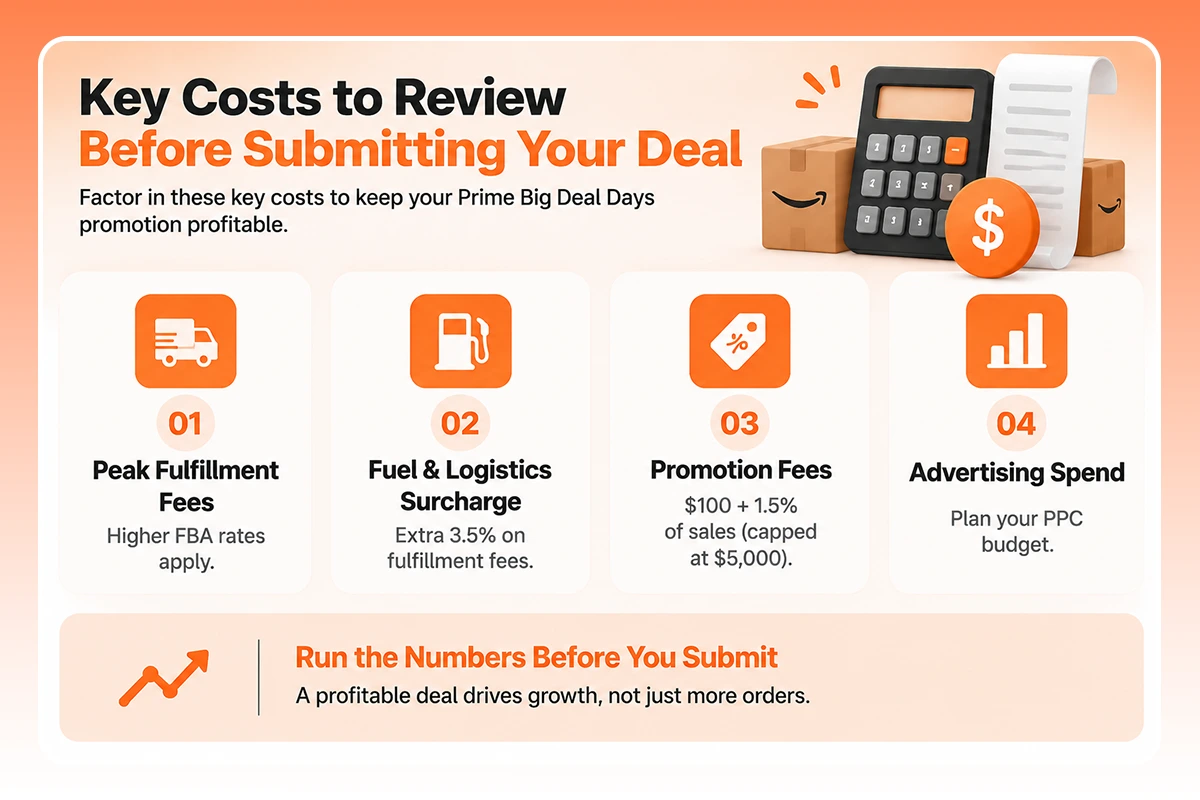
Before submitting a Prime Big Deal Days promotion, sellers should look beyond the discount amount and calculate the complete cost of running the deal. Understanding fulfillment fees, additional charges, and advertising expenses helps ensure the promotion drives growth without reducing profitability.
Peak Fulfillment Fees: Holiday peak fulfillment fees apply from October 15, 2026, to January 14, 2027. These higher FBA costs can impact margins, so sellers should calculate deal profitability using peak season fees rather than standard fulfillment rates.
Fuel and Logistics Surcharge: Amazon’s 3.5% fuel and logistics surcharge applies on top of fulfillment fees. Sellers should include this additional cost when reviewing their expected profit per unit.
Promotion Fees: Prime Big Deal Days promotions include a $100 upfront fee plus 1.5% of promotional sales, capped at $5,000. These fees should be included in the deal calculation before final submission.
Advertising Spend: Higher traffic during Prime events also increases advertising competition. Sellers should plan PPC budgets carefully and focus on campaigns that generate profitable sales rather than simply increasing order volume.
Tips for a Successful Prime Big Deal Days 2026
- Submit before the window closes: The Prime Big Deal Days deal sourcing and submission window has been extended to September 22. Submitting earlier gives your deal more time to clear review and reduces the risk of a last-minute rejection with no time to resubmit.
- Price with the lookback exclusion in mind: A strong October discount doesn’t cap what you can offer in November, so there’s no reason to hold back on Prime Big Deal Days pricing to protect a Black Friday deal.
- Reprice against the actual peak fee stack: Pull current numbers from the Revenue Calculator before finalizing discount depth, since a deal that clears margin today can miss it once the $0.32/unit peak fee and 3.5% surcharge land on the order.
- Ship inventory ahead of the badge cutoff, not on it: The September 16 deadline for standard FBA shipments is the one most sellers actually need to hit, and fulfillment center capacity gets tighter the closer you get to it.
- Match the promotion type to the goal: Lightning Deals for a short burst of velocity, Prime Exclusive Discounts for sustained visibility across the event, coupons for lower-commitment testing.
- Get advertising live before the event starts: Campaigns need time to index and build momentum, so launching on day one of the event instead of ahead of it costs you visibility during the highest-traffic hours.
- Use the event to clear aged inventory: ASINs sitting with more than 90 days of supply or 180+ days of age are good candidates for this high-traffic window, since moving them now avoids long-term storage fees before Q4 storage costs climb further.
- Expect a dip before and after the event, and don’t overreact to it: Shoppers hold off buying in the days before a Prime event and are already stocked up in the days after, so a sales dip on either side is usually the calendar, not a listing problem.
- Consider AWD if you’re expecting higher holiday volume: It stores extra inventory at lower rates, auto-replenishes fulfillment centers, and keeps you on off-peak storage pricing through the end of October.
- Confirm your actual fee in Seller Central before submitting: Given the discrepancy some sellers have flagged between published fees and what displays at registration, don’t assume either number without checking your own account.
Navigating the Hybrid Fee Structure for Prime Big Deal Days
Prime Big Deal Days (PBDD) is classified by Amazon as a Peak Event, alongside Prime Day and Black Friday/Cyber Monday. For 2026, eligible deals are subject to a $100 upfront fee per promotion plus a 1.5% variable fee on deal sales, capped at $5,000.
1. Understand How PBDD Deal Fees Work
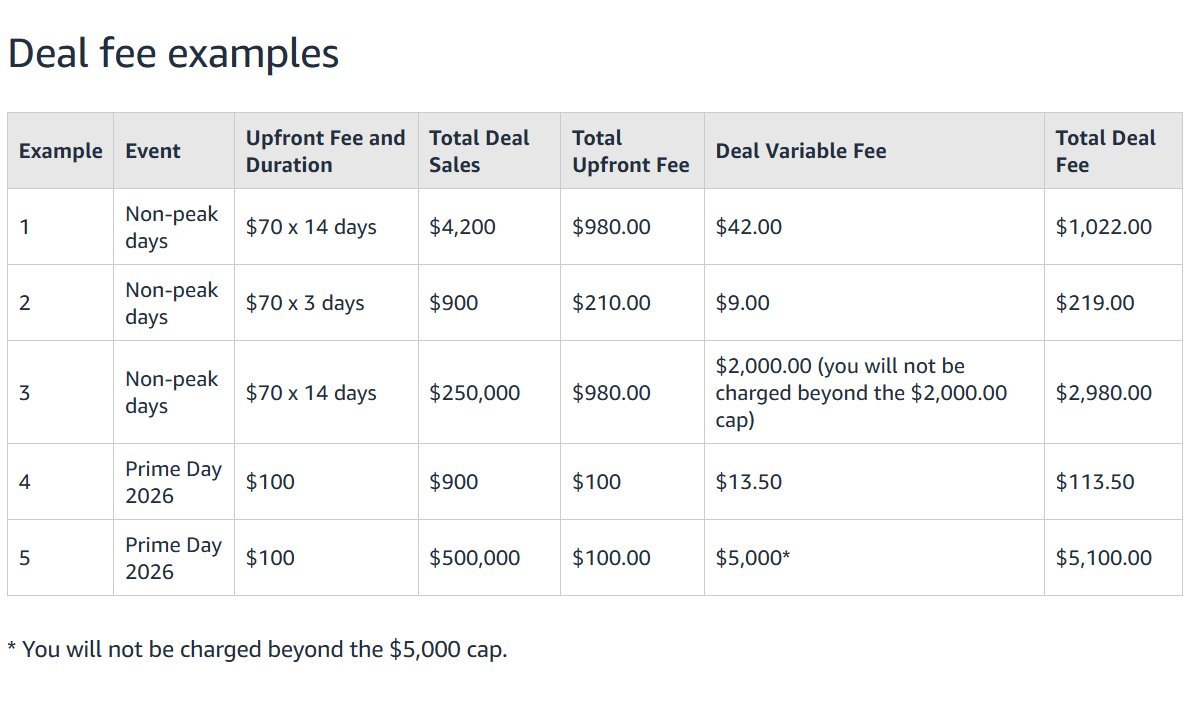
The upfront fee applies even if your deal generates no sales. The variable fee is calculated using the deal price, which is the amount the customer pays after the deal discount. Both fees are charged after the deal runs and appear as a deal fee transaction on your Seller Central statement.
For example, if a PBDD deal generates $900 in sales in a single day, the fee would be $100 upfront plus $13.50 in variable fees, resulting in a total deal fee of $113.50 for that day.
2. Understand the Cost Before Submitting Deals
Before enrolling products in PBDD, calculate the potential deal fees alongside your product costs, advertising spend, fulfillment expenses, and promotional discounts. This gives you a clearer picture of your expected profit margin instead of evaluating the deal based only on potential sales volume.
3. Don’t Assume a Deal Will Pay for Itself
Amazon does not guarantee sales from running a deal and does not provide refunds if the promotion performs poorly. Running a deal also does not guarantee that your product will receive the Featured Offer.
This makes profitability analysis important before submitting a PBDD promotion. Sellers should consider the deal fee alongside the discount, product cost, advertising spend, and fulfillment expenses.
4. Prepare for Higher Q4 Fulfillment Costs
PBDD takes place as Amazon’s holiday peak period begins, which can put additional pressure on fulfillment costs. Sellers should factor seasonal FBA fees into their unit economics before finalizing their promotions.
Higher sales volume does not necessarily mean higher profitability if fulfillment and promotional costs significantly reduce the margin.
5. Protect Working Capital for BFCM
PBDD is also the beginning of the broader Q4 selling period. After Prime Big Deal Days, sellers may need to replenish inventory ahead of Black Friday and Cyber Monday while continuing to fund advertising and daily operations.
Avoid putting all available working capital into PBDD inventory and promotions. Maintain sufficient reserves to cover upcoming manufacturing, freight, FBA replenishment, and advertising requirements.
6. Take Advantage of Early-Bird Savings
Amazon’s 2026 guidance provides an opportunity to reduce the upfront fee by $50 per deal when eligible deals are submitted and scheduled before the applicable early-bird deadline.
For Prime Big Deal Days 2026, the early-bird deadline was August 5, 2026. Sellers who met the deadline could reduce the fixed fee from $100 to $50 per eligible deal.
7. Consider Flexible Funding Options
Sellers facing a working-capital gap can consider options such as revenue-based financing or supplier payment terms. Negotiating extended terms such as Net-60, where available, can help spread inventory payments and reduce pressure on cash flow.
The goal is not simply to fund PBDD. The goal is to participate in Prime Big Deal Days while preserving enough liquidity to capitalize on the rest of Q4.
Before submitting a PBDD deal, calculate your expected net margin after the deal discount and all applicable Amazon costs.
Not Sure Your Q4 Pricing Actually Clears Margin?
A successful Prime Big Deal Days promotion is not just about increasing sales, but it is about protecting your margins while scaling revenue. With higher fulfillment fees, fuel surcharges, promotion costs, and advertising spend, even a strong discount can reduce profitability if the numbers are not planned correctly.
SPCTEK helps Amazon sellers evaluate deal pricing, forecast profitability, and optimize Q4 advertising strategies before promotions go live. Our team helps ensure your discounts drive growth without sacrificing your bottom line.