
Too busy to read? Listen to this article instead.
Running an online store often requires managing multiple responsibilities at once. Listings need updating, customers need answers, orders need tracking, and somewhere in between you’re supposed to be growing the business. This is usually the point where sellers start to look into how to hire an ecommerce virtual assistant.
A good VA can remove repetitive workload, but poor hiring decisions can create operational and security problems. This guide covers what the role involves, what it costs, and the warning signs to consider before making a hiring decision.
What Should You Look for When Hiring a Virtual Assistant?
Not every virtual assistant is built for ecommerce. A general admin VA can format a spreadsheet, but they may have never touched Seller Central, Shopify admin, or a return policy. When you hire a virtual assistant for ecommerce work specifically, look for real platform experience, not just general VA work. Test with a paid trial task and watch how fast they communicate. The best hires flag problems they notice, not just finish the task.
1. Platform Experience
Someone who has managed real Amazon, Walmart, or Shopify accounts will spot problems a generalist won’t, like knowing a listing change needs a specific format or that certain customer communications must follow Amazon’s messaging policies. A VA without platform-specific experience may treat every platform the same way, which can lead to missed requirements.
2. A Trial Task Before You Commit
Ask them to upload a sample product, respond to a mock customer message, or clean up a small spreadsheet. This shows you how they follow instructions and whether they ask questions when something is unclear, rather than guessing and moving on. A candidate who asks one or two smart clarifying questions before starting is usually a safer hire than one who dives in without asking anything.
3. Communication Habits
Early communication habits can be a useful signal, although they should be evaluated alongside experience and reliability. If a candidate takes two days to answer a simple scheduling question before you’ve even hired them, that pace won’t improve once they’re managing your customer inbox.
4. Judgment, Not Just Task Completion
A good VA finishes the task. A better one tells you when a process is broken and suggests a fix. For example, if you ask them to update ten product descriptions and they notice three have outdated pricing, a good VA flags it instead of quietly updating the description and leaving the price wrong.
How Do You Hire an Ecommerce Virtual Assistant?
The process is straightforward once you break it into steps, but where you look for candidates changes both your cost and your risk. Start by listing tasks to hand off and setting your budget. Choose a sourcing channel: freelance marketplaces are cheapest but need more vetting; agencies pre-screen for you. Run a paid trial before committing, then onboard with clear SOPs.
1. List the repetitive tasks eating your time: Product uploads, order tracking, customer replies, and inventory checks are usually the first things worth handing off.
2. Decide your budget and hours needed: Part-time support for 15-20 hours a week is common for smaller stores; larger operations often need full-time coverage.
3. Pick a sourcing channel, and know the trade-offs each option involves:
- Freelance marketplaces (Upwork, OnlineJobs) give you the widest pool of candidates and usually the lowest rates, but the vetting work falls entirely on you. Expect to screen more applicants to find one who actually understands ecommerce platforms.
- Dedicated VA agencies pre-screen for platform experience and often replace a VA who doesn’t work out, which costs more per hour but saves the screening time.
- Full-service ecommerce agencies go a step further and manage the account work itself rather than just supplying a person, which suits sellers who don’t want to manage a VA’s day-to-day output at all.
4. Run a paid trial task: Do this before offering ongoing work. This step can quickly identify candidates who are not a good fit.
5. Onboard with clear SOPs: Give them documented processes, tool access, and a way to escalate anything unusual, rather than leaving them to guess.
Many sellers can move from job posting to a trial task within a short timeframe, depending on the sourcing channel. Going through an agency is often faster since the candidate pool is already vetted, but you’ll spend more time upfront defining scope so the agency matches you with the right specialist.
How Much Do Virtual Assistant Services Typically Cost?
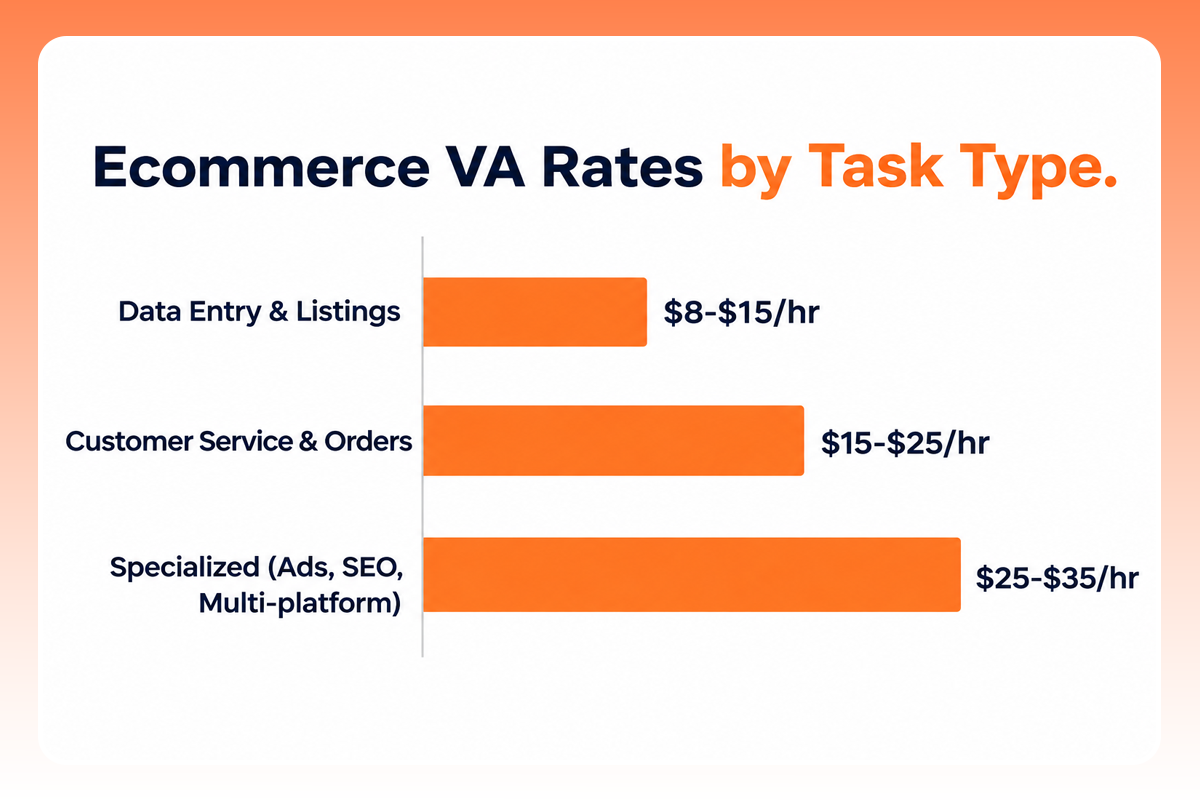
Pricing depends heavily on task complexity and where the VA is based. Basic data entry and product listing work tends to sit at the lower end, while VAs handling customer service, Amazon-specific tasks, or ad support cost more. Ecommerce VA rates vary widely based on location, experience, and responsibilities. Many ecommerce-focused VAs fall somewhere in the $10–$35/hour range, although specialists may charge more, with monthly retainer packages through agencies typically running. Agency retainers commonly vary from several hundred to several thousand dollars per month depending on scope, coverage, and specialization. However, rates vary based on location, experience, platform knowledge, and task complexity.
For comparison, a full-time in-house ecommerce coordinator costs more than the salary alone. The U.S. Bureau of Labor Statistics tracks employer compensation costs every quarter, and Employer costs typically include wages plus additional compensation such as benefits and payroll-related costs. This is why many sellers use a mix: a VA for repeatable daily tasks, and an agency for account-level work like Amazon management, where pricing and scope work differently than hourly VA rates.
Rates shift depending on what you’re actually asking the VA to do. Basic data entry and product listing work sits at the lower end of the range, usually $8 to $15 an hour. Customer service and order management, which require more judgment and faster response times, typically run $15 to $25 an hour. Specialized work like Amazon advertising support, SEO-optimized listing copy, or multi-platform account coordination sits at the top, often $25 to $35 an hour or more. Knowing which category your tasks fall into before you start hiring keeps you from either overpaying for basic work or underpaying for a specialist and getting inconsistent results.
How and When Should You Hire a Shopify Virtual Assistant?
The right time to bring in a virtual assistant for ecommerce store support on Shopify is usually when you notice specific signs: product updates are getting delayed, customer emails are piling up, or you’re spending hours each week on tasks that don’t need your personal attention.
Shopify VAs typically handle:
- Product uploads and listing updates
- Order processing and shipping confirmations
- Customer service replies through chat or email
- Basic inventory and collection management
Look for candidates who can show you real Shopify stores they’ve worked on, not just a general claim of ecommerce experience. Shopify itself limits staff account access by pricing plan, so check your plan’s staff account permissions before assuming you can add unlimited team members.
What Tasks Should You Outsource First?
When hiring an ecommerce virtual assistant, the goal is not to hand over every responsibility immediately. Start with repetitive tasks that consume time but do not require your direct decision-making. This allows you to focus on strategy, growth, and higher-value activities while ensuring daily operations continue smoothly.
Product Listing Management
Updating product information, uploading new listings, optimizing basic details, and maintaining catalog accuracy are common tasks that can be delegated. A VA can help ensure listings stay organized and updated across platforms such as Amazon, Walmart, Shopify, or other ecommerce channels.
Customer Support
Customer messages, frequently asked questions, order updates, and basic return requests are often repetitive and time-consuming. With clear guidelines and response templates, a VA can handle routine communication while escalating complex issues when needed.
Order and Inventory Management
A VA can monitor order status, track shipments, update inventory records, and identify potential issues before they affect customers. Regular inventory checks can help prevent overselling, stockouts, and delayed fulfillment.
Reporting and Administrative Tasks
Routine reporting, spreadsheet updates, competitor tracking, and data organization are additional areas where a VA can save sellers significant time. These tasks provide better visibility into operations without requiring the business owner to spend hours collecting information.
Start by outsourcing tasks that are clearly defined and easy to measure. As the VA gains experience with your processes, additional responsibilities can be delegated based on performance and trust.
How Can a Virtual Assistant Improve Your Business Productivity?
The direct benefit of hiring a VA is the time it gives back, while the indirect benefit is greater focus on growth activities. By removing repetitive operational tasks, sellers can dedicate more time to revenue-driving activities such as product research, marketing, and strategic initiatives. For specialized areas like account management, advertising, or marketplace compliance, sellers may need dedicated e-commerce experts rather than relying on a general VA.
The productivity gain isn’t only about hours saved. It shows up in fewer missed customer messages, faster listing turnaround, and catching small issues (a wrong SKU, an outdated image) before they turn into refund requests or bad reviews.
What Red Flags Should You Watch for Before Hiring a Virtual Assistant?
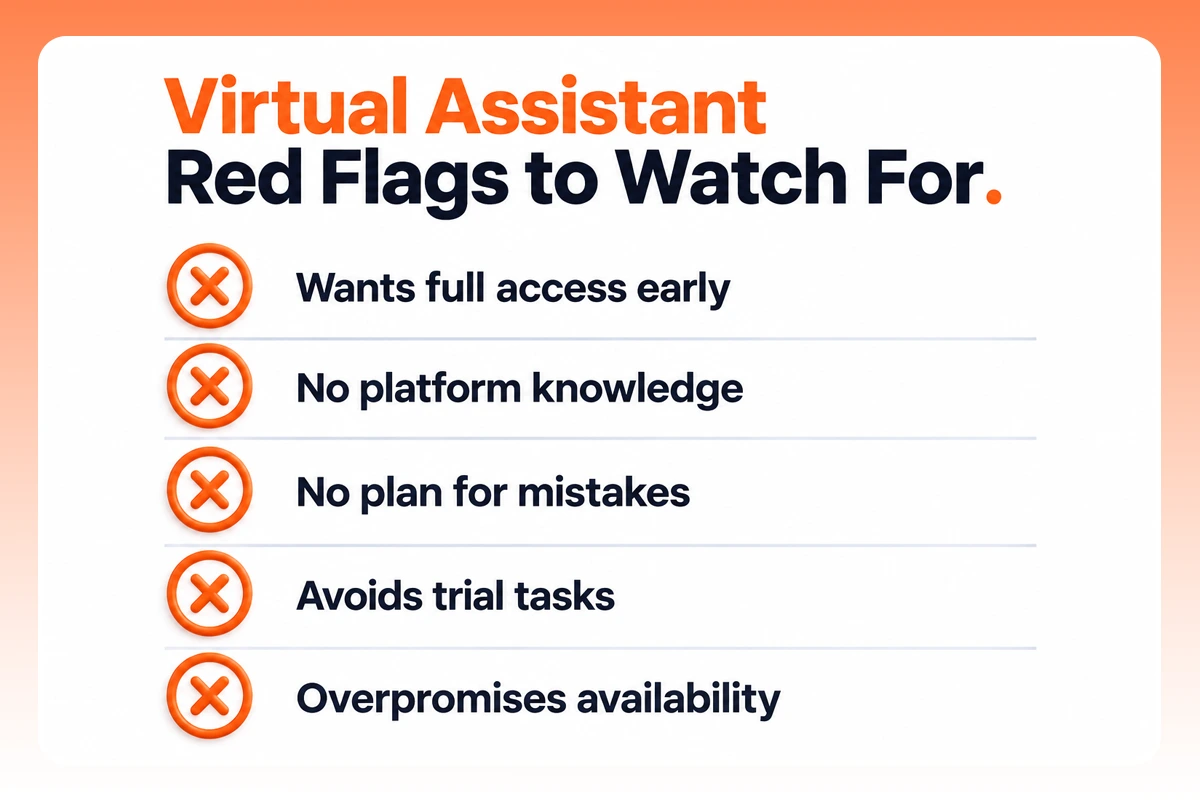
Watch for candidates who want full access before any trial or trust is built, give vague answers about returns or listing issues, avoid a paid trial task, or promise 24/7 availability across multiple clients.
- Wants full access early: They want your main login before any trial task or trust has been established. This is usually a sign they haven’t worked with sellers who take account security seriously.
- No platform knowledge: They can’t explain how a return works on your specific marketplace or what happens if a listing gets flagged. Vague answers here usually mean their “ecommerce experience” is thinner than it looks.
- No plan for mistakes: Ask directly, “If you accidentally changed a price on 50 listings, what would you do?” A strong candidate names a specific fix and explains the recovery process, not just how they would avoid mistakes.
- Avoids trial tasks: They dodge a short paid trial or want full rate before proving anything. A confident VA has no problem showing their work first.
- Overpromises availability: Anyone claiming 24/7 coverage across multiple clients is usually stretched too thin to do any one job well.
How Do You Protect Your Store When You Give a Virtual Assistant Access?
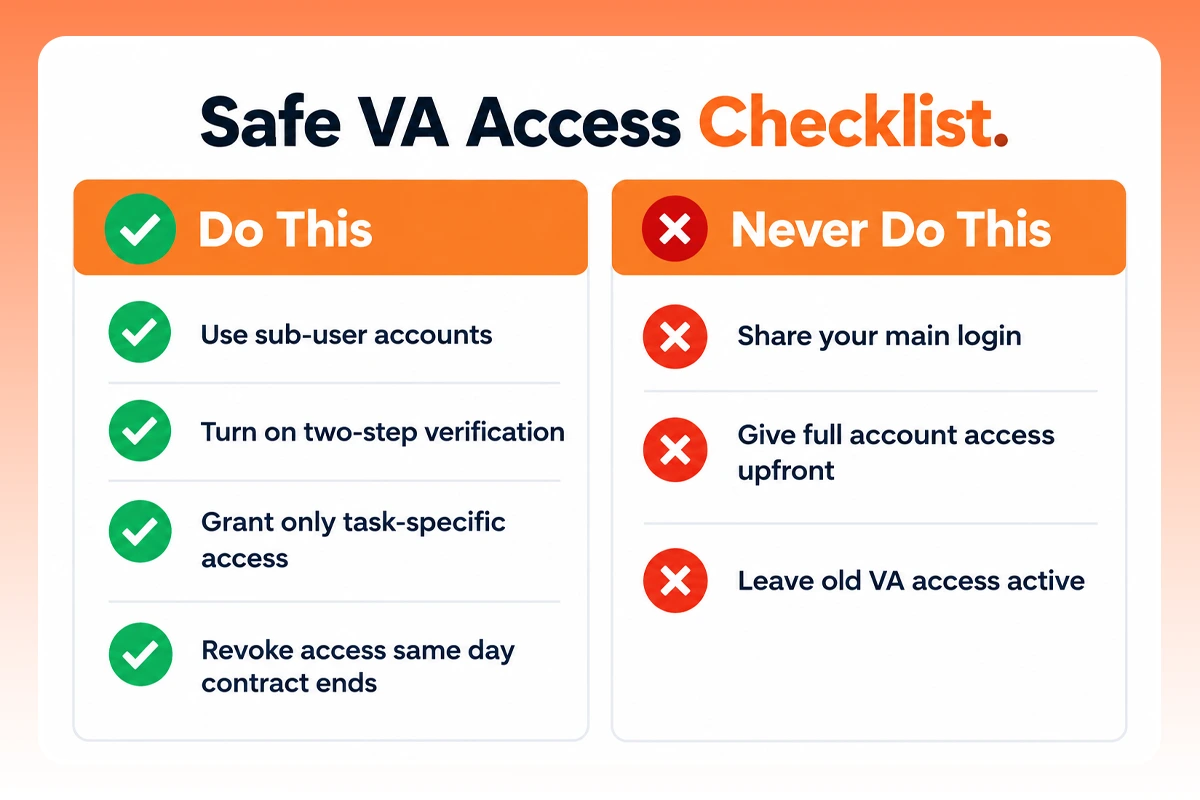
Giving a virtual assistant access to your ecommerce store is not the same as assigning a task. It gives them access to important business systems, customer data, and operational settings. Sharing your main login can create unnecessary security risks, so sellers should use proper user permissions, enable security protections, and provide only the access required for the assigned tasks.
Instead:
- Use separate user accounts: Never share your primary account credentials. Amazon Seller Central allows sellers to create additional users with specific permissions instead of sharing the main login. Learn more about managing account permissions through Amazon Seller Central User Permissions. Shopify also provides staff accounts with customizable permissions, allowing store owners to control which areas team members can access or modify through Shopify Staff Permissions.
- Enable two-step verification: Protect every account connected to your store with two-step verification. This adds an additional security layer by requiring a verification code along with the password. Amazon recommends enabling two-step verification to help protect seller accounts through Amazon Seller Central Security Settings.
- Grant access based on responsibilities: A VA managing customer messages does not need access to financial information, payment settings, or sensitive account controls. Limiting permissions reduces the chance of accidental changes and helps maintain better account security.
- Review and remove access regularly: User permissions should be reviewed periodically and removed immediately when a working relationship ends. Keeping inactive users connected creates unnecessary security risks.
Proper access management allows sellers to delegate daily operations while maintaining control over their ecommerce accounts and protecting their business from avoidable account issues.
Virtual Assistant vs E-commerce Agency: Which One Is Right?
Choosing between a virtual assistant and an e-commerce agency depends on your business needs, the complexity of your operations, and how much management support you require.
A VA is typically best suited for repetitive operational tasks that follow clear processes. They can help with activities such as product updates, customer communication, order tracking, and administrative support. However, a VA usually requires training, supervision, and detailed instructions to complete tasks according to your standards.
An ecommerce agency provides broader support by combining specialized expertise, established processes, and strategic guidance. Agencies are often better suited for sellers who need support with areas such as marketplace management, advertising optimization, account health, compliance, SEO, or overall growth strategy.
Choose a Virtual Assistant When:
- You have clearly defined tasks that can be documented through SOPs.
- You have the time to train and manage daily workflows.
- You need support with repetitive operational activities.
- Your main goal is reducing workload rather than outsourcing strategy.
Choose an E-commerce Agency When:
- You need specialists across multiple areas of e-commerce operations.
- Your business requires strategic decision-making and growth planning.
- You want experienced professionals managing complex marketplace challenges.
- You need less daily supervision and more complete operational support.
For many growing e-commerce businesses, the right approach may involve using both: a VA for routine execution and an experienced e-commerce partner for strategic operations, optimization, and marketplace growth.
Conclusion
Hiring the right virtual assistant can free up hours every week, but getting the vetting and access setup wrong costs more than it saves. If you are still unsure whether a solo VA can support your store’s needs, that uncertainty is worth resolving before you post a job listing, not after you’ve onboarded someone.
If managing, training, and monitoring a VA on top of running your store sounds like more work than it’s worth, there’s another option. A team that already handles account strategy, advertising, and platform compliance can take this off your plate entirely, without you needing to vet, train, or supervise anyone yourself.