
Too busy to read? Listen to this article instead.
More customers, more revenue, and the same product you already know how to sell. That’s the pitch behind Amazon Global Selling, and on paper it sounds like an easy decision. The sellers who struggle are usually the ones who treat international expansion as a simple switch instead of a new market operation.
This guide explains how the program works, which countries to prioritize, and where margins can be reduced if costs are overlooked.
What Is Amazon Global Selling?
Amazon Global Selling is Amazon’s program that lets sellers list and sell products across its international marketplaces. Amazon Global Selling helps sellers access multiple international marketplaces through connected Seller Central tools and regional account structures. According to Amazon’s own global selling page, the program spans marketplaces across North America, Europe, Asia-Pacific, and the Middle East, with a single account can help sellers manage multiple marketplaces within supported regions.
For most sellers already running a US store, this means the infrastructure to sell internationally already half-exists. What’s missing isn’t access. It’s knowing how to use it without losing money in the process.
How Does Amazon Global Selling Work?
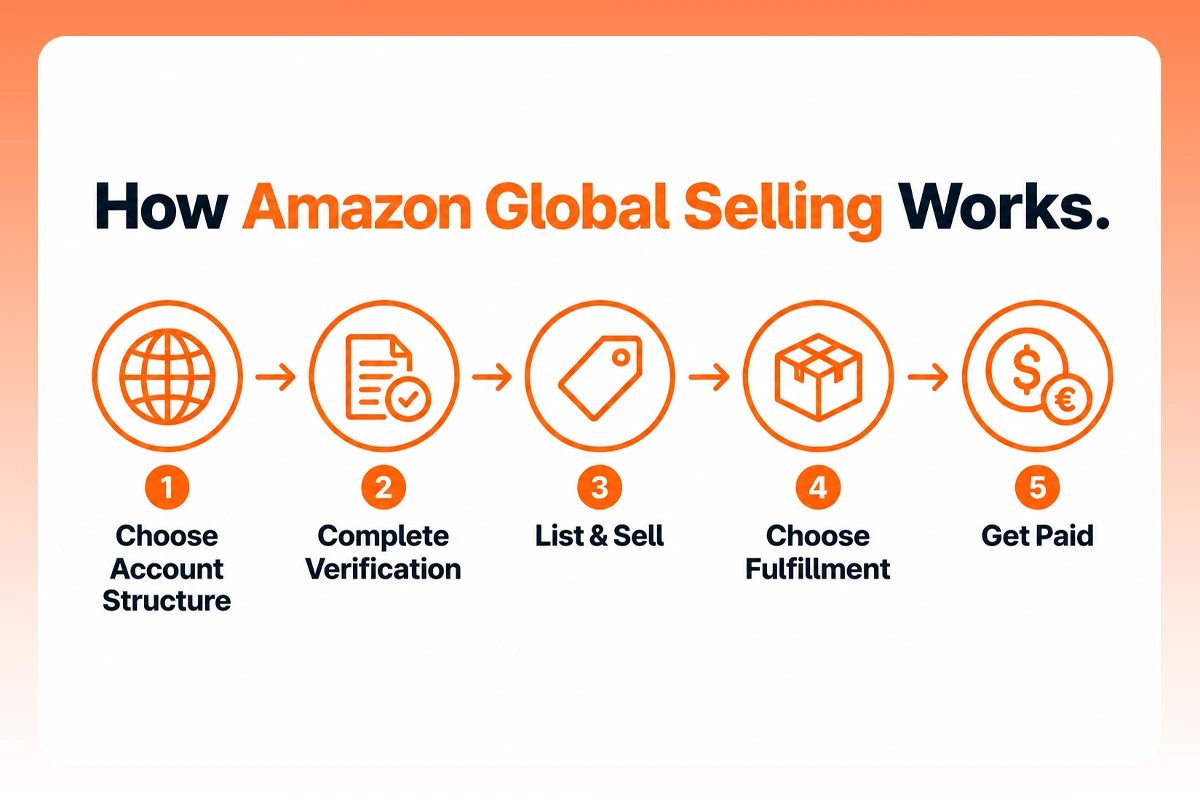
Once you decide to sell internationally on Amazon, the expansion process follows a structured path: select a marketplace, complete verification, create listings, choose fulfillment, and manage payments. Use a unified account where available, complete any additional verification and marketplace-specific requirements Amazon requests, then list, fulfill through FBA or your own shipping, and get paid with currency conversion applied automatically.
- Choose your account structure: North America and Europe both offer unified accounts, meaning one registration gives you access to every marketplace in that region. Other regions, like Asia-Pacific, often require separate registration per country, so check this before assuming one signup covers everywhere you want to sell.
- Complete verification: Amazon requires business details and identity documents for each new marketplace, similar to your original seller account setup. Sellers who already went through this process once usually find it faster the second time, since much of the required documentation carries over.
- List and sell: Once approved, your products become visible to customers in that marketplace, and orders flow into the same Seller Central account you already use. You can manage multiple marketplaces through Seller Central, although each marketplace may have separate requirements, reports, and performance metrics.
- Choose fulfillment: You can ship yourself internationally, or, depending on the region, sellers may use programs such as Pan-European FBA, Remote Fulfillment, or marketplace-specific fulfillment solutions. FBA can simplify local fulfillment and delivery, but sellers still need to handle marketplace-specific tax and compliance requirements.
- Get paid: Amazon collects its fees, then transfers your proceeds, converted into your home currency if needed, on the same payout schedule as your existing account.
How Do You Build International Listings on Amazon?
The tool is useful, but sellers should understand what it does and what still requires manual work, and it’s worth understanding properly before you rely on it to do more than it actually does. Amazon’s Build International Listings (BIL) tool automatically syncs your pricing and offers from an existing listing to new marketplaces, based on pricing rules you set, like a fixed markup or a currency-adjusted price. Once the rules are set, the tool keeps applying them going forward, which is what makes it useful for sellers managing several marketplaces at the same time.
What BIL handles well:
- Price syncing: Update your source listing, and connected marketplaces update automatically based on your rules. You’re not logging into four separate storefronts every time a price changes.
- Offer creation: Adding a product to a new marketplace doesn’t require rebuilding the listing from scratch. The tool pulls from what already exists and applies it to the new market, which saves real time when you’re expanding into several countries at once.
What still needs manual attention:
- Category and compliance mapping: Product categories and required fields differ by marketplace, and BIL won’t catch a mismatch for you. A listing that’s correctly categorized in the US can land in the wrong category elsewhere if nobody checks it after the sync.
- Title and description localization: Straight translation often reads oddly to local shoppers, and a listing built for a US audience rarely converts the same way in Germany or Japan without adjustment. Search behavior, phrasing, and even what details shoppers care about most can differ by market, so a word-for-word translation misses more than it captures.
Treat BIL as a pricing and syncing tool, not a full localization solution. Sellers who assume it handles everything usually end up with listings that are technically live but poorly optimized for the local market, which shows up later as weak conversion rates that are hard to trace back to the actual cause.
Which Countries Should Amazon Sellers Consider for Expansion?
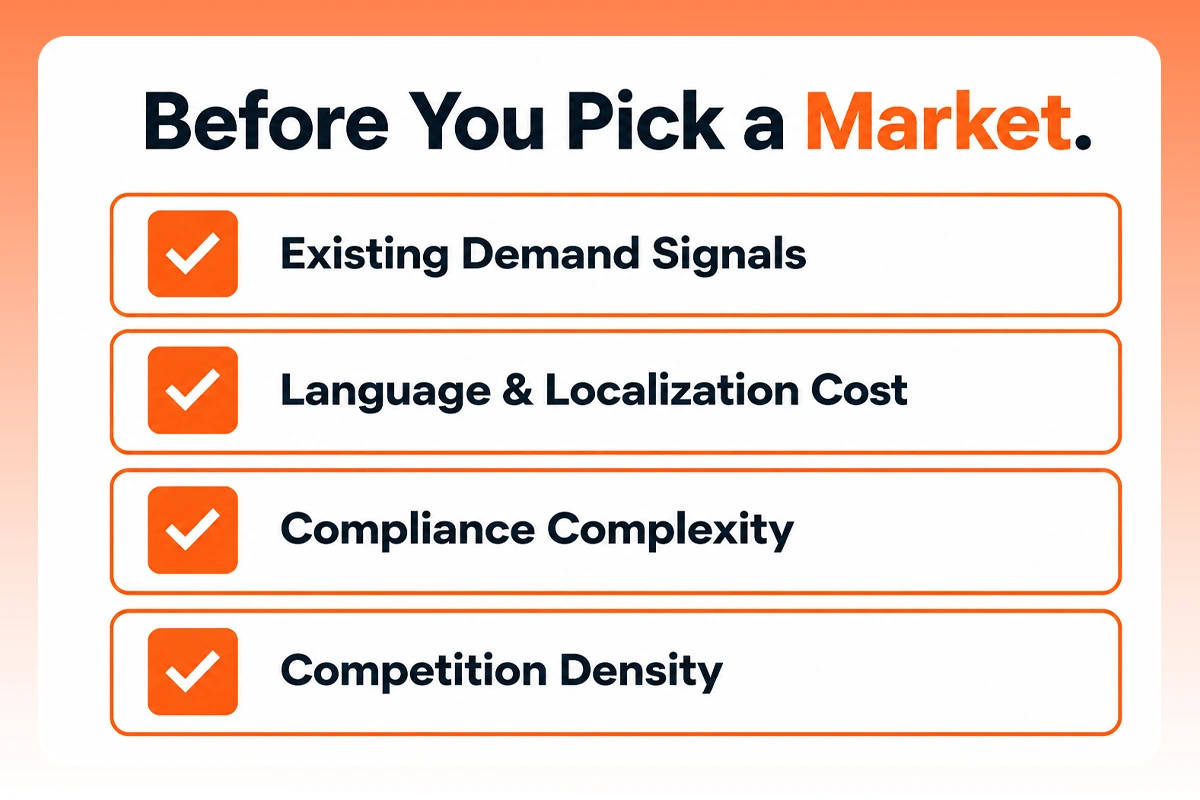
There isn’t a universal answer here, and any list claiming to name “the best countries” without context is oversimplifying. Instead, weigh these factors before picking a market:
- Existing demand signals: Check whether your product category already sells well in a target country before assuming it will. Amazon’s own marketplace tools can show category-level demand by region.
- Language and localization cost: English-speaking markets, like the UK or Canada, generally require less upfront localization work than markets requiring full translation and cultural adaptation.
- Compliance complexity: VAT registration requirements, import documentation, and product certification rules vary significantly by country. Germany, for example, requires separate packaging-law registration (VerpackG) before you can sell there, on top of standard VAT rules, which is the kind of extra step that can make an otherwise attractive market more expensive to enter than it first appears.
- Competition density: A category that’s saturated on Amazon.com can have less competition on a less-established marketplace, simply because fewer sellers have expanded there yet.
The US, UK, and Germany are among Amazon’s largest marketplaces by sales activity, which makes them a reasonable starting point for demand. But size alone isn’t the same as opportunity: the US carries the most competition of any marketplace, while a market like the UK offers a large, English-speaking customer base with comparatively less localization work required to get started. Run your own product through the checklist above before committing to a market, rather than expanding based on marketplace size alone. A smaller, less competitive market can outperform a larger, saturated one for a specific product.
Amazon Global Selling Compliance Requirements
Expanding to a new Amazon marketplace is not only about creating listings and attracting customers. Each country has its own compliance requirements, and sellers need to understand these obligations before sending inventory or launching sales.
A product that is approved for sale in one marketplace may require additional documentation, certifications, or registrations in another. Ignoring these requirements can lead to listing removals, inventory restrictions, or unexpected costs. Key compliance areas sellers need to review are:
1. VAT Registration and Tax Requirements
Tax requirements vary by country and depend on factors such as where inventory is stored, where products are sold, and which fulfillment method is used.
For example, sellers using FBA in European marketplaces may need VAT registration in countries where Amazon stores their inventory. Understanding tax obligations before expansion helps avoid compliance issues after sales begin.
2. Product Regulations and Certifications
Different marketplaces may have specific rules for product categories such as:
- Electronics
- Beauty products
- Food and supplements
- Toys
- Medical devices
- Automotive products
Before expanding, sellers should confirm whether their products require additional certifications, testing reports, labeling changes, or safety documentation.
3. Import Duties and Customs Requirements
International expansion also introduces customs and import responsibilities. Sellers need to understand:
- Import duties and tariffs
- Customs documentation
- Product classification requirements
- Country-specific labeling rules
These costs should be included in profitability calculations before choosing a marketplace.
4. Packaging and Environmental Requirements
Some countries have additional packaging obligations. For example, sellers entering European markets may need to comply with local packaging registration requirements depending on their products and sales activities.
Compliance planning should happen before inventory is shipped internationally, not after problems appear.
What Tools Can Help You Manage Your International Amazon Store?
A few built-in tools help sellers manage multiple marketplaces more efficiently without hiring a specialist for every country. The Currency Converter deposits proceeds in your home currency, the Language Switcher bridges communication across languages, and the Service Provider Network offers proper localization instead of machine translation.
- Amazon Currency Converter for Sellers: automatically converts your international proceeds into your home currency and deposits them into your local bank account, removing the need to manage multiple foreign bank accounts.
- Seller Central Language Switcher: helps sellers navigate Seller Central and manage marketplace communication across languages, helping bridge day-to-day language gaps without a dedicated translator for every message.
- Translation and localization services: available through Amazon’s Service Provider Network for sellers who want listings properly adapted rather than machine-translated.
These tools reduce the operational load of running multiple storefronts, but none of them replace the planning step of knowing which fees you’re actually paying, which is where the next section matters most.
How to Calculate Profitability Before Expanding to a New Amazon Marketplace
A product that performs well on Amazon US does not automatically guarantee success in another country. International expansion changes your entire cost structure, and sellers need to understand the complete financial picture before entering a new marketplace.
Calculate Your True International Cost
Before launching in a new marketplace, sellers should calculate all costs involved in selling internationally. A product’s profitability depends on more than just the selling price.
Your calculation should include different types of fees, including Amazon referral fees, FBA fulfillment fees, storage costs, currency conversion expenses, international shipping, import duties, VAT obligations, and any localization costs required for the new market.
Selling Price − Amazon Fees − Fulfillment Costs − Shipping & Import Expenses − Taxes & Compliance Costs = Actual Profit Margin
Understanding these costs upfront helps sellers avoid entering markets where sales volume may increase, but profitability decreases.
Consider Marketplace-Specific Pricing
The same product may require different pricing strategies across different Amazon marketplaces. Customer purchasing power, competitor pricing, marketplace fees, currency fluctuations, and shipping costs can all affect the final selling price.
A price that works successfully in the US marketplace may not generate the same margin in Germany, the UK, or Japan. Sellers should analyze local market conditions and adjust pricing based on the actual cost structure of each marketplace.
Test Before Scaling Inventory
International expansion should be approached as a controlled market test rather than an immediate large-scale investment. Before sending significant inventory, sellers should analyze category demand, review competitor performance, estimate sales potential, and start with manageable inventory levels.
Once the product demonstrates consistent demand and profitability, sellers can increase inventory and expand further. This approach reduces risk and helps build a sustainable international growth strategy.
How Do You Protect Your Margins When Selling Internationally?
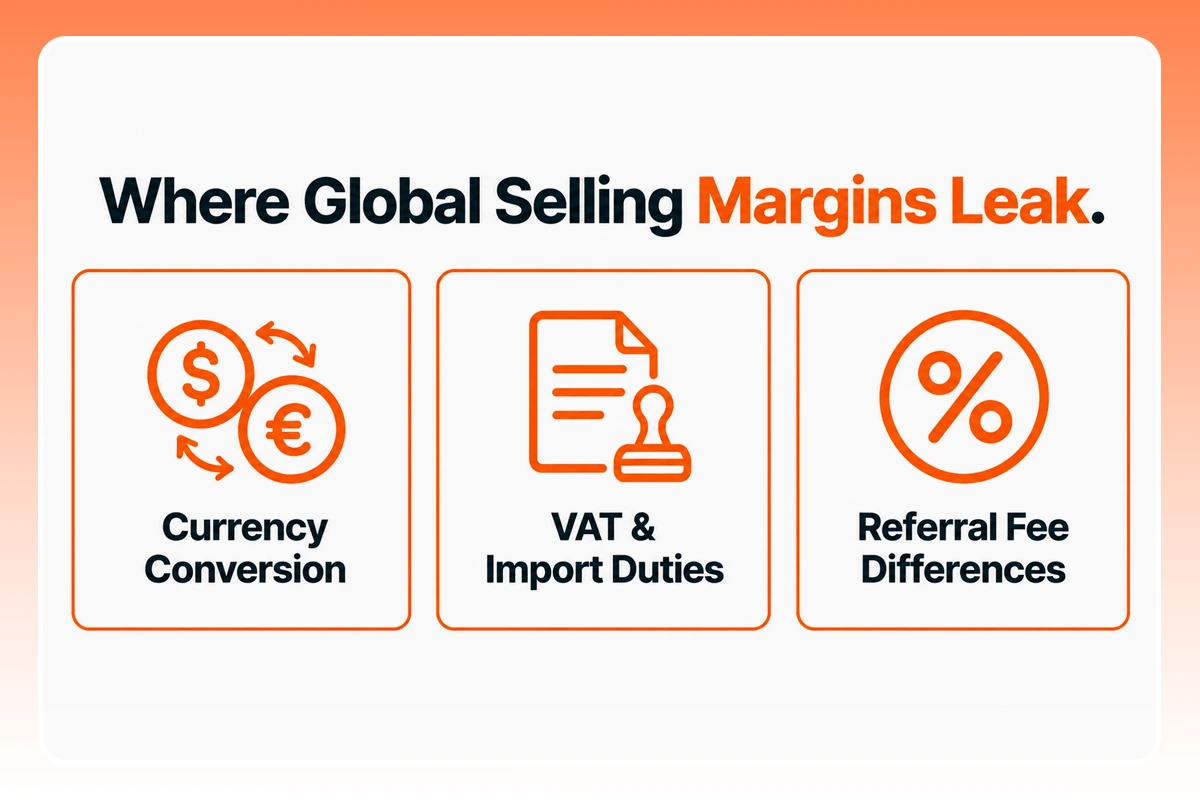
Margins usually slip in three spots: currency conversion fees baked into the exchange rate, VAT that often needs registering right after your first sale, and referral fees that vary by marketplace.
1. Currency Conversion Fees Are the Highest Hidden Cost
Amazon’s official pricing for its Currency Converter for Sellers is volume-based: sellers with Amazon Currency Converter fees vary depending on marketplace, currency, and transaction volume. Sellers should compare exchange rates when calculating margins. Sellers should check current rates before modeling international margins. This fee is built into your exchange rate rather than shown as a separate line item, which means many sellers never realize how much they’re actually paying until they compare it against the mid-market rate directly.
2. VAT And Import Duties Differ by Region, And Timing Matters
VAT requirements vary by country and may depend on inventory location, sales activity, and fulfillment method. Sellers should understand obligations before launching. Waiting until compliance becomes urgent is more expensive than planning for it upfront. Amazon’s Service Provider Network connects sellers with VAT specialists who handle registration across European marketplaces specifically because this step trips up so many new international sellers.
3. Referral Fees Aren’t Identical Across Marketplaces
The same product category can carry a different referral fee percentage depending on which storefront it’s sold on, so a margin calculation that worked on Amazon.com doesn’t automatically transfer to Amazon.de or Amazon.co.uk. Always confirm the specific fee for your category in the marketplace you’re entering. This is worth checking against your existing margin math the same way you’d check what a managed account actually costs before committing to it.
Getting this section right before you launch in a new market is one of the most important factors in determining whether international expansion improves profitability or just adds complexity.
Common Mistakes Amazon Sellers Make When Expanding Globally
Many sellers treat Amazon Global Selling as a simple extension of their existing business. However, each marketplace has different customer expectations, regulations, and cost structures. Avoiding these common mistakes can help protect profitability during expansion.
- Copying US Listings Without Localization: A direct translation of a US listing may not perform well in another marketplace. Sellers should adapt titles, bullet points, images, keywords, and descriptions based on local customer behavior and search patterns.
- Expanding Into Too Many Markets at Once: Launching across multiple countries simultaneously can create unnecessary complexity. Start with one or two suitable marketplaces and build a repeatable process for managing inventory, advertising, compliance, and customer service before scaling further.
- Ignoring Complete Cost Calculations: Strong sales potential does not always mean strong profitability. Sellers should account for international shipping, VAT, currency conversion, fulfillment fees, duties, and return costs before entering a new marketplace.
- Treating International Customers Like US Customers: Customer expectations vary by region, including delivery preferences, return policies, language, and purchasing behavior. Successful sellers adapt their operations to match each marketplace.
- Expanding Without an Operations Plan: International selling requires ongoing management of inventory, listings, compliance, advertising, and customer support. A structured process helps sellers turn global expansion into a sustainable growth channel.
Conclusion
Everything above is manageable for a seller willing to do the research market by market. But sellers who successfully expand into three or four marketplaces usually do not manage every requirement manually.
If juggling compliance deadlines and fee structures across multiple countries sounds like more operational overhead than your team has room for, that’s a reasonable point to bring in support that already knows the process, the same way sellers often turn to outsourced account management once a single marketplace becomes too much to run alone.
If you’re ready to grow beyond your home market without guessing at the fee structure, international expansion becomes easier when the operational foundation is already in place. If you need support managing international expansion, get in touch with our team today.