
Selling on Amazon offers a great opportunity for entrepreneurs, but it comes with strict policies that must be followed. Many new sellers unknowingly violate policy guidelines, which can lead to seller account suspension, product listing removal, and even permanent bans. Amazon has stringent regulations to ensure a safe and trustworthy marketplace, and failing to comply can have serious consequences.
Understanding the most common policy violations can help sellers avoid costly mistakes and maintain a healthy account. This guide explores the major reasons why sellers get suspended, the best ways to resolve these issues, and strategies to ensure long-term compliance.
Common Amazon Policy Violations
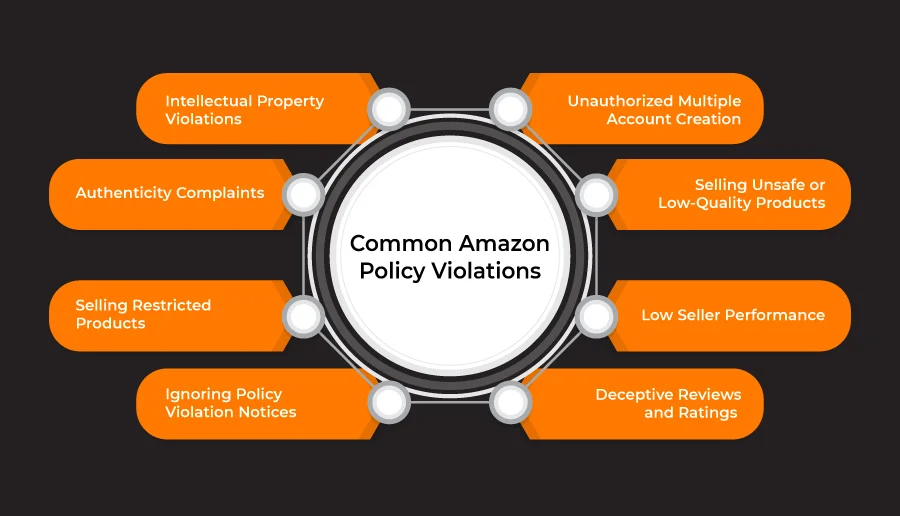
Usually, new Amazon sellers are not very accustomed to the strict policies that they are required to follow. Sometimes, they unknowingly violate a policy that is critical to account standing, leading to seller account suspension or product listing removal. Here are the most common policy violations that new sellers are prone to commit.
1. Intellectual Property Infringement
One of the most common reasons sellers face Amazon terms of service violations is intellectual property complaints. These complaints come in two forms: suspected and received.
- Suspected Intellectual Property Complaints: These are system-generated warnings when Amazon detects a possible policy violation. The issue may arise from using copyrighted images, brand names, or descriptions that closely resemble another company’s intellectual property. To resolve this, sellers must edit their product listing and remove any infringing content.
- Received Intellectual Property Complaints: These are more serious, as they originate from rights owners who file complaints against sellers. The most common subcategories include counterfeit claims, trademark violations, copyright infringement, and patent complaints. The appeal process for these complaints varies, but in most cases, sellers need to provide proof of authorization to sell the product.
If a seller receives an intellectual property infringement notice, they should immediately check if they have permission from the brand or rights owner. Unauthorized reselling, even if the product is genuine, can lead to product listing removal and seller account suspension.
Also Read: Understanding IP Violations on Amazon: An Ultimate Guide
2. Authenticity Complaints
Amazon is strict about product authenticity, and any complaints regarding fake or low-quality items can quickly lead to Amazon policy violations. Authenticity-related complaints typically fall into three categories:
- Product Authenticity Complaints: Customers may report that an item they received does not appear genuine. This could be due to improper packaging, missing brand markings, or differences in quality.
- Product Condition Complaints: If an item arrives in damaged or used condition when it was listed as new, buyers may complain, triggering an investigation.
- Food and Safety Issues: Amazon has strict regulations regarding food and supplements. If a product is expired, incorrectly labeled, or unsafe for consumption, it will be removed immediately.
To resolve authenticity complaints, sellers must provide invoices from authorized distributors or manufacturers. These invoices should include detailed product information and be dated within the last 365 days. Failing to provide this documentation can result in product listing removal or even seller account suspension.
3. Selling Restricted Products on Amazon
Amazon prohibits the sale of certain items due to legal regulations or safety concerns. When a seller lists a restricted product, they risk receiving a Restricted Products Policy Violation.
If a listing is flagged as restricted, sellers should check Amazon’s guidelines to understand the exact reason for the restriction. Some restricted product categories require additional certifications, compliance documents, or prior approval from Amazon before selling.
To resolve restricted products Amazon violations, sellers must:
- Verify that the product complies with Amazon’s rules.
- Remove any policy-violating content, such as misleading claims or prohibited ingredients.
- Submit proper documentation to prove compliance if required.
Failing to adhere to Amazon’s restricted product policies can result in account warnings or seller account suspension.
4. Ignoring Policy Violation Warnings
Sometimes, Amazon issues policy violation warnings for various reasons, including incorrect listings, misleading descriptions, or failing to meet marketplace standards. These warnings often appear at the bottom of the violation section on the Account Health page, and many sellers overlook them.
Ignoring policy violation warnings can negatively impact an account’s health rating, leading to restricted selling privileges. If a seller receives a warning, they should carefully review the message and take corrective actions, including:
- Editing the product listing to comply with Amazon’s guidelines.
- Removing misleading claims or images.
- Addressing performance issues, such as late shipments or negative reviews.
By taking these warnings seriously, sellers can prevent minor issues from escalating into full seller account suspension.
5. Multiple Accounts Without Legitimate Reasons
Amazon has a strict one-seller-account-per-person rule unless a seller has legitimate business needs, such as more than one brand with unique storefronts and names. Otherwise, if Amazon detects multiple linked accounts, it may suspend or permanently ban the seller.
However, if you have multiple accounts, you need to keep them in good standing. If one of your accounts becomes deactivated, the other accounts will be deactivated as well until you resolve the violation issues.
Many new sellers unknowingly violate this policy when a business partner, employee, or even a family member previously operated an Amazon account. If there is any possibility of a linked account, sellers should contact Amazon before creating a new one.
To avoid policy violations related to multiple accounts, sellers should:
- Check if they or any business partners have ever had an Amazon seller account.
- If an old account exists, attempt to re-open it rather than create a new one.
- Contact Amazon’s support team for guidance before opening a second account.
- Only create multiple accounts if there is a legitimate business need.
Once an account is suspended for being linked to another, recovering it is extremely difficult. So, you should be careful about creating a new account.
6. Selling Unsafe or Poor-Quality Products
Amazon is committed to product safety, and sellers who distribute low-quality or dangerous goods may face product listing removal and seller account suspension. Issues often arise when products are expired, improperly labeled, or fail to meet regulatory standards.
To ensure compliance, sellers should:
- Source products only from authorized manufacturers or distributors.
- Verify that all certifications and labels meet industry standards.
- Check expiration dates and avoid selling products too close to their expiration.
- Conduct third-party safety tests if manufacturing their own products.
If Amazon removes a listing due to safety concerns, the seller must provide lab test reports, compliance certificates, and proof that the issue has been resolved before reinstatement.
7. Manipulating Ratings and Reviews
Amazon prohibits any attempts to influence customer ratings and reviews. Sellers cannot:
- Review their own products or competitors’ products.
- Offer incentives in exchange for positive reviews.
- Ask buyers to change or remove negative reviews.
If Amazon detects policy violations related to fake reviews, it will remove the affected product listings and may suspend your account. In severe cases, Amazon can permanently ban the account.
To avoid this, sellers should focus on providing quality products and excellent customer service, allowing genuine reviews to build their reputation naturally.
8. Poor Seller Performance
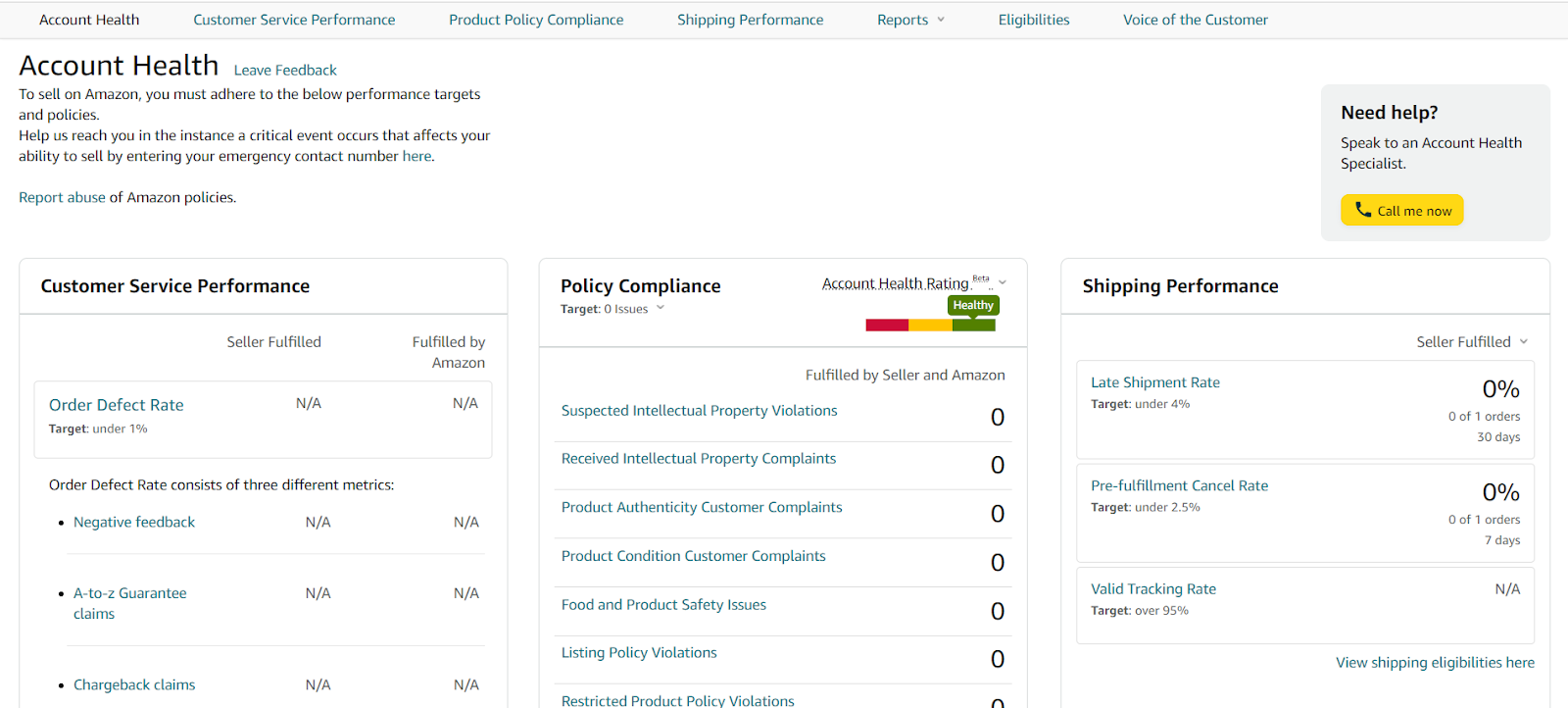
Amazon holds sellers accountable for maintaining high-performance standards. If a seller frequently cancels orders, ships late, or receives poor customer feedback, their seller account may be flagged for suspension.
Key performance metrics to monitor include:
- Late shipment rate: This must remain under 4%. Failing to meet this threshold can lead to seller account suspension.
- Order defect rate: Negative reviews, A-to-Z claims, and chargebacks should be kept under 1%.
- Cancellation rate: Frequent cancellations due to stock issues can damage seller performance and lead to policy violations.
- Valid Tracking Rate: Non-FBA orders should have valid tracking IDs. If the VTR falls below 95%, Amazon suspends your seller-fulfilled listings.
To maintain good standing, sellers should ensure they have a reliable logistics partner or use FBA to always keep inventory levels updated.
Also Read: A Complete Breakdown of Amazon’s Seller Performance Standards
How to Prevent Your Amazon Seller Account Suspension
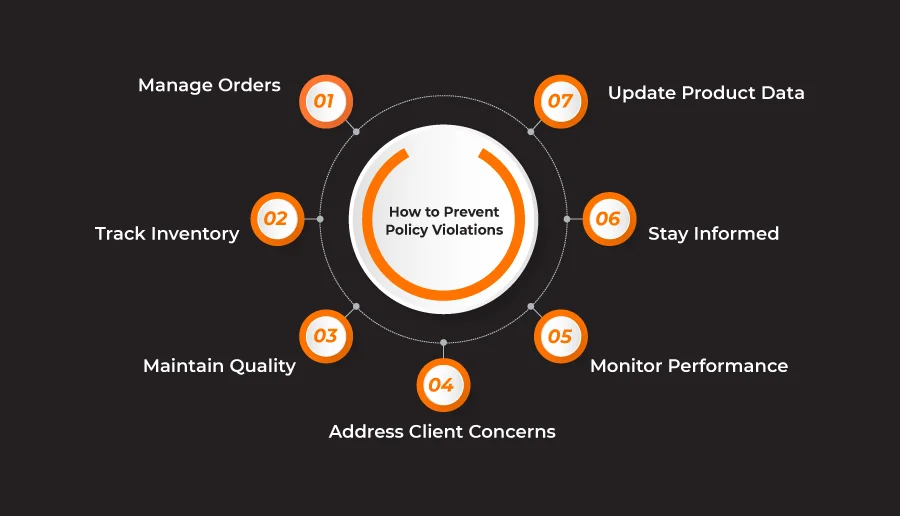
Amazon offers vast opportunities for sellers, but failing to follow its guidelines can lead to policy violations, product listing removal, or even seller account suspension. To keep your account in good standing, you must comply with Amazon’s Terms of Service, maintain product quality, and deliver excellent customer service.
1. Follow Amazon’s Policies
Many sellers face account suspension due to ignorance of Amazon’s rules. Regularly reviewing policies helps prevent Amazon Terms of Service violations that can lead to penalties. Misleading product information, unauthorized sales, or deceptive practices put accounts at risk. Staying updated on Amazon’s latest regulations is key to long-term success.
2. Ensure Accurate Product Listings
Incorrect or misleading details in product descriptions, images, or attributes can lead to product listing removal. Amazon requires sellers to provide clear, truthful, and precise information. Violating these guidelines can result in policy violations, negative reviews, and account restrictions. Ensuring compliance with Amazon’s Terms of Service helps maintain credibility.
3. Maintain Order Fulfillment & Timely Shipping
Late shipments and canceled orders negatively affect performance metrics, leading to seller account suspension. Using reliable shipping services and updating tracking details ensures a smooth fulfillment process. Sellers using Fulfillment by Amazon (FBA) have an advantage, but self-fulfillment requires careful management to avoid policy violations.
4. Monitor Inventory Levels
Running out of stock and canceling orders damages the seller’s performance. To prevent policy violations, sellers should track inventory and restock on time. Additionally, they must avoid listing restricted products that Amazon prohibits, as selling unauthorized items can result in product listing removal and even account suspension.
Also Read: 10 Best Amazon Inventory Management Strategies: Updated guide
5. Maintain High-Quality Products
Selling counterfeit or low-quality products can lead to intellectual property infringement claims and seller account suspension. Ensuring product authenticity and quality compliance is essential. Addressing customer feedback and quality concerns quickly can help prevent policy violations and protect account health.
6. Provide Excellent Customer Service
Delayed responses and unresolved complaints contribute to negative feedback, impacting seller metrics. To avoid policy violations, respond to customer inquiries within 24 hours. Resolving disputes professionally prevents A-to-Z claims and reduces the risk of seller account suspension.
7. Monitor Account Health Metrics
Amazon tracks key performance indicators like Order Defect Rate, Late Shipment Rate, and Cancellation Rate. Failing to meet these benchmarks can result in seller account suspension. Regularly reviewing account health helps sellers take corrective actions before facing penalties.
8. Stay Updated on Amazon’s Policies
Amazon frequently updates its policies, including its restricted products list. Selling prohibited items or violating branding rights can lead to intellectual property infringement claims. Regularly reviewing Amazon’s seller updates and ensuring compliance prevents policy violations and account deactivation.
Also Read: Amazon Policy Compliance: Protect Your Business and Boost Sales
What Is MAP Policy Violation?
Minimum Advertised Price (MAP) is a rule created by a brand or manufacturer. It sets the lowest price a seller can show publicly when advertising a product. This rule is meant to protect brand value and avoid price wars between sellers.
MAP applies to the advertised price, not the actual sale price paid at checkout. When a seller or retailer advertises a product below the MAP, the brand or manufacturer counts it as a MAP violation.
Does Amazon Have a MAP Policy?
Amazon does not have an official MAP policy that it enforces for brands. Amazon does not monitor or enforce MAP policy violations on behalf of brands. The price sellers choose to list on Amazon is mostly up to the seller and Amazon’s own pricing rules, not the brand’s MAP policy.
When a brand sells its product directly to Amazon, any MAP terms may not be enforceable against Amazon itself. Some brands find Amazon’s pricing can go below MAP because Amazon does not agree to follow the brand’s MAP terms.
Who Is Responsible for Enforcing MAP?
On Amazon, the brand or manufacturer is responsible for enforcing MAP. Amazon treats MAP as a private agreement between the brand and its authorized sellers. Amazon does not automatically remove or punish sellers for MAP violations alone.
Brands must monitor the marketplace, find sellers violating their MAP, and then take action themselves. This can include sending warning notices to sellers or cutting off supply to repeat offenders.
Sometimes, brands even launch IP violation complaints against sellers who violate their MAP policy. Amazon may take action, although the complaint isn’t a MAP violation claim.
Where Can I Find Legal Advice Regarding Amazon’s Seller Agreements?
Here are good places to get legal advice about Amazon’s seller agreements:
1. Specialized Amazon seller lawyers: You can consult lawyers who focus on Amazon issues like account suspensions, policy violations, intellectual property disputes, and seller agreements. Firms that offer these services include Amazon Sellers Lawyer (CJ Rosenbaum), Mandour & Associates, ESQgo, and others that help with appeals and compliance.
2. Law firms with e-commerce experts: Some law firms specialize in broader e-commerce and online marketplace law. These firms help with contracts, intellectual property rights, seller terms, and business law related to selling on Amazon.
3. Online legal services platforms: Legal tech services like Rocket Lawyer let you find and consult with attorneys online and can help with contract review or general legal questions about your Amazon seller agreement.
Before you engage a lawyer, look for someone experienced with Amazon’s policies, marketplace disputes, and contract issues so you get advice tailored to your situation.
Conclusion
Understanding and preventing policy violations is crucial for long-term success on Amazon. By following Amazon’s rules, maintaining high-quality products, and ensuring smooth order fulfillment, sellers can avoid seller account suspension, product listing removal, and other serious penalties.
If violations do occur, taking prompt corrective action and providing the necessary documentation can help resolve the issue before it escalates. Selling on Amazon can be highly rewarding, but it requires caution and compliance to maintain a strong presence in the marketplace.