
Too busy to read? Listen to this article instead.
Imagine you wake up, check your phone, and there’s an email from Amazon. Your account has been deactivated. No warning, no phone call, just a notice sitting in your inbox. Your listings are gone. Your cash is frozen for weeks. And if Amazon is the only place you sell, your business stops the moment you read that email.
This isn’t a rare horror story anymore. It’s a real risk that more sellers are facing every month, and most of them find out the hard way that having one sales channel means having one point of failure. Industry pain-point research on Amazon sellers doing $200K to $500K a month puts single-channel dependence on Amazon at close to half of that group, sellers who know they’re too exposed but haven’t done anything about it yet. This blog is about why you need a successful multichannel e-commerce strategy and how to actually go about it without wasting money or spreading yourself too thin.
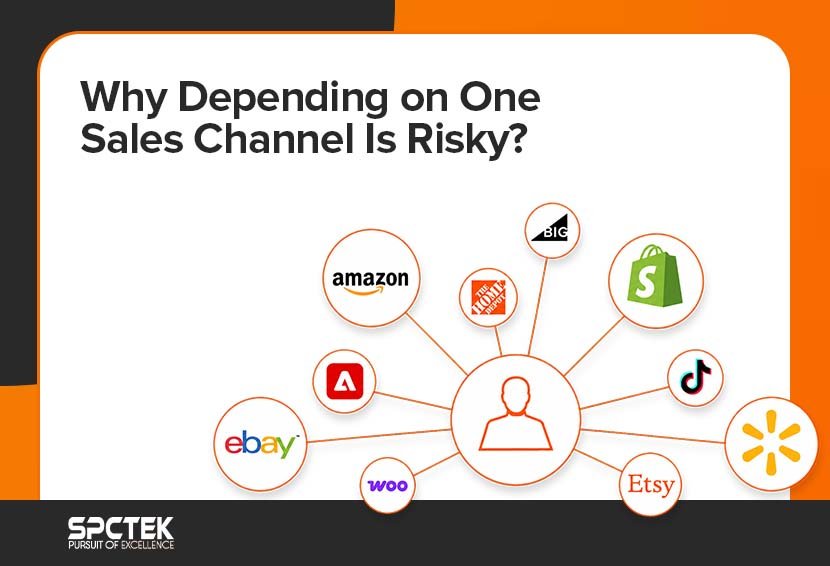
Why Is Relying on One Sales Channel Risky for E-commerce Brands?
Relying on one sales channel is risky because you don’t control the rules, the algorithm, or the fees on someone else’s platform. When a marketplace changes its policy, raises its fees, or tweaks its search algorithm, your revenue moves with it, and you have no say in the decision.
This is the core idea behind a multichannel e-commerce strategy. Spreading your sales across more than one platform so no single company can flip a switch and take your income with it. Three things make single-channel selling fragile:
- Algorithm dependency: Your visibility is decided by a system you don’t control and can’t see inside. One update and your best-selling product disappears from page one.
- Revenue fragility: If your only channel has a bad month, so does your business. There’s no second engine to lean on.
- Limited reach: Different buyers shop in different places. Staying on one platform means you’re invisible to everyone who shops somewhere else.
Research from Mirakl found that sellers active on multiple channels generate over $10 million in GMV on average, compared to just $575,000 for single-channel sellers. That’s not a small gap. It’s the difference between a business and a side hustle.
Is It Risky to Sell Only on Amazon?
Yes, selling only on Amazon is risky, not because Amazon is a bad platform, but because it means one company controls 100% of your revenue, your customer data, and your ability to reach buyers.
Amazon is still the best place to start for most sellers. The traffic is real, the trust is built in, and the fulfillment network is hard to beat. The problem isn’t using Amazon. The problem is using only Amazon.
Among the pain points sellers doing $200K–$500K a month report most often, single-channel dependence on Amazon shows up for close to half of them (47%). That’s almost 1 in 2 sellers in this revenue range who know they’re exposed but haven’t taken the first step to fix it. Usually, it’s because Amazon is working, and it feels risky to take time and budget away from something that’s already making money. That thinking is understandable, but it’s also how sellers end up with no plan B when something goes wrong.
What Happens If Your Main Sales Channel Disappears?
If your main sales channel disappears, your sales stop immediately, your cash gets held for weeks, and getting back online can take anywhere from a few days to several months, depending on why you were suspended.
Here’s what that actually looks like on Amazon right now. Over 2,000 sellers are suspended from Amazon every month. Since February 2026, Amazon has also rolled out an AI system called Risk-Shield that scans seller accounts for risk signals before a human even looks at the case. That means accounts can now get flagged automatically, sometimes before you’ve done anything you’d call a mistake.
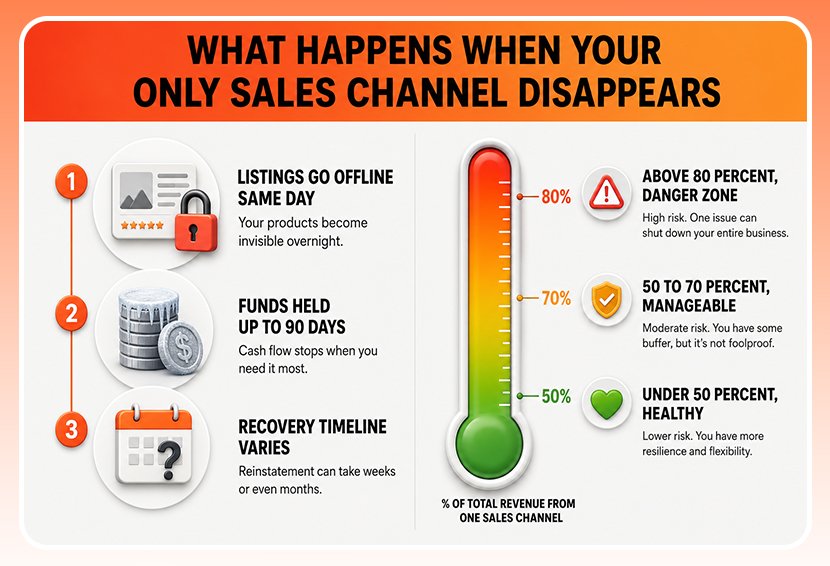
When a suspension hits:
- Your listings go offline the same day: No grace period, no warning window in most cases.
- Your funds get held: Funds often get held for at least 60 days after deactivation and can stretch up to more than 3 months to cover potential refunds and claims.
- Recovery timelines vary wildly: Simple performance issues might clear up in a couple of days. Anything tied to account authenticity or “related account” flags can take months, and in rare cases, never gets resolved.
If Amazon is your only channel, all of this happens with zero backup. If you read about how to recover from an Amazon suspension, you’ll notice the advice always assumes you have time and cash reserves to wait it out. Multichannel sellers have that cushion. Single-channel sellers usually don’t.
What’s the One Metric That Tells You If You’re Too Dependent on One Platform?
The metric to watch is simple: what percentage of your total revenue comes from a single sales channel. If one platform makes up more than 70–80% of your revenue, you’re carrying ecommerce platform risk at a level that should worry you.
Most sellers have never actually calculated this number. It sounds obvious once you say it, but very few brands track it as a KPI the same way they track ACoS or conversion rate. Here’s a rough way to read it:
- Under 50% from one channel: You’re in a healthy spot. A bad month on one platform won’t sink the business.
- 50–70% from one channel: Manageable, but worth actively working on before it climbs higher.
- Above 80% from one channel: This is the danger zone. One policy change or suspension puts the whole business at risk.
If you’ve never worked this number out, take five minutes and do it this week. It’s the single clearest signal of how exposed your business really is.
What’s the Difference Between Omnichannel and Multichannel Ecommerce?
Multichannel means selling on more than one platform. Omnichannel means those platforms are connected, so a customer’s experience feels the same whether they’re buying from your website, Amazon, or your Instagram shop.
People mix these two terms up constantly, so here’s the plain version:
- Multichannel: being present in more than one place. Amazon, Walmart, your own Shopify store. Each one can run somewhat independently, with its own pricing, inventory tracking, and marketing.
- Omnichannel: connecting all of those places so they talk to each other. Inventory syncs automatically, customer data flows between channels, and the shopping experience feels unified no matter where someone buys.
For most sellers reading this, multichannel is the right starting point. You don’t need a fully unified system on day one. You need to stop depending on one platform. Omnichannel is the upgrade you build toward once multichannel is already working.
How Do You Build a Successful Multichannel E-commerce Strategy Without Spreading Too Thin?
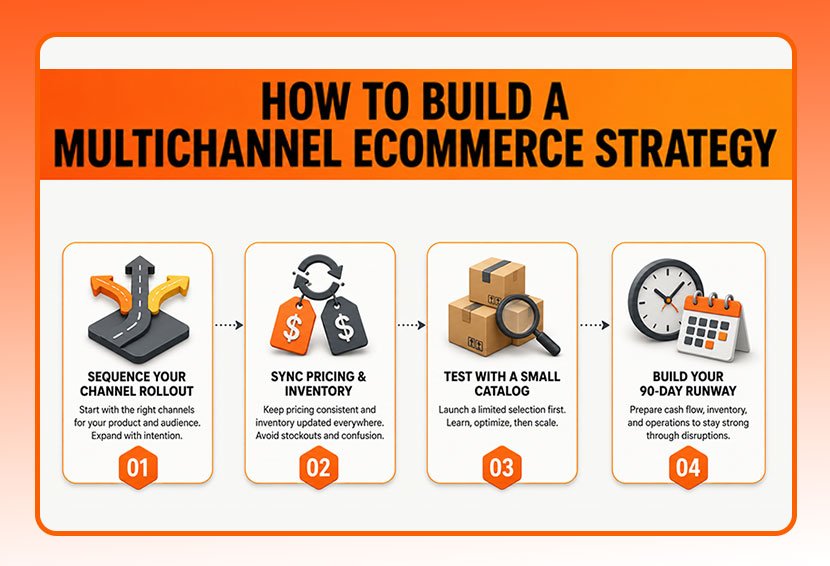
A strong multichannel e-commerce strategy isn’t about being everywhere at once. It’s about adding one channel at a time, based on your current revenue and what your product actually needs, not jumping onto every platform in the same month. Don’t launch three at once. A slow, sequenced rollout beats a rushed one every time, and it’s the difference between a real strategy and a scramble.
This is where most advice online falls apart. “Just diversify” isn’t a plan, and neither is copying whatever multichannel selling strategies worked for a seller in a completely different category.
1. Sequence Your Channel Rollout by Revenue Stage and Product Type
Where you start depends on your current revenue and what you sell, not on which platform sounds most exciting. If you’re doing $200K–$350K/month on Amazon, start with Walmart, the closest thing to Amazon in buyer intent and fulfillment logistics, since WFS mirrors FBA closely and the seller base is smaller. See how Walmart and Amazon actually compare before you commit.
If you’re doing $350K–$500K/month, add a Shopify store. It’s the one channel that’s fully yours, no referral fees, no algorithm to please, and it’s where your email and SMS marketing actually pays off since you own the checkout. If your product is visual or trend-driven, test TikTok Shop early; Spark Ads and UGC-style content perform well here, and it reaches a younger audience that Amazon search doesn’t touch. And if you sell handmade, vintage, or niche category products, eBay or Etsy can be a faster win than Walmart, since the audience is already primed for those categories. Here’s how eBay and Amazon compare if you’re deciding between the two.
2. Keep Pricing and Inventory in Sync Across Every Channel
A successful multichannel ecommerce strategy falls apart fast if a customer finds your product cheaper on Walmart than Amazon, or your Shopify store shows an item in stock that sold out on Amazon an hour ago. Price mismatches get flagged by Amazon’s repricing algorithms and can cost you the Buy Box even when the discrepancy is unintentional. Inventory mismatches create refunds, bad reviews, and customer service headaches you don’t need while you’re still learning a new platform. Most sellers underestimate this until they’re running two or three channels and realize spreadsheets can’t keep up, which is usually the point where a basic multichannel inventory tool earns back its cost in the first month alone.
3. Test With a Small Catalog Before Committing Full Budget
Launch a new channel with your 5 to 10 best-selling, cleanest-listing ASINs, not your full catalog. This keeps the operational lift manageable while you learn a platform’s fulfillment quirks, return policies, and customer expectations, and it gives you real performance data before you’ve sunk real money into the channel. Expanding the catalog once the first batch is profitable is a much lower-risk move than launching everything at once and discovering three months in that half your listings needed rework you didn’t budget for.
4. Give Each New Channel Its Own 90-Day Runway Before Judging It
Every new channel looks slow in the first month, since Walmart, Shopify, and TikTok Shop all reward accounts and listings with a track record, not brand-new ones. Judging a channel’s viability inside the first 30 days is one of the most common reasons sellers give up on multichannel selling strategies too early and go right back to being fully dependent on Amazon. Give a new channel a full quarter before deciding whether it’s working, long enough to build some listing history, run a real ad test, and see if repeat customers start showing up.
Why Does an Email List Matter More Than Social Media Followers?
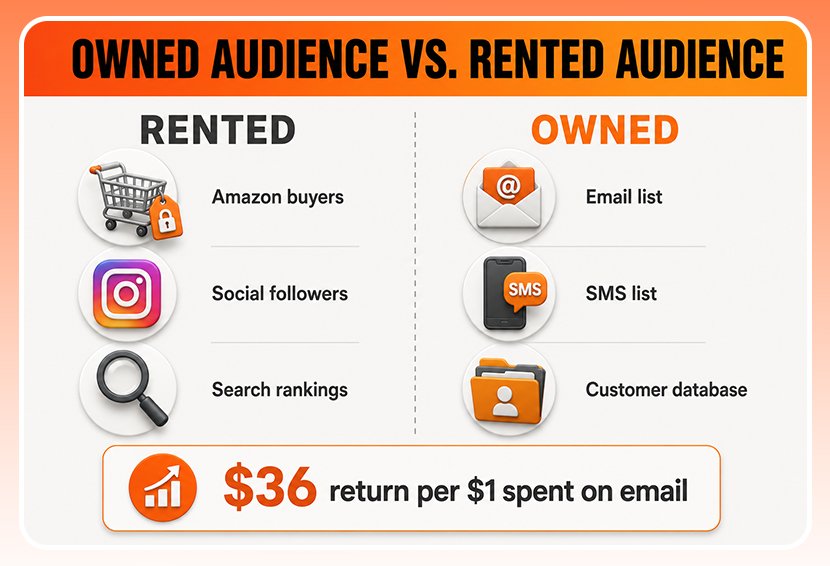
An email list matters more because you own it. A social following, an Amazon storefront, and search rankings are all rented space, controlled by a platform that can change the rules or shut off your access at any time.
This is the real idea behind owned audience vs rented audience marketing. Split your channels into two buckets:
- Rented audience: Amazon buyers, Instagram followers, Google rankings. You’re borrowing access. The platform decides who sees you and what it costs to reach them.
- Owned audience: Your email list, your SMS list, your customer database. Nobody can take this away from you, and nobody charges you more each year just to keep reaching the same people.
The numbers back this up. Email marketing returns roughly $36 for every $1 spent on average. That’s a return most paid channels can’t touch, especially as ad costs keep climbing. And a Harvard Business Review study found that 73% of online shoppers research across multiple channels before buying, which means the brand that shows up in someone’s inbox after they’ve browsed your Amazon listing has a real edge over one that doesn’t.
If your entire customer relationship lives inside Amazon’s messaging system, you don’t actually have a relationship with your customer. Amazon does.
How Do You Build First-Party Data as an E-commerce Brand?
None of this needs to be complicated on day one. Start with the insert card and one email flow. That alone puts you ahead of most sellers who are still 100% dependent on Amazon’s rented audience.
Here’s where to start, in order of effort:
- Insert cards with a QR code: Drop one in every package that links to a simple offer, a discount, a warranty registration, or a bonus guide in exchange for an email or phone number.
- Post-purchase email and SMS flows: Once someone buys, don’t let that be the last time you talk to them. A simple thank-you sequence with a next-purchase offer keeps the relationship alive.
- A basic loyalty or rewards program: Even something simple gives people a reason to hand over their email and come back to your own site instead of searching for you on Amazon again.
- Your own storefront (Shopify): This is the single best first-party data engine you can run, since every checkout captures a real customer record you control.
Conclusion
Nobody plans to lose their whole business over an email from Amazon’s compliance team. But it happens every month to sellers who never got around to building anything outside that one platform, because things were going fine, and there never seemed to be a good time to start. The truth is, there’s rarely a perfect time. The right time is before something forces your hand.
Diversifying doesn’t mean walking away from Amazon. It’s still the strongest channel most sellers have, and it should stay your main focus. What it means is making sure Amazon isn’t the only channel with your name on it. Start with one number: what percentage of your revenue sits on one platform? Then start with a second channel, an email list, an insert card, whatever fits your stage. The sellers who scale their business to $1M a month don’t avoid risk completely, but they stop carrying all of it in one place.