
Too busy to read? Listen to this article instead.
Q4 decides the year for most Amazon sellers. It’s not just that the holidays bring more shoppers, though they do. It’s that everything that goes wrong in Q4 goes wrong at the worst possible time. A missed inventory deadline in September becomes an out-of-stock listing during Black Friday. A campaign left untouched since summer starts bleeding budget the moment competitors turn on their holiday bids. Prepare for Amazon Q4 early enough, and the same traffic surge that sinks unprepared sellers becomes the single biggest revenue push of the year.
This covers the actual 2026 dates sellers need to know, the 60-day window before Black Friday that determines how the whole quarter goes, and the specific Q4 planning, advertising, and inventory that separates a seller cruising through Amazon FBA Q4 from one scrambling through it.
What Is Amazon Q4?
Amazon Q4 runs October 1 through December 31 and covers the busiest, highest-traffic stretch of the entire Amazon calendar. It includes Prime Big Deal Days in early October, Halloween at the end of October, Black Friday and Cyber Monday over Thanksgiving weekend, and the full holiday shopping run through Christmas and into the last week of December. For Amazon Q4 for sellers, this stretch alone can carry more weight than the rest of the year combined.
Unlike Prime Day, which is a single scheduled event, Q4 behaves more like one long, escalating demand curve. Traffic builds through October, spikes hard across Black Friday week, holds through December, and only tapers after Christmas. Sellers who treat Q4 like a handful of isolated sale days tend to miss the bigger picture. The inventory, advertising, and account decisions made in August and September are what actually determine how big that November-December spike turns out to be. That’s the core of Q4 planning, which starts months before the traffic ever shows up, and it’s exactly why a Q4 sales plan built in July looks completely different from one thrown together in October.
What Are the Amazon Q4 2026 Event Calendar and Deadlines
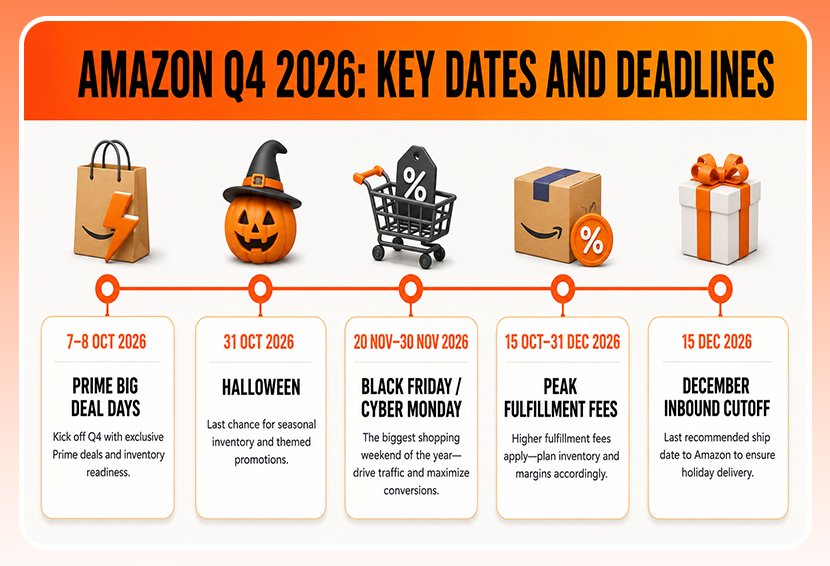
Prime Big Deal Days hit early October, with deadlines due in September. Halloween offers an early Q4 demand signal. Black Friday/Cyber Monday (Nov 27–30) needs submissions by October 20 and inventory by late October. Peak fulfillment fees run from October 15 to January 14. FBA’s Christmas cutoff is around December 19. Amazon’s also changing Featured Offer eligibility this month. These are the dates every Q4 action plan needs to be built around, so here is a breakdown of the events.
1. Prime Big Deal Days (expected early October, likely October 7-8)
Amazon hasn’t confirmed the exact 2026 dates yet, but the event has landed in early October each of the past several years. Deal submissions are open now, from July 8 through September 8. Submitting by August 5 saves $50 on the upfront promotion fee. To keep Prime-badge eligibility, inventory needs to arrive at Amazon by September 2 for AWD shipments, September 9 for FBA shipments using minimal shipment splits, or September 16 for FBA shipments using Amazon-optimized shipment splits, the option most sellers use.
2. Halloween (October 31)
Not an official Amazon sale event, but a real demand spike for costumes, decorations, candy, and party supplies. An estimated 40 percent of Halloween purchases now happen online, and sellers in gift-adjacent or seasonal categories often use a strong Halloween showing as the first read on how Q4 demand is trending.
3. Black Friday Week and Cyber Monday (November 20 – December 1)
Black Friday falls on November 27, 2026, and Cyber Monday on November 30, the two highest-traffic shopping days of the year on Amazon. Deal submissions are open from July 8 through October 20, and submitting by September 5 saves the same $50 on the promotion fee. Inventory needs to arrive by October 14 for AWD shipments, October 21 for FBA minimal-split shipments, or October 28 for FBA Amazon-optimized split shipments to guarantee availability for the event.
4. Holiday Peak Fulfillment Fees (October 15, 2026 – January 14, 2027)
Amazon’s peak fulfillment surcharge applies across this entire window for FBA, Remote Fulfillment, Multi-Channel Fulfillment, and Buy with Prime. The increase averages $0.32 per unit over standard rates, with a 3.5 percent fuel and logistics surcharge on top. Sellers need to build this into their Amazon FBA Q4 margin calculations now, not discover it in the October invoice.
5. December Shipping Cutoffs
Based on historical patterns, the last FBA order date for guaranteed Christmas delivery typically falls around December 19. After that, sellers with low FBA stock often shift remaining demand to FBM to avoid missing last-minute orders entirely.
One more 2026 change worth tracking is that Amazon is rolling out a policy that removes certain seller eligibility requirements for the Featured Offer position, starting this month, completing globally by the end of 2026. No action is required, but it’s a meaningful shift in how competitive placement works heading into Q4, worth watching for how it affects Buy Box dynamics during peak.
The 60-Day Amazon Q4 Action Plan for 2026
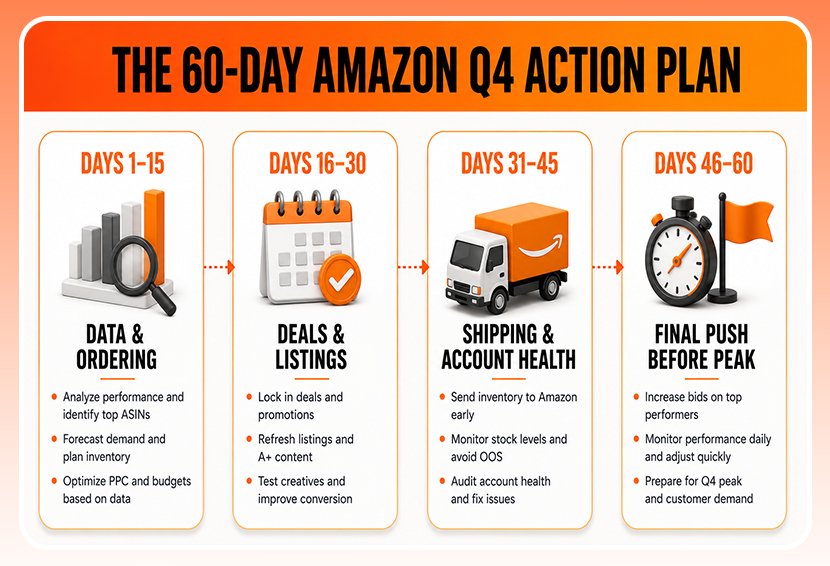
Starting mid-July gives sellers a real 60-day runway before the two biggest inventory deadlines of the season hit. Here’s what each phase of this Q4 action plan actually requires to reach a million in revenue, broken down week by week instead of just top-line goals.
Days 1-15 (Mid-Late July): Data and Ordering
Pull last year’s Q4 sales data by ASIN, not just at the account level. Look at unit velocity during Prime Big Deal Days, Black Friday week, and December separately, since a product that spikes hard on Black Friday might barely move during Prime Big Deal Days, and treating them the same wastes budget on the wrong week. This is the foundation of any real Q4 sales plan, since guessing at volume instead of measuring it is where most prep work goes wrong first.
Calculate this year’s inventory multiplier from that data. Most sellers see Q4 volume run at 2 to 3 times their normal monthly average, though top-performing ASINs and gift-category products often see higher spikes. Build the multiplier per ASIN, not as one flat number across the whole catalog.
A data-driven inventory forecast is the most crucial part of preparing for Amazon Q4. Place inventory orders with suppliers immediately once the multiplier is set, factoring in real production and freight lead times, not the lead time you wish you had. This is the single most common Q4 failure point. A stockout during Black Friday week can’t be fixed by reordering, since new inventory won’t arrive until the peak has already passed and the sale is over.
Start early keyword research for holiday search terms in your category. Amazon’s autosuggest starts surfacing seasonal terms weeks before shoppers actually search them in volume, and catching that shift early means your backend terms and campaigns are ready before competitors update theirs.
Days 16-30 (Late July-Early August): Deals and Listings
Submit Prime Big Deal Days deal applications before August 5 to lock in the discounted upfront promotion fee, a $50 savings per deal that disappears the moment the early window closes. Submitting early also means the deal gets reviewed and approved with time to fix rejections, instead of scrambling in September.
Finalize listing refreshes for every ASIN going into Q4:
- Update main images with subtle seasonal cues, warm lighting, gift-appropriate framing, without breaking Amazon’s image guidelines
- Revise titles and bullets to include natural holiday phrasing where it fits the product, not forced into every listing regardless of category.
- Refresh A+ content and backend search terms so Amazon’s algorithm has time to index the changes before October traffic arrives.
Listings updated the week of an event rarely rank as well as ones that have had a few weeks to settle, so this work needs to land now, not in September.
Audit your Sponsored Brand and video ad creative now. These formats take longer to produce than Sponsored Products campaigns, and holiday-specific versions, gift bundles, and seasonal banners need to be ready before the ad calendar gets tight in September.
Days 31-45 (Early-Mid August): Shipping and Account Health
Ship inventory toward the September Prime Big Deal Days deadlines:
- September 2 for AWD shipments
- September 9 for FBA shipments using minimal shipment splits
- September 16 for FBA shipments using Amazon-optimized shipment splits, the option most sellers use
Ship in one consolidated batch where possible rather than splitting shipments across these three windows, since a single well-timed shipment is easier to track than several partial ones arriving at different cutoffs.
Run a full account health check now, not in November. Check these four numbers specifically:
- Order Defect Rate
- Late Shipment Rate
- Valid Tracking Rate
- Any open policy notifications in Seller Central
A suspension risk caught in August is a fixable problem with weeks of runway. The same issue discovered in November can cost the entire peak season, since Amazon’s review process doesn’t move faster just because it’s Q4.
Begin warming up PPC campaigns tied to your holiday keyword research from Days 1-15. Increase budgets gradually, 10 to 20 percent every few days, rather than all at once, so Amazon’s algorithm has time to learn which keywords convert before the real spend increases hit in October.
Days 46-60 (Late August-Mid September): Final Push Before Peak
Submit Black Friday Week and Cyber Monday deal applications before September 5 for the same early-bird fee discount. The submission window itself stays open through October 20, but waiting past the discount deadline means paying full price for the same deal slot.
Use Prime Big Deal Days performance, once the event runs in early October, as a live signal rather than waiting for Black Friday to test anything. Which ASINs converted best, which campaigns held ACoS under target, and which keywords actually drove sales all become real data points here instead of guesses, and that data should directly shape where Black Friday budget gets weighted, the same logic behind any solid Q4 action plan.
Finalize and ship the bulk of Black Friday and Cyber Monday inventory toward the October deadlines:
- October 14 for AWD shipments
- October 21 for FBA shipments with minimal splits
- October 28 for FBA shipments with Amazon-optimized splits
Build in buffer time here specifically, since October freight and warehouse congestion tends to run heavier than September’s.
Recalculate your break-even ACoS one more time before Black Friday, factoring in the holiday peak fulfillment fees that apply from October 15 through January 14, averaging $0.32 per unit on top of standard rates, plus a 3.5 percent fuel and logistics surcharge. Margin that looked fine in July can look very different once these fees are actually applied to Q4 volume, and this is the last checkpoint to catch that before the biggest spend of the year begins.
How to Prepare for Amazon Advertising in Q4: Amazon Seller Tips for Q4
Q4 advertising works differently, and coasting on the same budgets and targeting is a common way sellers lose money. Scale PPC early, refresh listings with holiday keywords and A+ content, use Prime Big Deal Days to preview November demand, and watch dayparting closely on BFCM so budgets don’t run dry before the evening surge.
1. Scale Budgets Ahead of Demand, Not in Reaction to It
A common pattern is increasing PPC budgets by roughly 40 to 60 percent starting in early November and holding that through the Black Friday-Cyber Monday window, then adjusting again for the final December push. Waiting until Black Friday morning to raise budgets means missing the pre-event research traffic that starts building the week before. A PPC specialist can help build this scaling plan before the ramp starts rather than during it.
2. Refresh Listings Before the Traffic Arrives, Not During It
Listings need holiday-relevant keywords, imagery, and A+ content refreshed before the traffic arrives, not during it. Buyers searching in November are searching differently than they were in August, and a listing still running summer-season imagery or generic keywords loses conversion share; it never gets back during the shortest, highest-value selling window of the year. Refreshing A+ content is one of the fastest wins here.
3. Use Prime Big Deal Days as a Stress Test
Prime Big Deal Days functions as a live stress test for Black Friday and Cyber Monday. Whatever converts well in early October is a strong signal for which ASINs deserve the heaviest ad investment in November, rather than spreading budget evenly and hoping.
4. Daypart and Monitor in Real Time
Dayparting and real-time monitoring matter more here thanat any other time of year. On Black Friday and Cyber Monday specifically, campaigns can exhaust their daily budget by early afternoon if they’re not actively managed, missing the evening traffic surge that often converts at a higher rate than the morning rush. Getting a clearer read on what actually drives ad costs up makes this budget planning far more accurate going in.
Conclusion
The same structural issues that cap a seller under $500K get magnified at Q4 volume. A slightly inefficient PPC account becomes a much bigger leak once budgets triple in November. An account health issue that’s normally a quick fix can wipe out the most valuable 10 days of the year if it surfaces during Black Friday week. A listing that hasn’t been refreshed loses share right when the first-time buyers of the year are searching.
None of this takes a different product or a bigger budget than competitors already have. Scaling past a million in Q4 takes having the inventory, advertising, and account health work done before October traffic arrives, since there’s no room to fix problems once Q4 starts. Get the four stages of this Q4 action plan right, and the rest of Amazon FBA Q4 takes care of itself.