
Too busy to read? Listen to this article instead.
You’ve probably watched a competitor go from nothing to seven figures on TikTok Shop in what felt like a few weeks, while your own account sits at a few thousand views per video and a TikTok Ads Manager dashboard that never quite adds up. TikTok clearly works for e-commerce brands. TikTok Shop’s US sales grew 108% year over year in 2025, and its global GMV is projected to hit $112.2 billion in 2026.
So the platform isn’t the variable. Brands on TikTok are working with the same algorithm, the same ad formats, and often similar budgets. What actually separates the winners is having a real TikTok strategy for brands, not a handful of disconnected tactics, built on a few specific decisions made early and made correctly.
What Separates Brands That Blow Up on TikTok From the Ones Wasting Their Budget?
Pull apart any account that’s actually scaled on TikTok, and you’ll find the same four decisions made correctly, usually all at once:
- They know when to lean organic versus when to put paid dollars behind something
- Their creative is built for the format instead of repurposed from Meta or YouTube
- They measure what spend is genuinely adding, not just what the dashboard reports
- They treat TikTok Shop as its own channel with its own rules, not a smaller Amazon
Accounts stuck under a plateau usually have one or two of these right and stop there. A strong TikTok strategy for brands treats all four as one connected system, not four separate boxes to check. That’s the thread running through everything below.
What’s the Real Difference Between Organic and Paid TikTok Marketing?
This is the first fork, and it’s where the gap usually starts. On most platforms, paid is the engine and organic is a nice-to-have. On TikTok, the brands that blow up run it in reverse, and understanding how content marketing and social media marketing actually work together makes the reasoning easier to follow.
Winning accounts use organic as the testing lab. Every post tells them something: which hook worked, which format the algorithm pushed, which topic their audience actually cared about. It costs nothing but time, and it’s the only place that signal comes from.
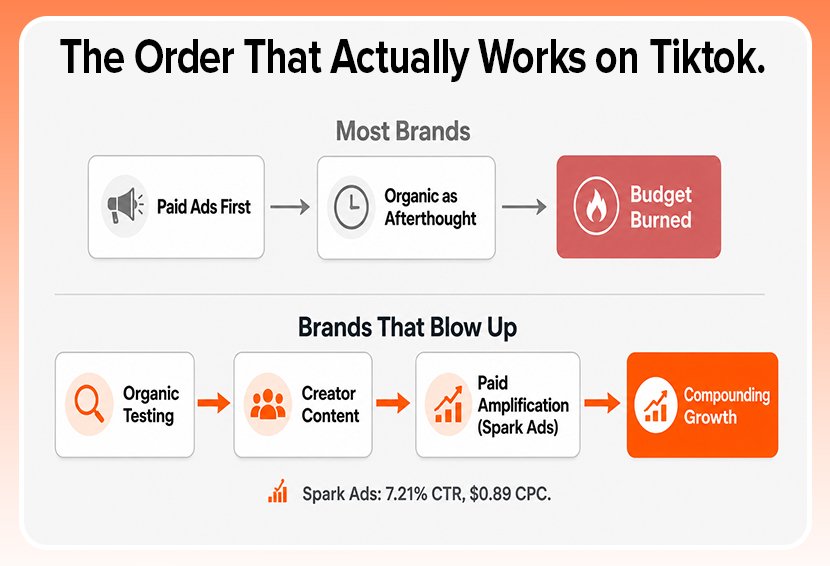
Losing accounts skip straight to paid and hope targeting settings can substitute for actual audience data. The organic vs paid TikTok marketing differences show up starkly in the numbers. Spark Ads, which boost content already proven organically, post the highest click-through rate of any TikTok ad format at 7.21%, with the lowest cost per click at $0.89. A polished, studio-shot ad with no organic testing behind it rarely comes close.
The practical version of TikTok organic vs paid is to post organically first, watch what performs, then put paid dollars behind the winners. Brands treating TikTok like a paid-media-only channel are paying full price to find out what a week of free organic testing would have told them anyway.
What Are the Top-Performing Creative Strategies for TikTok Ads Right Now?
Same platform, same ad formats, wildly different results, and the gap almost always comes down to creative strategy, not budget. The brands blowing up have figured out what actually makes an ad feel worth watching instead of worth skipping, and the ones stuck are still making TikTok content the way they’d make a Meta ad.
Winners lean into content that looks raw and native. TikTok’s average engagement rate sits between 3.85% and 4.90%, nearly eight times higher than Instagram’s, and brands using handheld, real-feeling video over studio production tend to see that number roughly double. Losers reuse the same polished ad they already ran on Meta, and it flops here because the audience can spot it as an ad on sight.
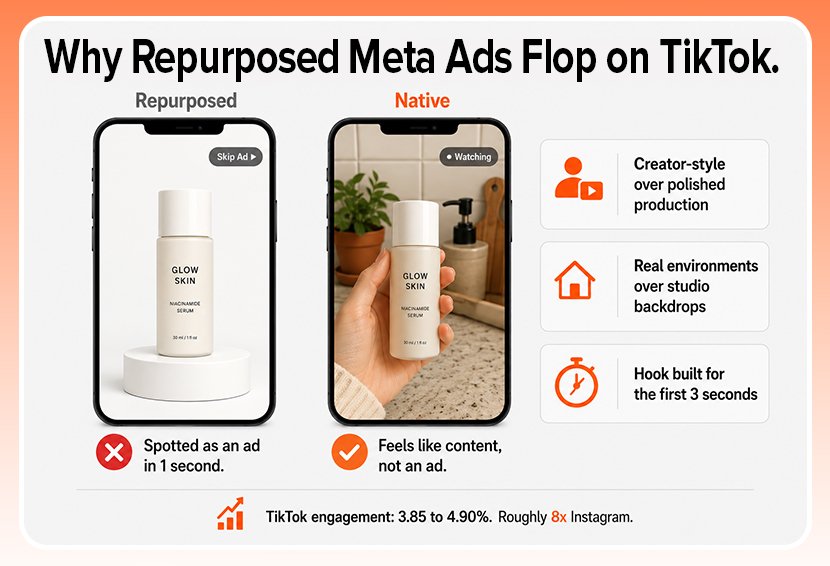
The top-performing creative strategies for TikTok ads all share the same three traits:
- Creator-style content over polished production: The ad shouldn’t look like an ad. It should look like something a real person filmed on their phone, because that’s exactly what gets treated as trustworthy content instead of something to scroll past.
- Quick cuts and real environments instead of studio backdrops: A kitchen counter, a car, a bedroom, anywhere that looks lived-in outperforms a clean white-background product shot, because it matches what the rest of the feed already looks like.
- A hook built for the first three seconds: This window decides whether someone keeps watching or scrolls past, and it’s the single highest-leverage three seconds in the entire ad. TikTok’s own platform guidance recommends front-loading the hook within the first six seconds, and the strongest-performing creative treats that window as the whole pitch, not a warm-up before the real message starts.
Format choice reinforces the strategy, but it’s secondary to the creative itself. Per WebFX‘s 2026 benchmark data, TopView ads, the full-screen placement users see the moment they open the app, post view rates between 12% and 16%, making them the strongest format for pure visibility. In-Feed videos, the standard and most affordable format, sit closer to 5%, but they’re the most accessible starting point for a brand just getting going and testing what creative direction actually resonates before committing budget to a bigger placement.
None of this means production quality is optional. It means the quality that matters on TikTok looks different than what wins on Instagram or YouTube, which is part of why choosing UGC over polished creator content is its own decision worth thinking through rather than an afterthought.
Where Does Most TikTok Ad Spend Actually Go to Waste?
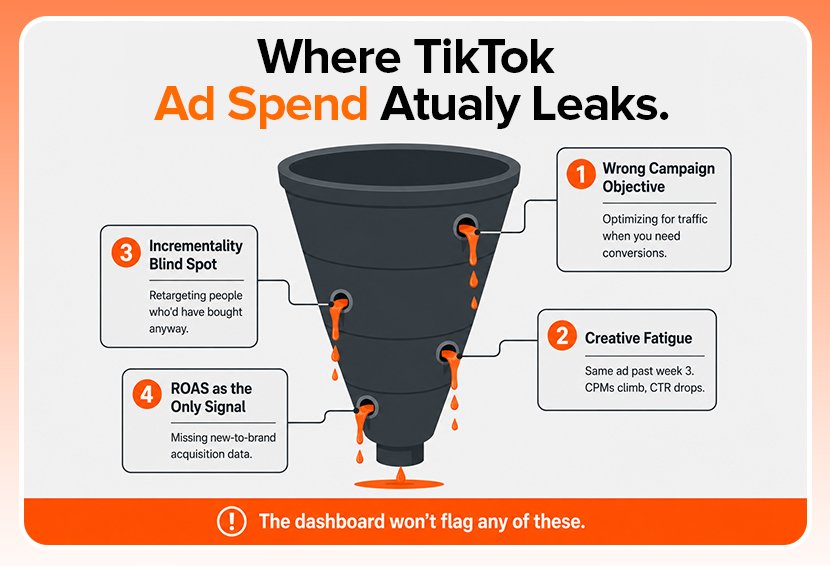
This is the one most accounts never diagnose, because the dashboard doesn’t flag it. A campaign can post a reasonable ROAS and still be quietly bleeding money in ways that only show up once someone digs past the summary numbers, the same way ad spend can climb on Amazon for months before anyone actually reviews it. This is also where the gap between a real TikTok strategy for brands and a handful of disconnected tactics shows up most clearly, since spend without a system behind it tends to leak in the same four places.
Leak 1: The wrong campaign objective: A brand chasing conversions with a campaign optimized for traffic, or the reverse, is paying TikTok’s algorithm to optimize for a goal that isn’t the actual goal. The report looks fine. The business result doesn’t.
Leak 2: Creative fatigue nobody’s watching for: TikTok audiences move through content fast, and the same ad that converted well in week one can see CPMs climb and CTR drop by week three simply because the audience has seen it too many times. Losing accounts blame targeting when the real problem is stale creative. Winning accounts rotate creative weekly or biweekly as a standing habit, not a reaction, which is exactly why top-performing creative strategies for TikTok ads treat rotation as part of the strategy, not an afterthought once numbers start slipping.
Leak 3: Incrementality, the leak that’s hardest to see: A branded search campaign or a retargeting ad running to people who already knew the brand can post a fantastic ROAS while doing very little to actually grow revenue, since a meaningful share of those buyers would have converted without the ad.
Leak 4: Measuring ROAS as the only signal: Brands genuinely scaling on TikTok track new-to-brand customer acquisition and incremental lift alongside ROAS, not instead of it. Brands stuck under a plateau look at one number, see it’s acceptable, and never go looking for where the other three leaks are quietly eating the difference. This is where a real TikTok brand strategy earns its keep: the ROI isn’t in spending more, it’s in catching these four leaks before they compound.
Are There Any Common Challenges When Selling on TikTok Shop?
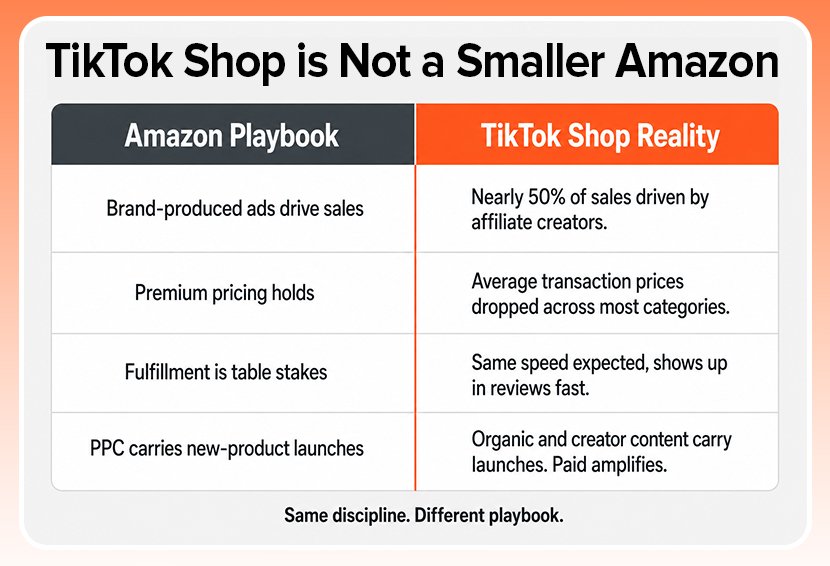
TikTok Shop’s in-app checkout removes almost every point of friction between seeing a product and buying it, and conversion rates on the platform generally run in the 3% to 5% range as a result. That upside is real. But most of the friction brands on TikTok hit here traces back to one root cause, treating TikTok Shop like a smaller version of Amazon instead of its own thing with its own rules.
The common challenges:
- Creator sourcing: TikTok Shop runs largely on affiliate creator content, not brand-produced ads. Nearly half of all platform sales are driven by creators who don’t own the products they’re promoting.
- Pricing pressure: Average transaction prices on TikTok Shop dropped across most categories over the past year, reflecting the platform’s pull toward impulse-friendly, lower-priced products.
- Fulfillment expectations: TikTok Shop buyers expect the same speed and reliability Amazon trained them for. Brands that treat fulfillment as an afterthought see it show up fast in reviews and repeat purchase rates.
None of these are reasons to avoid the platform. They’re just proof that a real TikTok brand strategy here needs its own playbook, not a copy-paste of what already works on Amazon.
How Can You Increase Sales on TikTok Shop?
Fixing the challenges above comes down to building a real system instead of posting occasionally and hoping something sticks:
- Run structured creator programs through influencer and UGC marketing instead of one-off gifting
- Test live shopping sessions, since these convert several times higher than standard video content
- Turn top-performing organic content into paid Spark Ads that point straight to the shop listing, not an external site
That loop, organic proof, creator content, paid amplification, and in-app purchase, is what separates the brands compounding on the platform from the ones still figuring it out. Getting this system running well is usually where a dedicated TikTok agency for brands earns its keep, since it takes real bandwidth to manage creator sourcing, content testing, and paid amplification all at once. It’s also exactly the kind of diversification that matters once a brand is trying to grow past where Amazon alone can take it, the same logic behind expanding onto Walmart or Shopify once Amazon growth flattens out.
How Do You Grow a Brand on TikTok From Scratch?
Starting from zero on TikTok looks different than starting from zero on Amazon, and the sequencing is what most new accounts get wrong. This is the practical version of a broader TikTok strategy for brands, and the order is organic, then creators, then paid. Skipping ahead is what burns budget on unproven creative.
Step 1: Post for volume and signal, not perfection
Three to five posts a week tends to outperform daily posting with lower-quality content, since the goal here is data, not a viral hit. Every post is a small test: which hook stops the scroll, which format the algorithm pushes into more feeds, which topic actually holds attention past the first few seconds. Watch completion rate and shares instead of raw view count, since those are what tell you a piece of content is genuinely working rather than just getting served to a few thousand people once and going nowhere. This is really where TikTok organic vs paid decisions get made, since nothing paid should launch until organic has already told you what’s worth amplifying.
Step 2: Bring in creators once traction shows
TikTok’s Creative Center and its affiliate marketplace make it possible to find creators already active in your category, rather than cold-pitching strangers who have no context for the product. Starting with 8 to 15 micro-creators tends to outperform betting everything on one or two bigger names, both on cost and on the range of creative angles you get back. A single large creator gives one interpretation of the product. A group of smaller creators gives a dozen different hooks and use cases to test, which becomes the raw material the next step builds on.
Step 3: Let paid amplify proven content, not carry the account
Once organic and creator content have already shown what works, paid budget goes toward pushing that content further, not toward untested creative hoping to get lucky. Spark Ads are the tool for this, since they run directly off existing organic or creator posts instead of requiring separate ad creative built from scratch. A video that already has strong watch time and engagement as an organic post tends to convert well as a paid ad too, because the proof of performance already exists before a single paid dollar gets spent on it. This staged approach is one of the top-performing creative strategies for TikTok ads precisely because it removes the guesswork paid campaigns usually start with.
What Are the Best TikTok Shop Agencies for DTC Brands?
Picking the wrong TikTok Shop partner is expensive twice over, once in wasted retainer, and again in the months lost before a brand realizes the agency never understood the platform. Here’s how the space actually breaks down right now.
When evaluating any of these, the questions that actually matter are whether they hold official TikTok partner status, whether they’ve worked with brands coming from an Amazon-heavy background specifically, and whether their model treats organic, creator, and paid as one connected system rather than three separate line items on an invoice.
1. SPCTEK
SPCTEK is an official TikTok Shop partner, which means the storefront setup, creator sourcing, and Spark Ads work happen with direct platform-level access instead of working around it. For DTC brands already running a tight operation on Amazon, that matters more than it sounds, since the same organic-to-creator-to-paid system covered above needs a team that’s actually built it before, not one learning the platform on a client’s budget. This is also the team already inside the account for PPC, listings, and expansion strategy, so TikTok Shop becomes one more channel in a connected system instead of a disconnected vendor relationship.
2. AdQuadrant
AdQuadrant is a certified TikTok Shop Preferred Partner, closely aligned with high-growth DTC brands. Their positioning leans into brands that are past the early testing phase and ready to treat TikTok Shop as a real revenue channel, with partner-level access built into how they run storefront and creative work. A solid fit for brands that want a partner already inside TikTok’s official partner program rather than working through a general agency.
3. MuteSix
MuteSix was one of the earliest agencies to partner with TikTok and has built its reputation around high-volume native content designed to blend in with organic content while still driving purchase intent. As a certified TikTok Shop Agency Partner, they cover the full commerce stack, storefront setup, affiliate creator programs, and Spark Ads. Their tenure on the platform means they’ve watched the format shift through several algorithm changes, which shows up in how deliberately their content avoids looking like a traditional ad.
4. Pattern
Pattern operates as a category-leading enterprise marketplace accelerator across Amazon, Walmart, TikTok Shop, and more, making it a strong fit for brands already running multi-marketplace operations that want one operator across channels. Worth knowing this is a broader marketplace operation with TikTok Shop as one piece, not a TikTok-first specialist, so the depth on creator strategy specifically tends to run lighter than agencies built around TikTok alone.
5. NoGood
ByteDance’s inaugural U.S. growth partner and one of the first TikTok studios established in the American market. Combines organic content strategy with paid amplification, using TikTok’s algorithm to drive top-of-funnel discovery while tracking performance through custom dashboards. Premium pricing, typically $5,000+ to start.
6. AdParlor
AdParlor has run 15,000 campaigns since 2021 and holds certified TikTok Marketing Partner status, combining creator-led content development with paid media buying at real scale. That volume of campaign history gives them a wide enough dataset to spot format and audience patterns faster than a newer agency working with a smaller sample size.
Conclusion
Every brand asking why some accounts blow up on TikTok while others burn through budget is really asking one question with four answers: whether they’re testing organically before spending, whether their creative looks native or looks like an ad, whether they’re measuring incrementality instead of a single ROAS number, and whether they’re running TikTok Shop as its own channel with its own rules. Brands that get all four right compound. Brands that get one or two right and stop there plateau. If you’ve already scaled on Amazon and are wondering what the next channel looks like, this same discipline is what took our clients from $500K to $1M, just applied here instead.
None of it requires a bigger budget than what’s already being spent. It requires spending it in the order that actually works, organic first, creators second, paid third, TikTok Shop treated as its own channel throughout.