

Too busy to read? Listen to this article instead.
Most Amazon sellers who plateau under $500K a month aren’t failing at demand. Their products still sell. Customers still buy, but what’s actually holding them back is structurally rising ad costs, thin margins, listings that stopped keeping up with search, and a business that depends entirely on one platform. How to scale your Amazon business past that ceiling comes down to fixing those structural issues before chasing more traffic.
This guide walks through why the plateau happens, what the data says about sellers who break past it, and the specific changes that separate a $500K account from a $1M one.
Why Do Sellers Get Stuck Under $500K/Month?
Five issues show up again and again in accounts that stall. They rarely show up alone. Most sellers are dealing with two or three at once without realizing it, because from the inside, a plateau just looks like normal, gradual friction.
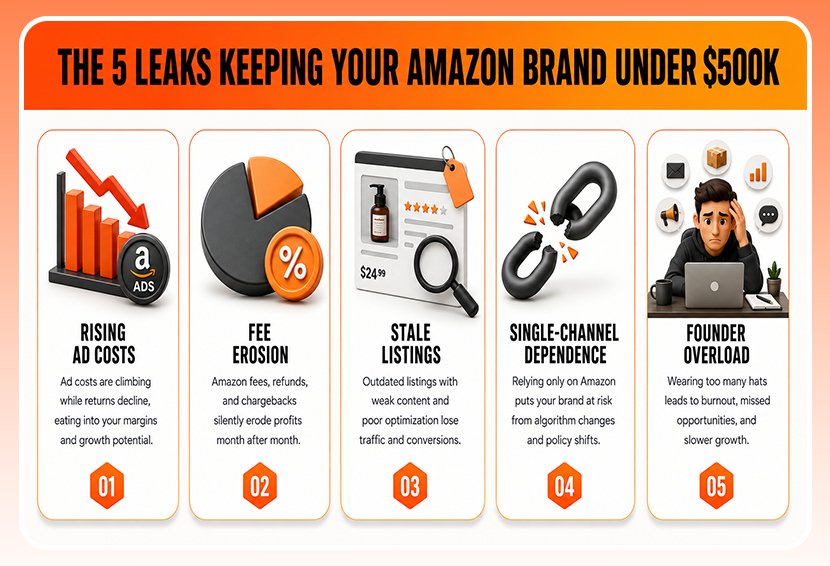
Here is a breakdown of those five issues:
1. Rising Ad Costs That Outpace Sales
This is the most common leak. Ad spend climbs every quarter, but revenue barely moves with it. The usual cause is a campaign structure nobody revisits. Broad match keywords keep pulling budget toward searches that were never going to convert, and bids get set once and left alone while competition and costs rise around them. If your strategies for Amazon business growth don’t include a recurring PPC audit, this is where profit disappears first. A PPC specialist can usually spot the leak within an hour of opening the account, and there are practical ways to lower PPC costs without touching sales volume once it’s found.
2. Fees Eating Into Margin Without Anyone Tracking It
Referral fees, fulfillment fees, storage fees, and ad spend together can run 30 to 35 percent of total revenue for the average FBA seller, according to seller-economics data. Most sellers know these fees exist. Few actually track how much of every sale gets absorbed before it reaches the bank account. For Amazon private label brands, revenue 2026 targets mean anything real like margin needs the same attention as top-line sales. A seller doing $500K at 15 percent margin is in a very different position than one doing the same revenue at 25 percent, even though the top-line number looks identical.
3. Listings That Stopped Evolving
Amazon’s Rufus reads product listings differently than it did even a year ago, and buyer search behavior shifts along with it. A listing that converted well in 2023 can lose relevance without ever getting flagged as a problem, because nothing about it technically “broke.” This is where Amazon business growth organically actually comes from relevance signals that get refreshed on a schedule, not optimized once at launch and left alone. Understanding how Amazon’s AI search reads listings now is basic maintenance, not an advanced tactic, and there are a handful of common, fixable reasons a listing quietly stops converting that most sellers never check.
4. Depending on Amazon as the Only Channel
This is the risk multiplier sitting underneath the other three. When Amazon is 100 percent of revenue, every fee increase, algorithm change, or policy shift lands directly on the business with nowhere else to absorb it. Enforcement has also gotten stricter policy and performance-related account suspensions rose an estimated 12 percent in 2026 as Amazon leaned harder into AI-driven monitoring. A single-channel seller has no buffer when that enforcement lands on their account. Sellers weighing a second channel usually start by comparing Walmart against Amazon before deciding where to expand.
5. The Founder Doing Everything
This one doesn’t show up in a spreadsheet, but it’s just as real. Once a founder is running sourcing, ads, customer service, and listings alone, growth caps out at whatever one person can physically manage in a week. Hiring help or bringing in a specialist for one piece, PPC or account health, usually, frees up enough time to actually work on the business instead of just running it.
How to Scale Amazon Business Past $500K in 2026?
Seven-step action plan for getting past $500k and reaching $1 million in monthly revenue includes fixing break-even ACoS and campaign structure, refreshing listings every 90 days, running weekly account health checks, launching a second channel with just 2-3 top ASINs, and hand off PPC and account health first.
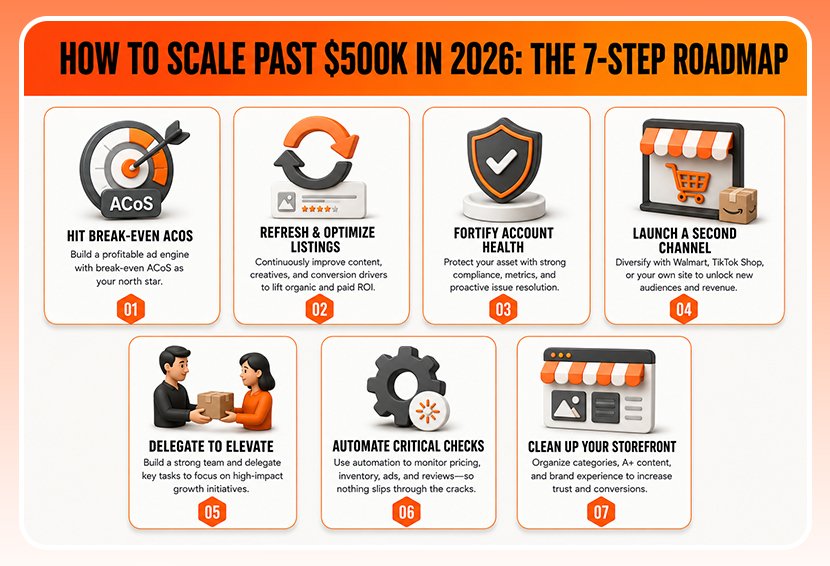
Here’s what each fix actually involves, in order to tackle them.
Step 1: Calculate Your Real Break-Even ACoS, Then Rebuild Campaigns Around It
Break-even ACoS is your gross margin before ad spend, not a flat number like “25%.” Sell for $30 with $18 in landed costs, and you can spend up to 40% on ads before losing money. Split one blended campaign into three: exact-match, phrase-match, and a small broad-match layer for discovery. Add negative keywords to block terms that attract unqualified traffic. That alone usually recovers 10-15% of wasted spend.
Once a campaign converts, push more budget into it instead of testing something new next to it. Review weekly at first, then biweekly, and let automated bid tools handle the small adjustments between reviews.
Step 2: Put Listings On a Refresh Schedule Instead Of a Launch-and-Forget Cycle
Set a recurring 90-day check for every ASIN doing meaningful volume. Each check covers three things, including search term relevance (are the terms you’re ranking for still the ones customers are actually searching, which you can see in Brand Analytics), A+ content and imagery (does it still reflect current buyer questions and competitor positioning), and title/bullet structure (has Amazon’s search AI changed how it weighs certain fields since your last update).
The fastest win here is usually the search terms backend field. Amazon’s algorithm re-weights relevance signals over time, so a term that ranked you on page one in 2024 might not carry the same weight now. Pull your Brand Analytics search query report, compare it against your current backend terms, and update anything that’s drifted.
Step 3: Build a Weekly Account Health Routine, Not a Reactive One
Check four numbers every week. Order Defect Rate (needs to stay under 1%), Late Shipment Rate (under 4%), Valid Tracking Rate, and any new policy notifications in Seller Central. Set your own internal threshold tighter than Amazon’s, and if Amazon’s limit is 1% ODR, treat 0.5% as your trigger point to investigate, since by the time you hit Amazon’s actual limit, you’re already at risk.
Log this weekly in a simple tracking sheet, or set an automated alert to flag anything that crosses your internal threshold the moment it happens. This turns account health from something you notice after a suspension notice into something you catch three weeks before it becomes a problem.
Step 4: Launch a Second Channel With the Smallest Viable Version First
Don’t try to replicate your full Amazon catalog on day one. Pick your two or three best-selling ASINs, the ones with the fewest listing issues and steady demand, and launch those on Walmart or Shopify first. This keeps the operational lift manageable while you learn a new platform’s fulfillment and ads system.
For Walmart specifically, apply for Walmart Fulfillment Services early since approval can take time, and reuse your existing Amazon product photography and copy as a starting point rather than building from scratch. For Shopify, the first month should focus on getting checkout, email capture, and basic retargeting running, not on driving heavy traffic yet.
Step 5: Hand Off the Two Roles that Eat the Most Founder Time First
PPC management and account health monitoring are the two easiest to hand off because they’re measurable, repeatable, and don’t require the founder’s product judgment day to day. Listing strategy and second-channel decisions can stay with the founder longer since they need more context about the brand.
If hiring isn’t realistic yet, this is also where an agency doing PPC and account management together makes sense, since the same person managing your ad spend can flag account health issues before they escalate, rather than treating them as two separate problems.
Step 6: Automate the Repetitive Checks Before Hiring for Them
Some of the weekly work above doesn’t need a person to do it manually forever. Automated tools can track profitability, flag inventory issues, and monitor PPC performance, then surface only the exceptions that need a decision. This doesn’t replace judgment. Deciding what to do about a rising ACoS still takes a person. But it frees the founder or specialist to spend time on decisions instead of hunting for the numbers first.
Step 7: Clean Up the Storefront, Not Just the Product Pages
Sellers pour their optimization effort into individual listings and skip the Amazon Storefront itself. If a shopper lands on the Store page and can’t find a bestseller within a click or two, that’s lost demand, the same as a bad listing. Cut the steps between landing on the Store and reaching a top product, especially on mobile. That usually moves conversion more than another banner or category tile does.
None of this requires a dramatically different product or a bigger budget. It requires running the business like the seven-figure operation it’s trying to become, before the revenue actually catches up.
How Many Amazon Sellers Actually Reach $1 Million in Annual Sales?
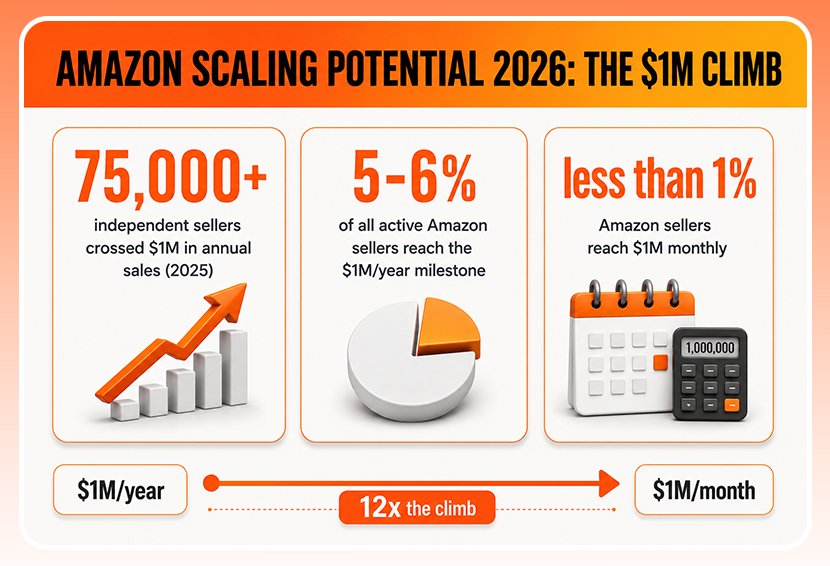
Amazon scaling potential in 2026 looks different from what most sellers assume. According to Amazon, the number of sellers crossing $1 million in annual sales is 75,000 in 2025. That growth happened even as the total number of active sellers dropped.
Analysts call this the competition paradox: fewer sellers entering the marketplace, but the ones who stay are getting more sophisticated. Amazon currently has around 1.9 million active sellers worldwide, which puts the share crossing $1 million at roughly 5 to 6 percent of all active sellers. It’s a small group, but it’s grown by nearly 70 percent in just a few years.
The middle of the market is what’s actually getting squeezed. Sellers in the $500K to $2M range aren’t failing dramatically. They’re watching the same effort that produced healthy margins a few years ago produce thinner ones today, because the sellers above them have better systems and tighter operations, not necessarily better products.
How Many Amazon Sellers Make $1 Million in Sales Monthly?
Crossing $1 million in annual sales puts a seller in the top 5 to 6 percent of all active Amazon sellers, a milestone more than 75,000 independent sellers reached in 2025. Spread across twelve months, that works out to roughly $83,333 in monthly revenue, the actual bar those sellers cleared.
No published research breaks down what percentage of sellers reach this specific level, but the available data suggests that less than 1% percent of sellers reach the $1 million monthly revenue mark.
What Changes Once a Brand Crosses $500K/Month?
The tactics that work under $500K stop being enough past it. Below that line, a decent product and a basic PPC setup can carry a business a long way. Above it, growth needs structure.
A few things tend to separate brands that break through from those that stay stuck.
- PPC gets rebuilt around margin, not just sales volume: Every campaign gets measured against a real break-even ACoS instead of a general target.
- Listings get treated as living pages, not launch assets: Search terms, A+ content, and imagery get revisited every few months, not once at launch.
- Account health gets monitored proactively: A regular account audit catches small compliance issues before they turn into suspensions.
- Revenue starts coming from more than one channel: Even a modest second channel reduces how much damage a single Amazon policy change can do.
- New product launches become a growth lever, not a gamble: Sellers scaling past $500K research demand and margin before they launch an ASIN, instead of launching first and figuring out profitability later.
None of this requires a dramatically different product or a bigger marketing budget. It requires treating the business like the seven-figure operation it’s trying to become, before the revenue actually gets there.
Conclusion
Crossing from $500K to $1M in monthly revenue rarely comes down to one big fix. It’s usually a few structural gaps closing at the same time. A break-even ACoS that actually protects margin, listings that get revisited instead of forgotten, account health checked weekly, and a second channel that takes pressure off Amazon alone. None of this requires a bigger budget. It requires running the account like the seven-figure business it’s trying to become.
The sellers who make this jump aren’t the ones who found a secret tactic. They’re the ones who stopped treating PPC, listings, and account health as separate problems and started managing them as one system. That’s the exact gap SPCTEK works inside every day, finding where an account is leaking revenue and rebuilding the structure around it. If you want a clear picture of where your business stands, reach out, and we’ll walk through it together.