
Too busy to read? Listen to this article instead.
Ask a $400K per month Amazon seller what their business is worth, then ask what happens if their top listing gets suspended tomorrow. The first answer usually comes with a proud number attached. The second answer is silence. That gap is why building a business on Shopify has stopped being a side project for serious Amazon sellers in 2026, and started becoming the move that decides whether you own a real company or a distribution agreement Amazon can pull whenever it wants.
If you are running $200K to $500K per month on Amazon and treating your business on Shopify as optional, the next few sections will reframe why. You will see what the transition actually looks like from the inside, why the strongest sellers pair the two channels instead of picking between them, and how to build the traffic engine that turns a Shopify store into a growing revenue line.
Why Do Amazon Sellers Need a Shopify Store?
Amazon sellers need a Shopify store to own their customer data, protect against account suspension, capture higher margins, and build brand equity that transfers across channels. On Amazon, the customer belongs to Amazon.
Amazon vs Own Website Selling Pros and Cons
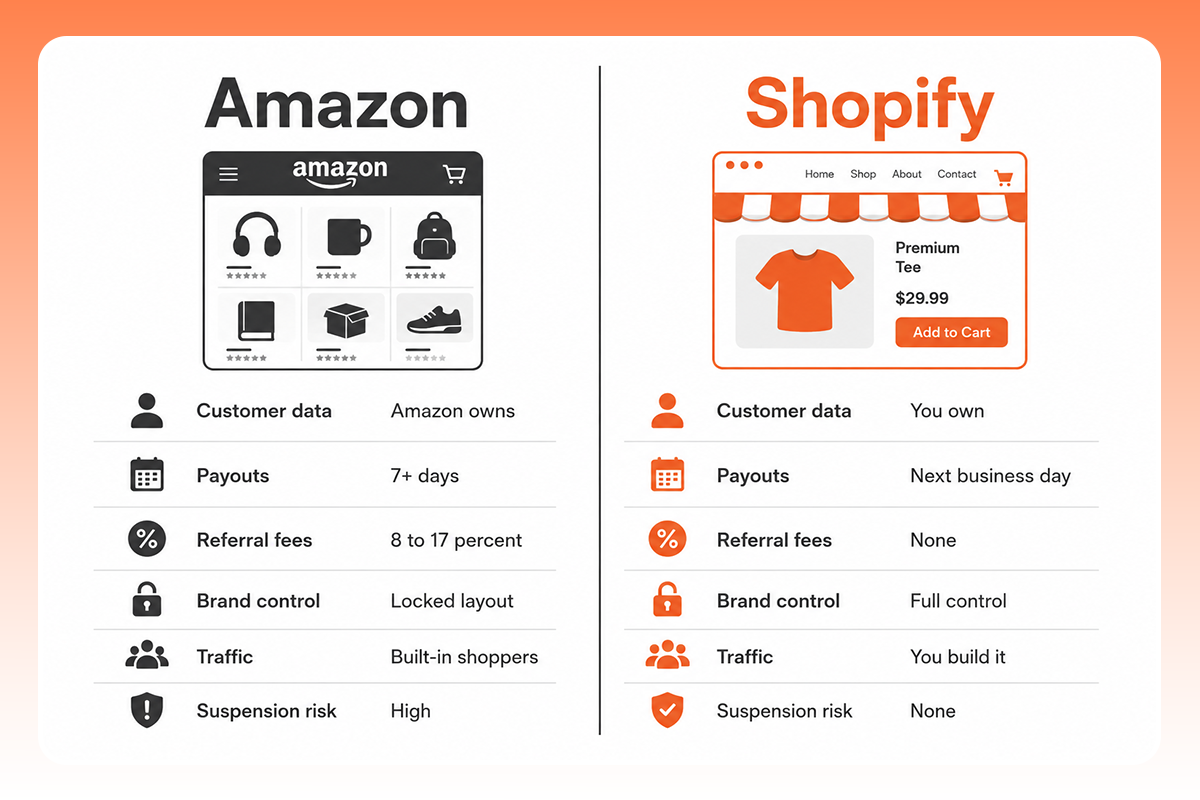
Before we go deeper, it helps to have an honest comparison of what each channel actually delivers. Both have real advantages. Both come with tradeoffs that only show up once you have been running the channel for a year or two, and the picture below strips away the platform marketing so you can see what is actually on offer.
Selling on Amazon: The Pros
- Enormous built-in shopper traffic, especially from Prime members who convert at higher rates than most direct-to-consumer visitors will.
- Fast product validation with real purchase data within weeks of launching a listing, which shortens the feedback loop on new SKUs.
- FBA logistics that handle warehousing, shipping, and returns at a scale most independent operators would struggle to match on their own.
- The Prime badge and Amazon’s return policy carry buyer trust that a new brand cannot buy anywhere else at a comparable cost.
- Sponsored Products advertising offers a relatively predictable path to first-page placement when the account is managed correctly.
- Consistent conversion rates, since shoppers arrive on Amazon ready to buy rather than needing convincing before they open their wallets.
Selling on Amazon: The Cons
- Referral fees between 8 and 17 percent of the sale price depending on category, before FBA fulfillment and storage costs get added in.
- No access to customer email, phone, or purchase history that you can actually use for retention marketing after the sale.
- Real risk of account suspension, listing hijacking, and category-wide policy changes that can erase weeks of revenue overnight.
- Extremely limited brand expression, since detail page structure, image placement, and layout are largely locked by Amazon.
- Payout delays of seven days or more after the estimated delivery date, which pushes cash flow further out during peak Q4 months.
- Aggressive competition on every listing, with race-to-the-bottom pricing in categories where differentiation is hard to establish.
- No control over how Amazon uses your sales data, including for launching Amazon Basics competitors in categories that grow too popular.
Selling on Your Own Shopify Store: The Pros
- Full ownership of customer data, which becomes the foundation for email, SMS, and every retention channel you build over time.
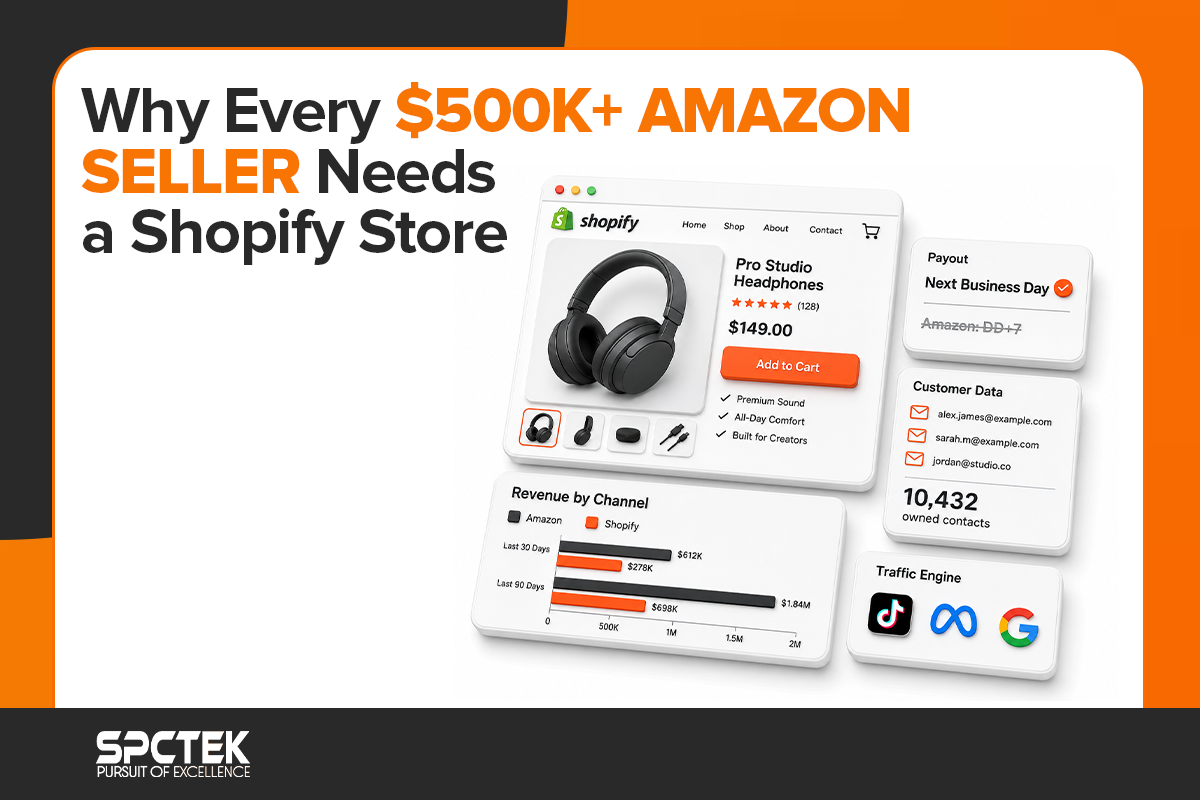
- Next business day payouts through Shopify Payments in the US, which frees up cash faster for reorders and paid media testing.
- Complete control over branding, product page design, checkout flow, and the entire post-purchase experience your customers see.
- Higher average margins per order because you skip the marketplace referral fee entirely, keeping more of every sale.
- Native integrations with TikTok, Meta, and Google that give you real paid media leverage from the day the store launches.
- A large app ecosystem covering email, SMS, subscriptions, reviews, loyalty, and analytics, most with free tiers to start.
- The ability to launch bundles, subscriptions, and limited editions that would look out of place on a standard marketplace listing.
Selling on Your Own Shopify Store: The Cons
- You own the traffic problem completely, which turns paid media and content production into required monthly cost lines.
- Ramp typically takes six to twelve months before the store contributes meaningfully to total revenue, and that timeline is realistic.
- Fresh creative production becomes an operational requirement, especially if TikTok and Meta are part of the channel mix.
- Higher upfront investment in store design, professional photography, and video content before the store is ready to open for business.
- App and tech stack maintenance is ongoing work, since integrations break, apps update, and new tools appear every quarter.
- No built-in trust layer, which means reviews, security badges, clear return policies, and social proof need to be built from scratch.
The honest verdict for a $200K to $500K per month seller is straightforward. You should not pick between the two channels, and you should build the Shopify side while Amazon revenue is still funding the ramp. Our scale from $500K to $1M playbook covers how channel diversification fits into the broader growth path.
Why Amazon Sellers Need a Shopify Store: The Four Reasons That Actually Matter
There are four reasons Shopify moves the needle for sellers already making serious Amazon revenue, and each one shows up on the P&L or the balance sheet within a year of launching the store properly.
1. Customer Ownership
On Amazon, buyers belong to Amazon, and you never see their email address or phone number. On Shopify, every buyer becomes a lead you can market to for years, which is what makes retention, lifetime value expansion, and email revenue possible in the first place.
2. Business Valuation
Aggregators and private equity buyers pay higher earnings multiples for hybrid Amazon and DTC brands than for Amazon-only businesses at the same revenue. The reason is defensibility. DTC revenue does not disappear because of a policy change, and sophisticated buyers price that stability into the multiple they will offer.
3. The Amazon Brand Referral Bonus
Amazon pays sellers a bonus on qualifying off-Amazon traffic that converts on Amazon. If your Shopify marketing sends shoppers to your Amazon listings through Attribution links, you earn back a portion of your referral fees, which most sellers never claim because they never set Attribution up in the first place.
4. Cash Flow
Shopify Payments in the US settles the next business day. Amazon pays DD+7 or longer during Q4. Over the course of a full year, that timing difference frees up meaningful working capital for inventory reorders, ad testing, and the kind of experiments that fund growth without borrowing.
How to Start a Shopify Business After Selling on Amazon
The biggest mistake Amazon sellers make when they start their business on Shopify is copying their Amazon setup and expecting the same results. Amazon listings are built for transactional buyers who have already decided to buy something in that category. Shopify pages need to work for a different audience entirely, one that arrived from an ad or a search result and needs to be convinced the brand is worth trusting.
Here is what a proper build looks like when you already have an established Amazon business behind you.
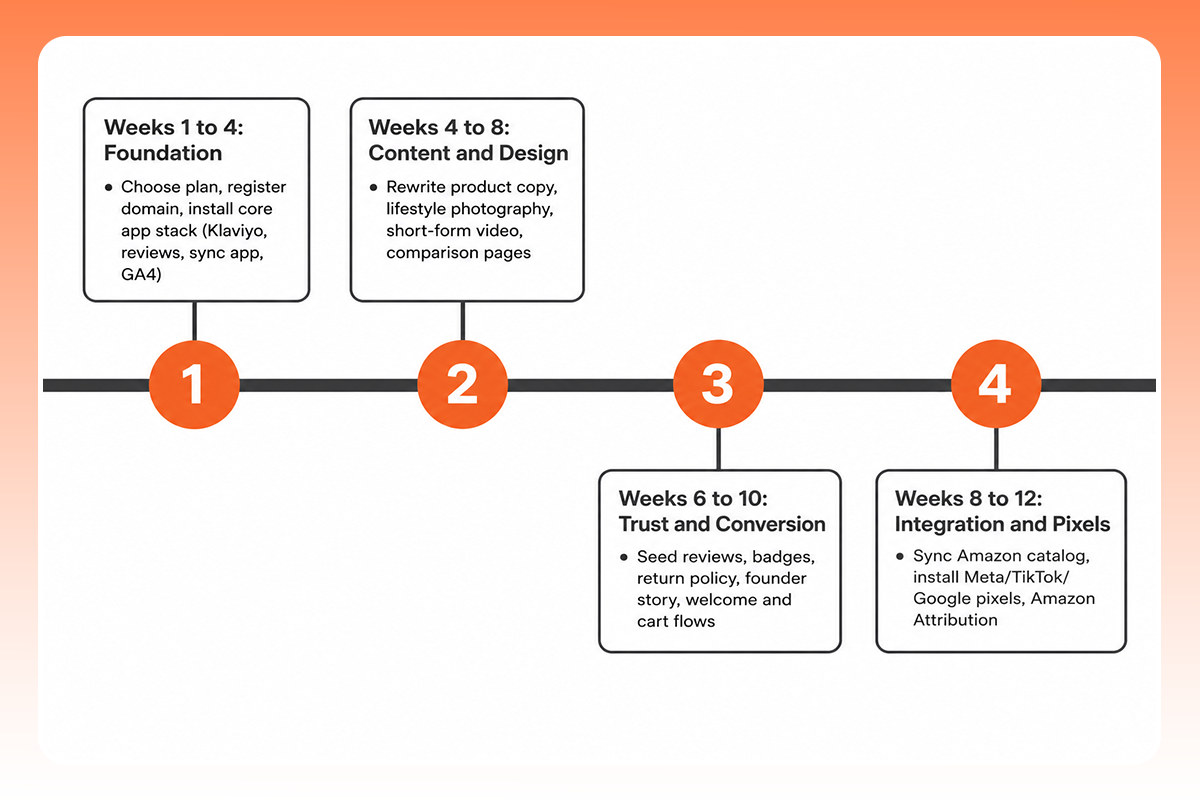
Weeks 1 to 4: Foundation: Choose a Shopify plan based on order volume and feature requirements. Register your domain, pick a theme, or commission a custom build if the budget supports it. Install the core app stack, which usually includes Klaviyo for email and SMS, a reviews tool such as Judge.me or Yotpo, an Amazon-Shopify sync app, and Google Analytics 4.
Weeks 4 to 8: Content and design: Rewrite product content so it tells a story instead of just listing specifications. Invest in lifestyle photography, short-form video, and clean product imagery that works across both the store and paid social. Build educational content around your category, and create comparison pages that answer the questions shoppers already have before they get to checkout.
Weeks 6 to 10: Trust and conversion layer: Seed or import reviews so the store does not launch empty. Add security badges, a clear return policy, an FAQ, and a founder story that explains why the brand exists in the first place. Set up welcome, abandoned cart, and post-purchase email flows so revenue does not leak from day one of launch.
Weeks 8 to 12: Integration and pixels: Sync your Amazon catalog to Shopify using a tool like Shopify Marketplace Connect. Install the Meta pixel, TikTok pixel, and Google tag so every marketing dollar you spend can be measured properly. Set up Amazon Attribution links and confirm that off-Amazon traffic driving Amazon sales gets tracked correctly.
Skipping the order of these steps is the single biggest reason business on Shopify fails for former Amazon-only sellers. The store goes live before the traffic plan is ready, and nothing meaningful shows up on the sales dashboard for months.
How to Start a Shopify Business Without Cannibalizing Your Amazon Sales
Learning how to start a Shopify business without hurting your Amazon revenue comes down to two rules. The first is pricing discipline. Match your Amazon price on Shopify, because undercutting Amazon costs you Buy Box eligibility and trains customers to always shop your website, which sounds like a win until you notice Amazon still drives the majority of your total revenue. The second is product strategy. Use Shopify to sell things that would never fit on Amazon: higher-AOV bundles, subscription offers, limited editions, and premium tiers that need a proper brand page to make commercial sense.
What Are the Best Apps or Tools for Shopify and Amazon Integration?
Once you decide to run both channels, you need a stack that keeps inventory synced, orders flowing, and marketing data connected across both platforms. Managing all of this manually falls apart the moment you get past 20 SKUs or start running promotions on either channel.
Here are the tools most sellers running an Amazon and Shopify e-commerce business in parallel actually use:
Marketplace and Inventory Sync
- Shopify Marketplace Connect (formerly Amazon by Codisto): Shopify’s official Amazon integration, free at the entry tier and compatible with any Shopify plan. It syncs listings, orders, and inventory between Amazon and Shopify from a single dashboard, which makes it the right starting point for most sellers with catalogs under 100 SKUs.
- CedCommerce Amazon Channel: A deeper feature set than Marketplace Connect for sellers with larger catalogs, complex product variations, or operations across Amazon US, Canada, UK, and the EU. Paid plans are tiered by SKU count, so pricing scales with your business.
- Sellbrite: A strong choice if you also sell on Walmart, eBay, or Etsy alongside Amazon and Shopify, since it gives you a single inventory view across every channel you run.
- Zentail: Built for enterprise-level operations and best suited for sellers doing over $10M in annual revenue with high SKU counts, multiple warehouses, and product information management requirements.
Fulfillment
- Amazon Multi-Channel Fulfillment (MCF): Uses your existing FBA inventory to ship Shopify orders. It is convenient, though per-unit fees can be higher than third-party providers, and shipments arrive in Amazon-branded packaging unless you enable the unbranded option in your settings.
- ShipBob, ShipHero, and Deliverr: Third-party fulfillment providers with native Shopify integrations. These usually offer better economics at volume, along with full control over branded packaging and marketing inserts.
Email, SMS, and Reviews
- Klaviyo: The default email and SMS platform for Shopify, with a native integration and features designed specifically for ecommerce. For most established stores, Klaviyo becomes the single largest source of retention revenue within the first year of proper implementation.
- Yotpo and Judge.me: Review collection and display tools. Judge.me is cheaper and works well for most sellers just getting started. Yotpo is stronger for larger brands that also want loyalty programs, referrals, and SMS all bundled together in one platform.
Tracking and Attribution
- Amazon Attribution: Free with Amazon Brand Registry and tracks off-Amazon traffic from Shopify, TikTok, Meta, or Google that eventually converts on Amazon. This is also what qualifies your account for the Brand Referral Bonus mentioned earlier.
- Northbeam and Triple Whale: Cross-channel attribution platforms that unify Meta, TikTok, Google, and Amazon data into a single dashboard. Usually worth the cost once you are above roughly $200K per month in blended ad spend across channels.
Setting all of this up is straightforward for a technical operator, though for most sellers at the $200K to $500K per month level it makes more sense to have a team handle the initial integration, ongoing sync monitoring, and app troubleshooting. Our Shopify store management services cover this entire stack as part of a standard onboarding process.
How to Build Brand Equity Outside of Amazon?
Brand equity is more than a logo or a color palette. It is the answer to one blunt question: why would a customer come back to you specifically instead of buying from any other seller in your category?
Learning how to build brand equity outside of Amazon starts with four assets that compound over years, and each one gets stronger the earlier you begin investing in it.
Owned Audience
Your email list, SMS list, and social following. Size matters, but engagement rate matters more. A list of 50,000 subscribers with a 15 percent open rate outperforms a list of 200,000 subscribers with a 5 percent open rate.
Content Library
Product content, category education, and user-generated content from real customers. This is one of the few genuine business assets that keeps compounding value, since it works across every channel you sell on and every ad you run.
Reviews on Your Own Domain
On-site reviews, Google reviews, and Trustpilot reviews. Unlike Amazon reviews, which are locked inside Amazon’s ecosystem, these transfer freely and support your brand wherever a shopper decides to research it.
Direct Search Demand
People typing your brand name into Google. This is the strongest single defensibility metric in ecommerce. When branded search volume grows month over month, you have a real brand. When it stays flat for a year, you have a product that sells, and that is a fundamentally different kind of business.
The three-year picture on this is straightforward. Sellers who invest in these assets today will have 10 to 100 times the branded search volume by 2029. Sellers who skip the work stay one Amazon policy change away from a very hard quarter, and they usually only realize it when the quarter arrives.
The Shopify Ecommerce Business Traffic Engine (TikTok, Meta, and Google)
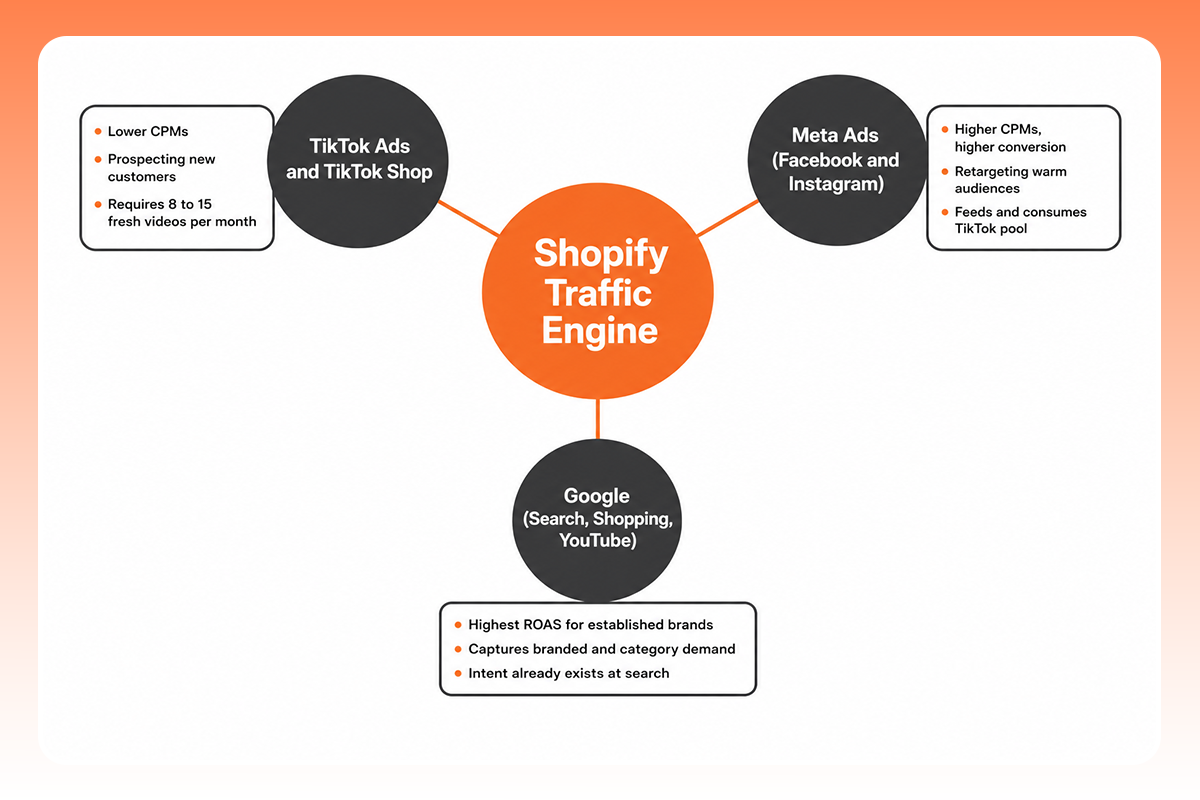
Here is what almost no competitor blog on this topic will tell you clearly: a Shopify ecommerce business without a traffic engine is a beautiful, dead website. The store looks polished and the photography is professional, but nobody visits it and nothing shows up on the sales dashboard.
For sellers coming from Amazon, this represents a genuine mindset shift. Amazon delivered traffic to your listings, and your job was to optimize conversion within that traffic. Shopify does none of that for you, which means the traffic engine has to be built from the ground up, and in 2026 that engine has three components that need to work together to actually produce revenue.
- TikTok Ads and TikTok Shop: The highest-growth paid channel for DTC brands in 2025 and 2026. CPMs are still lower than Meta in most categories, which makes TikTok attractive for prospecting new customers. The tradeoff is creative volume, since TikTok requires a steady flow of native short-form video that most Amazon sellers have never had to produce in-house before.
- Meta (Facebook and Instagram) Ads: Still the strongest paid channel for mid-funnel and warm audience retargeting. CPMs run higher than TikTok, but conversion rates hold up because the audience already recognizes the brand. Meta and TikTok work best when they run together, feeding each other prospects and retargeting pools throughout the funnel.
- Google (Search, Shopping, and YouTube): Captures both branded demand and category demand. Google Shopping tends to be the highest-ROAS channel for established brands, since the intent is already there when the search happens. Someone typing “electric toothbrush for sensitive gums” into Google is much closer to buying than someone scrolling TikTok for entertainment.
The creative reality is where most sellers underestimate the workload. Running paid social at scale usually means producing 8 to 15 fresh video creatives per active ad account every month. Amazon sellers who never built a creative pipeline are not ready for the cost, the process, or the talent required to hit that volume consistently. This is one of the reasons sellers at the $200K to $500K per month level typically bring in a digital marketing agency instead of trying to build the capability in-house.
Shopify Business Growth Mistakes to Avoid
Sellers who fail to unlock the Shopify business growth features that actually drive results usually make one of these mistakes in the first six months after launch.
1. Building the store, then thinking about traffic: Reverse that order and line up your paid media plan and creative pipeline before you launch, so opening day is not also the day the traffic problem becomes urgent.
2. Copying Amazon listing content: Amazon copy is transactional, since the shopper already decided to buy something in that category. Shopify copy is educational and emotional, since the shopper needs a reason to trust a store they have never heard of before landing on it. Different job, different words.
3. Undercutting Amazon prices on Shopify: This kills Buy Box eligibility on Amazon and trains repeat customers to always shop your website. That sounds fine on paper until you realize Amazon still drives the majority of your total revenue, and now it drives less of it.
4. Launching without email flows in place: Welcome, abandoned cart, and post-purchase flows should be live on day one. Skip them, and you leave roughly 30 to 40 percent of potential revenue sitting on the table while you figure out the rest of the marketing plan.
5. Ignoring Amazon Attribution: If your Shopify marketing drives shoppers to your Amazon listings (and it should, since the Brand Referral Bonus rewards it), you need Attribution links in place from the start. Without them, Amazon does not credit the traffic, and you never qualify for the bonus.
6. Treating Shopify like a side project: Sellers who allocate five hours a week to Shopify get five-hours-a-week results. It is a second business in every real sense, and it needs to be resourced the same way the first business was when you were building it up.
7. Skipping the creative pipeline: Paid social burns through creative fast. Sellers who cannot produce fresh video weekly end up blaming the platform for what is actually creative fatigue on their own ad account, which is a very different problem to solve.
The Bottom Line
Every Amazon seller doing $200K to $500K per month is one policy change, one hijacker complaint, or one algorithm update away from a bad quarter. The sellers who sleep well at night are the ones whose business does not depend on Amazon for survival, which is what building a business on Shopify eventually delivers if you do the work properly.
If you want to scale to $1 million/month and want the Shopify side built properly, with the store, integration, email and SMS, paid social, Amazon Attribution, and coordinated growth across both channels handled by one team, our Omnichannel Growth Services are designed to do exactly that. Book a strategy call, and we will walk through where the biggest gap is in your current setup.