
Too busy to read? Listen to this article instead.
Halloween falls on a Saturday in 2026, the first time since 2020. The National Retail Federation forecasts a record $13.5 billion in Halloween spending this year, with 74% of consumers planning to celebrate and about half saying they start shopping in September or earlier. Costumes lead at $4.4 billion, followed by decorations at $4.3 billion and candy at $4.1 billion.
Amazon does not run a dedicated Halloween sale the way it does for Prime Day or Black Friday. Prime Big Deal Days (October 6-7) lands inside the Halloween shopping window, but the shipping deadlines, deals, and ad timing for Halloween are yours to plan. This Amazon seller Halloween checklist covers what is still open, what has closed, and what each decision costs.
Q4 Event Windows for 2026
Several Q4 windows have already closed. Others are open for a few more days. Here are the dates that matter for Halloween sellers.
| Date | What Happens |
|---|---|
| Sept 2 / 9 / 16 | Inbound deadlines for Prime Big Deal Days (AWD / FBA minimal splits / FBA optimized splits). All passed. |
| Sept 22 | Best Deal and Lightning Deal submissions for Prime Big Deal Days closed. Amazon extended this deadline. |
| Oct 6-7 | Prime Big Deal Days. Prime Exclusive Discounts can still be submitted up to 12 hours before the event ends, and coupons stay available through the event. |
| Oct 14 / 21 / 28 | Inbound deadlines for Black Friday and Cyber Monday (AWD / FBA minimal splits / FBA optimized splits). |
| Oct 15 | Holiday peak fulfillment fees begin (through Jan 14, 2027). |
| Oct 20 | Black Friday and Cyber Monday deal submissions close. |
| Oct 31 | Halloween (Saturday). |
What Are the Amazon FBA Shipping Deadlines for Halloween 2026?
Amazon publishes inbound deadlines for its major events, but it does not publish a Halloween-specific cutoff. The commonly used Halloween window is a planning guideline. SupplyKick’s 2026 seller calendar recommends inventory arrive between early and late September, and suggests mid-September for Halloween-heavy categories. That window is closing.
Two Amazon-published schedules still matter to you:
- Prime Big Deal Days (October 6-7): the inbound deadlines have passed. Amazon’s stated position for its events is that late arrivals miss the Prime badge during the event.
- Black Friday and Cyber Monday: the AWD deadline is October 14, FBA minimal splits October 21, and FBA optimized splits October 28. If your catalog mixes Halloween and general Q4 products, these dates govern the non-Halloween stock.
Why the Deadline Changes by Shipment Method
AWD, FBA minimal-split, and FBA optimized-split shipments move through Amazon’s network differently, so each has its own cutoff. Optimized splits distribute inventory across more fulfillment centers up front and earn the latest deadline. Minimal splits mean fewer boxes and simpler prep for you, but the cutoff lands a week earlier.
Build Your Shipping Timeline Backward
Start from the date you need units sellable and work backward through four inputs:
- Receive-by date: your target arrival at the fulfillment center.
- Transit time: freight or parcel, plus customs if you import.
- Production time: how long your supplier needs to manufacture and pack.
- Buffer: extra days for delays, port congestion, and receiving backlogs. We recommend at least 5 to 7 days in peak season.
An arrival date is not a sellable date. Units must be checked in before they count as available stock, and Amazon has said fulfillment centers concentrate on receiving in September and October, so sellers may see lower capacity limits during that period.
If Your Halloween Stock Has Not Arrived Yet
You still have options this week:
- Confirm receiving status on every open shipment and escalate any that are stuck.
- For units that will land too late for FBA, consider fulfilling from your own stock or a 3PL and state a clear arrival promise in your listing.
- Do not send late Halloween stock into a shipment that will not be received before October 31. Redirect it to a later use or plan a post-holiday sell-through.
Peak Fees Are Charged by Ship Date, Not Arrival Date
This is the most common misunderstanding in Halloween planning. Amazon’s 2026 holiday peak fulfillment fees run from October 15, 2026 through January 14, 2027 across FBA, Remote Fulfillment with FBA, Multi-Channel Fulfillment, and Buy with Prime. Amazon says the increase averages $0.32 per unit, the same as last year.
The fee applies to the date an order ships from a fulfillment center. Inventory that arrived in early September still pays peak rates for every order that ships on or after October 15. Because Halloween demand concentrates in the final weeks of October, most of your Halloween orders will likely ship at peak rates no matter how early you inbound.
On top of that, Amazon’s 3.5% fuel and logistics surcharge, in effect since April 2026, applies to peak fees and is calculated on the fulfillment fee. Amazon has not announced an end date. Two of Amazon’s published examples show the effect:
- A large standard-size T-shirt goes from a $6.14 fulfillment fee to $6.53 at peak, or about $6.76 with the surcharge.
- A small standard-size phone case goes from $2.49 to $2.68, or about $2.77 with the surcharge.
Larger and heavier products see larger increases. Use Amazon’s Revenue Calculator to run your actual SKUs, and price seasonal margins against the peak figure, not the off-peak one.
What Deal Types Can Sellers Use for Halloween Products?
Because Amazon has no Halloween sale, you build the urgency yourself. You have four tools.
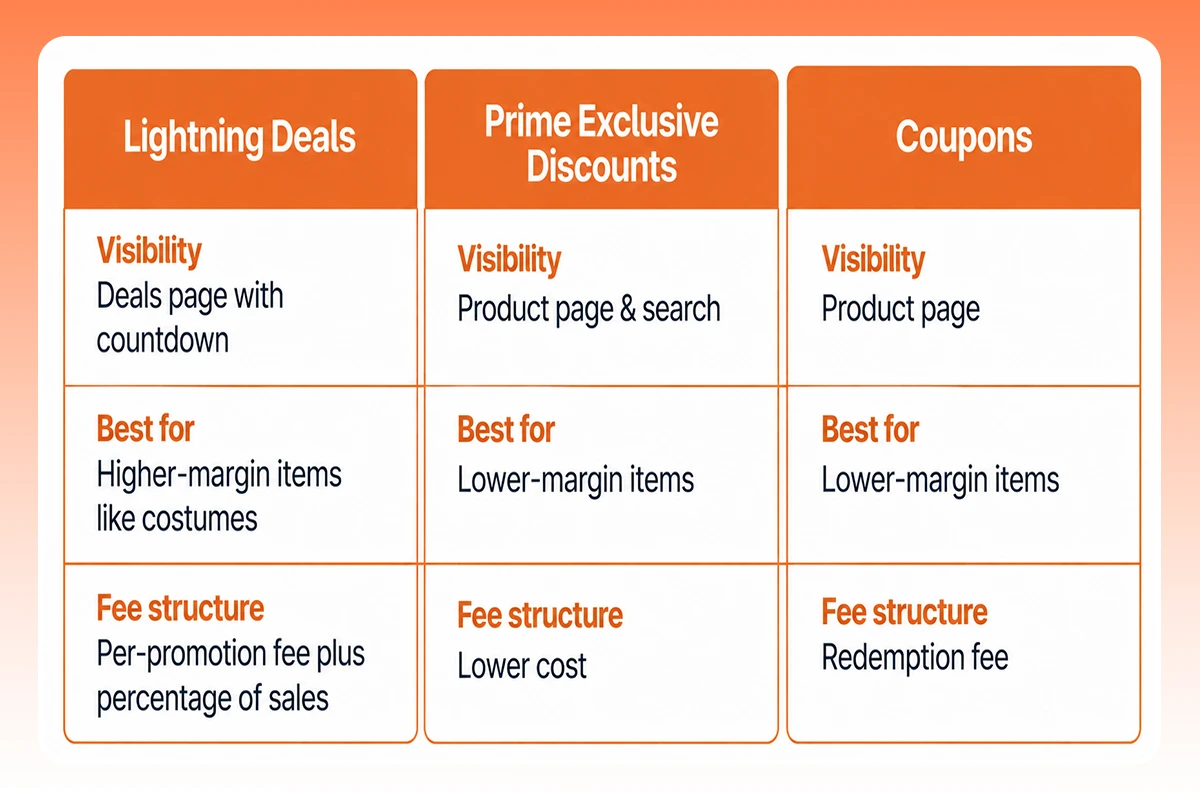
- Best Deals: They run for one to fourteen days without a fixed unit pool or a countdown. They share the Lightning Deal fee schedule.
- Lightning Deals: They appear on Today’s Deals with a countdown and a claimed-percentage bar. They typically run four to twelve hours, and Amazon, not the seller, chooses the exact slot.
- Prime Exclusive Discounts (PEDs): They show a discounted price to Prime members on the product page and in search results. Per Amazon, they work on any Prime-eligible ASIN that meets the discount threshold and need no advance scheduling. They are the most flexible option this late in the season.
- Coupons: You can add a visible coupon badge. Amazon has confirmed they remain available through Prime Big Deal Days.
Eligibility Varies, So Check the Deals Dashboard
Published eligibility numbers conflict, and Amazon does not publish a single scorecard. What sources generally agree on:
- You need a Professional selling plan. Reported seller-rating thresholds range from 3.5 to 4 stars.
- Products must be Prime-eligible, non-restricted, and meet Amazon’s rating requirement. ZonGuru’s breakdown lists a 3-star product rating for standard Lightning Deals and 3.5 stars for Prime Day-style events.
- Amazon sets a minimum discount for each ASIN from your recent selling history. Reported floors range from 10% to 20%, with 15% commonly cited.
- Amazon may cancel a deal if your stock cannot cover the committed quantity. Sources commonly cite a 20-unit guideline, but Amazon sets the actual minimum for each deal.
Treat the Deals dashboard in Seller Central as the only reliable answer for a given ASIN.
What Do Deals Cost
Two costs stack: the discount itself, and Amazon’s promotion fee. Per PPC Land’s reporting on Amazon’s fee schedule:
- Standard periods: Best Deals and Lightning Deals cost $70 per day plus 1.0% of deal sales, with the variable portion capped at $2,000.
- Peak events (Prime Big Deal Days, Black Friday Week): Best Deals, Lightning Deals, and Prime Exclusive Discounts cost $100 per promotion plus 1.5% of promotional sales, capped at $5,000. Amazon offered a $50 discount for early submission, but those early deadlines have passed.
- Coupons: reported at $5 per coupon plus 2.5% of coupon sales.
A quick example: a Lightning Deal that sells 300 units at $40 generates $12,000. The standard fee is $70 plus $120, or $190. The peak fee is $100 plus $180, or $280. The discount itself is the higher cost, so model both. Fee details have varied between Amazon’s announcements and the registration screen, so confirm the amount shown before you submit.
Which Deal Fits Which Product:
Based on typical Halloween margins, we recommend: candy and decorations usually work better with coupons or PEDs because margins are thin. Costumes can justify a Lightning Deal when the margin supports the discount, the fee, and the peak fulfillment cost. Whatever you choose, calculate profit per unit after the discount, the promotion fee, the peak fulfillment fee, and the 3.5% surcharge.
How Should You Adjust Amazon PPC for Halloween?
NRF’s survey shows nearly half of shoppers start Halloween shopping in September or earlier, so demand is not only a last-week rush. That supports a staged ramp instead of a single late push.
Ramp your budget in stages
- Early to mid-October: Keep budgets steady while you gather conversion data. Prime Big Deal Days (October 6-7) will lift CPCs on shared keywords, so keep Halloween campaigns separate from your general Q4 campaigns to see which spend drives Halloween sales.
- Mid-October onward: Raise spend gradually on proven terms as Halloween approaches. Some agencies raise budgets 20 to 40 percent in the final ten days. Treat that as a starting point and test it against your own conversion and ACOS data.
- Final week: Keep exact-match winners funded and use higher top-of-search bids on terms that already convert. With Halloween on a Saturday, watch evening and weekend performance closely.
Reducing spend on core Halloween terms while shoppers are still buying can cost you the last high-intent sales. Peak fulfillment fees also change your break-even ACOS from October 15, so update your targets on that date.
Structure That Protects Your Budget
- Split ad groups by product type. Costume shoppers compare styles earlier, while candy and last-minute decor searches spike closer to October 31.
- Use broad or auto campaigns for discovery, then promote converting search terms to exact match. Add negative exact keywords to discovery campaigns so your own campaigns do not compete.
- Point Sponsored Brands ads to a themed Storefront section when shoppers are browsing for ideas, and send bottom-funnel ads to your best ASINs.
- Use Sponsored Display to retarget shoppers who viewed but did not buy.
- Pull search term reports frequently in October and prune underperformers quickly. Refresh long-tail keyword ideas from your own search term data and Brand Analytics.
Review your PPC campaign structure before you raise your budget. If costs climb faster than sales, look at ways to lower PPC costs before assuming you just need to spend more.
Listing and Content Updates for Halloween
Listing changes need time to index, so we recommend getting them live one to two weeks before you expect demand to peak. With Halloween on October 31, that means now.
Titles and Item Highlights: Since July 27, 2026, product titles in all categories except media must be 75 characters or fewer, including spaces. Amazon added an Item Highlights field of up to 125 characters that is searchable and visible in search results and on product pages. Titles still over the limit are gradually replaced with Amazon’s AI recommendations. Put your core product name and the strongest Halloween term in the first 75 characters, and use Item Highlights for materials, use cases, and occasion details.
Images and A+ Content: Your main image should signal Halloween without breaking Amazon’s image rules. Add lifestyle images that show the product in a decorated doorway, on a party table, or in a family scene. Refresh A+ modules and add a Halloween section to your Brand Store if you have one.
Answer-ready content: NRF reports that 47% of surveyed shoppers are using AI tools for Halloween shopping. Write clear, factual bullets and A+ copy that state sizes, materials, ages, and what is included so that assistants and shoppers can find those answers.
Trademark and compliance: Do not use character names or licensed IP in titles, images, or ads unless you hold the license. Confirm the category requirements in Seller Central for costumes and candy before you list or restock.
Amazon Halloween Checklist for Sellers
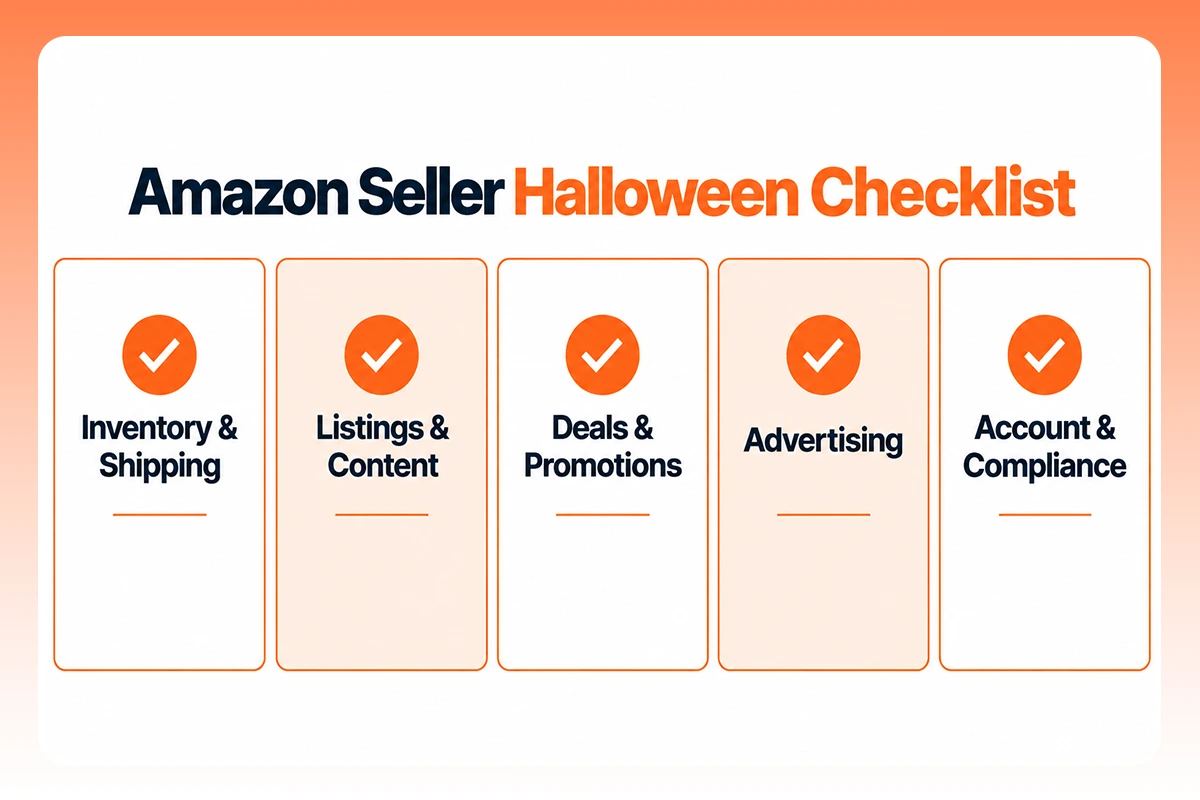
1. Inventory and Shipping
- Confirm your shipment method (AWD, FBA minimal splits, or FBA optimized splits) and its exact cutoff.
- Check receiving status on every open shipment today.
- Decide now what happens to units that will not be received before October 31.
- Confirm prep and labeling on every unit, including FNSKU labels.
- Model margins with peak fees (from October 15) and the 3.5% surcharge.
2. Listings and Content
- Rewrite titles to 75 characters or fewer and fill in Item Highlights.
- Update titles, bullets, and backend search terms with Halloween keywords, including this year’s trending style terms.
- Confirm you are not using licensed characters or restricted claims.
3. Deals and Promotions
- Check the Deals dashboard for eligibility and minimum discounts on each ASIN.
- Choose between a Best Deal, a Lightning Deal, a PED, or a coupon based on margin.
- Submit PEDs for Prime Big Deal Days before the event ends, and set up coupons.
- Confirm the fee shown in Seller Central before submitting any deal.
4. Advertising
- Keep Halloween campaigns separate from general Q4 campaigns.
- Set a staged budget ramp and update ACOS targets for peak fees on October 15.
- Add negative keywords and audit search terms on a regular cadence.
5. Account and Compliance
- Confirm your Account Health Rating is in good standing before order volume climbs.
- Make sure your team can handle returns and messages without slipping response times.
If your account health needs attention, improve your Account Health Rating before you take on more volume, not during the rush.
After Halloween: Protect Your Q4
Halloween ends on October 31, but Q4 does not. Plan for Q4 before the holiday:
- Black Friday and Cyber Monday: deals close October 20, and inbound deadlines run October 14, 21, and 28 depending on shipment method.
- Leftover Halloween stock: review storage costs and your removal or liquidation options in Seller Central instead of letting it sit. If you still hold last year’s Halloween stock, check whether it now counts as aged inventory.
- Retention: retarget October buyers with Sponsored Display and seasonal offers for Thanksgiving and the holidays.
This ties into the inventory management strategies you should already have in place before any peak period.
Conclusion
Halloween 2026 gives sellers a Saturday finish and a record spending forecast, but Amazon will not hand you the traffic or the deadlines. Several windows have already closed, and the peak fee window opens on October 15 no matter when your inventory arrived. Sellers who model margins with peak fees, use the deal tools that are still open, and keep advertising steady through the final week will be in the best position.
Start with your receiving status and your margins. Every other decision, from deal choice to ad spend, depends on having sellable stock at a price that still makes money.