
Ecommerce fulfillment is everything that happens between a customer clicking buy and the product arriving at their door. That covers receiving inventory, storing it, picking and packing each order, shipping it, and handling the returns that come back. For most sellers it starts as something they do themselves in a spare room and grows into one of the largest operational costs in the business.
The decision that matters most is which fulfillment model to run and when to change it, ahead of which provider to hire. A brand doing 200 orders a month and a brand doing 8,000 need entirely different setups, and the cost of staying on the wrong one shows up slowly, as margin erosion and late shipments rather than as a single obvious problem.
This guide explains what ecommerce fulfillment involves, how the process works step by step, the four main models and what each one costs, the order volumes where switching makes sense, how fulfillment choice affects your sales rather than just your shipping, and how to run it across multiple channels without splitting your inventory badly.
What Is Ecommerce Fulfillment?
Ecommerce fulfillment is the end-to-end process of getting an online order to a customer. It covers receiving inventory from your supplier, storing it, picking the items when an order comes in, packing them, shipping them, and processing any returns.
You will also see it written as e-commerce fulfillment or ecommerce product fulfillment. These describe the same thing, and the variation is spelling convention rather than a difference in meaning.
People use the term two ways, which causes some confusion. Sometimes it means the process itself. Sometimes it means the service, as in hiring a company to do it for you. Both are correct, and this guide covers the process first because you cannot evaluate a service until you know which parts of the process you want to hand over.
What fulfillment in ecommerce includes:
- Receiving and checking inventory arriving from suppliers or manufacturers
- Storing it in a warehouse, fulfillment center, garage, or spare room
- Picking the correct items when an order is placed
- Packing them securely and labeling the parcel
- Shipping through a carrier and passing tracking back to the customer
- Receiving, inspecting, and restocking or disposing of returns
Returns belong in that list even though plenty of definitions leave them out. For most consumer categories, returns handling is where fulfillment costs quietly escalate, and a model that handles outbound well but reverse logistics badly will cost you more than the shipping rate suggests.
How Does Ecommerce Fulfillment Work?
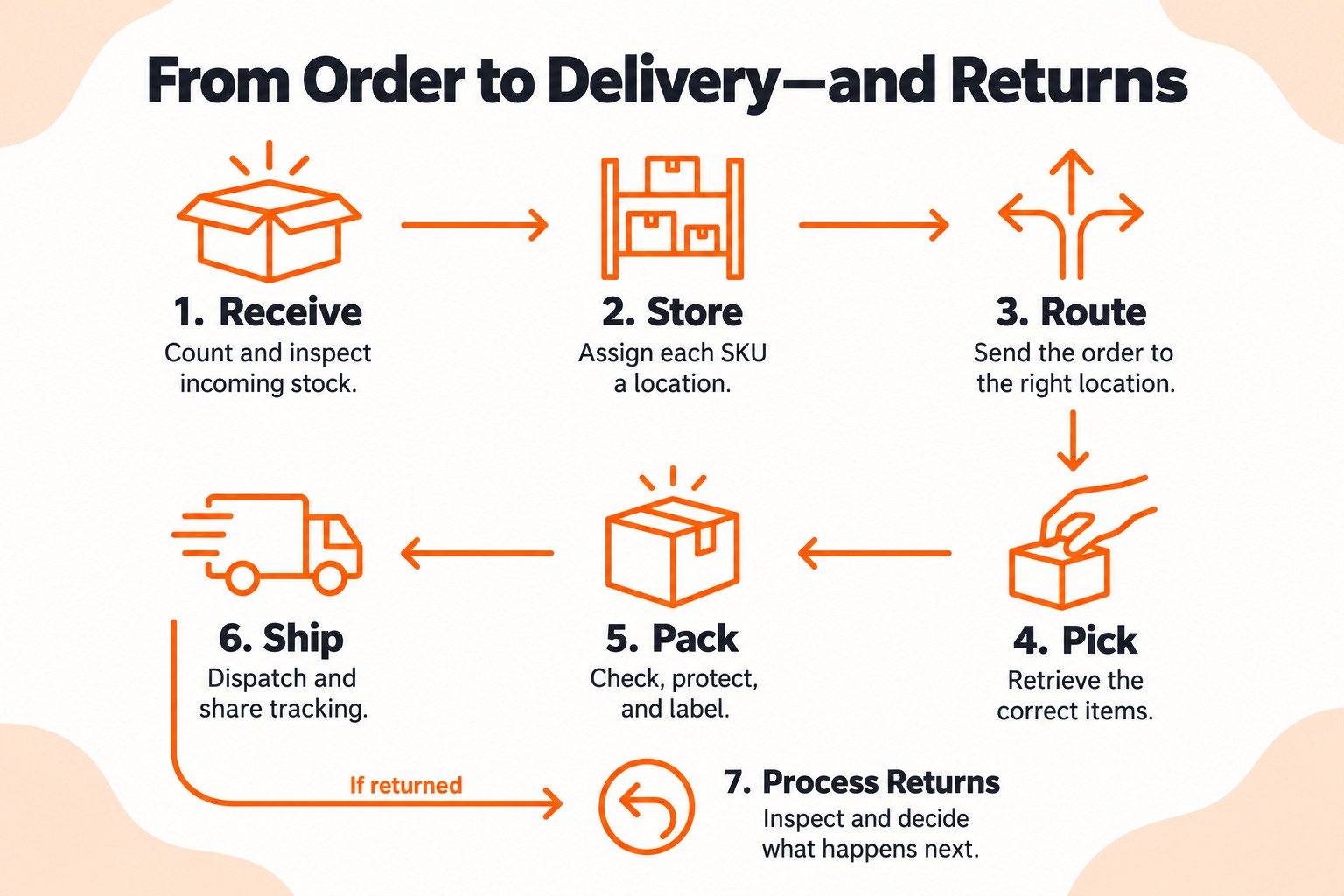
Ecommerce fulfillment works in seven steps: inventory is received, stored by location, routed when an order arrives, picked, packed, shipped with tracking, and processed again if it comes back as a return. The sequence runs the same way regardless of who performs it, and knowing each step is how you identify what is actually breaking when orders go out late or wrong.
- Inventory arrives and is received. Units are counted against the purchase order, inspected for damage, and logged into the system. Errors here propagate through everything downstream.
- Stock is stored and recorded by location. Each SKU gets a physical home and a system record. Accurate location data is what makes picking fast.
- An order comes in and is routed. The system decides which location fulfills it, which matters once you hold inventory in more than one place.
- Items are picked. A worker or robot retrieves the items from their locations. Picking accuracy determines your error rate more than any other step.
- The order is packed. Items are checked, boxed in appropriate packaging, and labeled. Packaging choice affects both damage rates and dimensional shipping costs.
- The parcel ships and tracking is issued. The carrier collects, and tracking flows back to the customer automatically.
- Returns are processed. Items come back, get inspected, and are either restocked, refurbished, or written off.
Most fulfillment problems trace to steps one, four, and seven rather than to shipping. If orders are going out wrong, the cause is usually receiving or picking rather than the carrier. Our guide to inventory management strategies covers the upstream side in more detail, and our piece on reducing marketplace returns covers the reverse flow.
What Are the Different Types of Ecommerce Fulfillment?
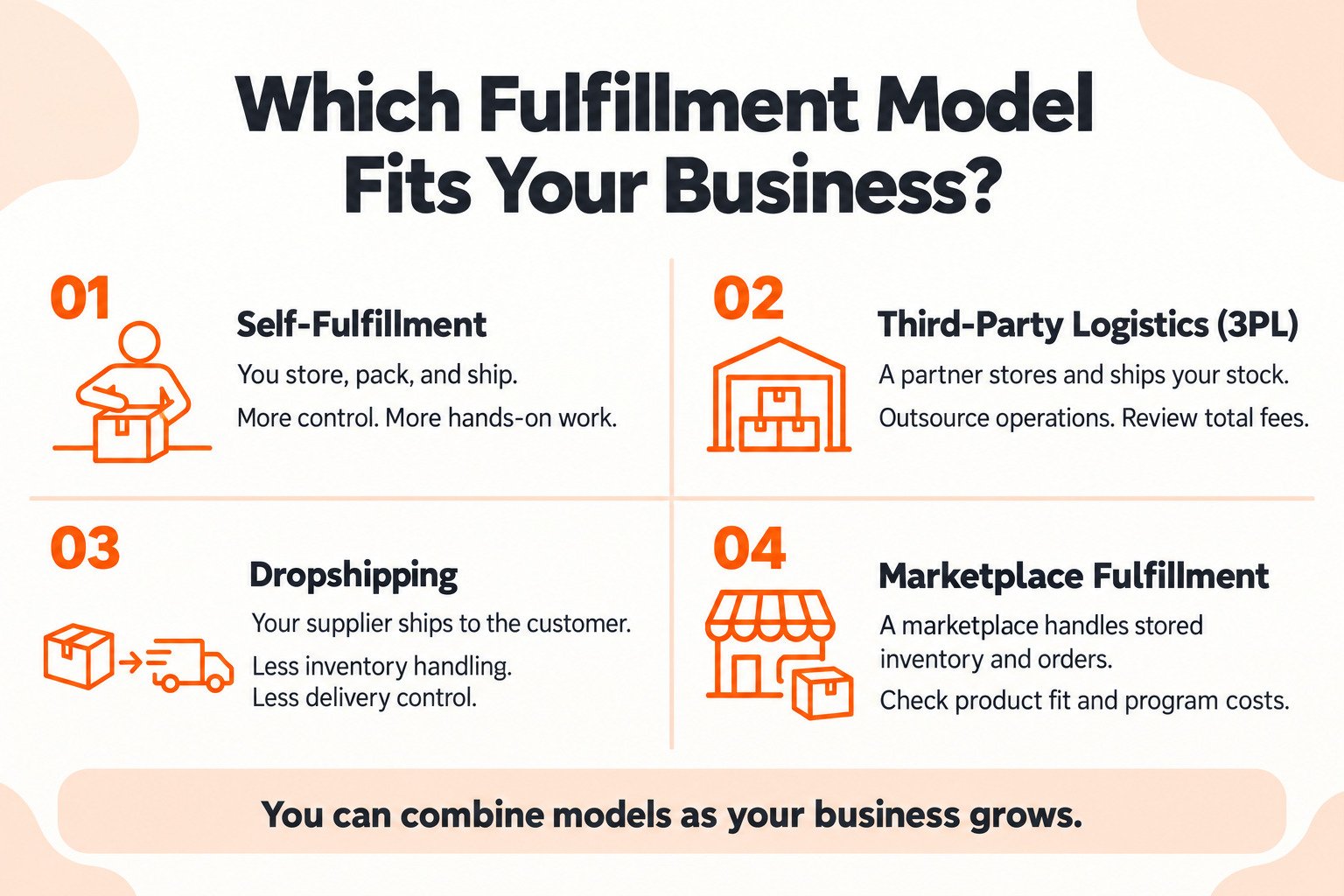
There are four main types of ecommerce fulfillment: self-fulfillment, third-party logistics, dropshipping, and marketplace fulfillment such as Amazon FBA. Most brands eventually combine two or more into a hybrid setup, covered at the end of this section, and move between them as they grow.
1. Self-Fulfillment
You hold the inventory and ship every order yourself, from home, an office, or your own warehouse. You control packaging, inserts, and the unboxing experience completely, and you pay no per-unit handling fee to anyone.
The cost is your time and your ceiling. Self-fulfillment works well at low volume and breaks down as order counts rise, usually before the owner is willing to admit it.
2. Third-Party Logistics
A 3PL stores your inventory in their fulfillment center and ships orders on your behalf under contract. You pay for receiving, storage, and a per-order pick and pack fee, plus shipping.
You gain capacity, better carrier rates, and your time back. You give up direct control, and you take on the risk of choosing badly, because migrating between providers is disruptive and expensive.
3. Dropshipping
Your supplier ships directly to the customer and you never hold inventory. Capital requirements are minimal and the catalog can be enormous.
Margins are thin, delivery times are usually long, and you have almost no control over packaging or accuracy. For an established brand it works as a way to test products or extend a catalog, rarely as a core model.
4. Marketplace Fulfillment
Amazon FBA is the main example, with Walmart Fulfillment Services operating similarly. You send inventory to the marketplace, and they handle storage, picking, packing, shipping, and customer service for those orders.
This is the most straightforward route to Prime eligibility and the delivery speed marketplace shoppers expect. Seller Fulfilled Prime offers an alternative for sellers shipping themselves or through a 3PL, but its performance requirements are strict enough that most brands find FBA the simpler path. The trade-off is that your inventory sits inside a platform that sets the fees.
5. Hybrid Fulfillment
Most brands past a certain size run two or three of these at once. Fast-moving products in FBA, slower or oversized ones with a 3PL, direct website orders from whichever is cheaper, and new products tested through dropshipping before committing to inventory.
| Comparison | Self-fulfillment | 3PL | Dropshipping | Marketplace (FBA) |
|---|---|---|---|---|
| Who owns the inventory | You | You | The supplier | You |
| Where it is stored | Your own premises | The 3PL’s warehouse | The supplier’s site | The marketplace’s warehouse |
| Setup cost, excluding inventory | Low | Medium | Very low | Low to medium |
| Per-order cost | Low fees, but retail shipping rates and unpriced labor | Moderate, with negotiated shipping rates | Built into the supplier’s margin | Competitive for standard fast movers, high for oversized or slow stock |
| Control over experience | Full | Partial | Almost none | Minimal |
| Scales with volume | Poorly | Well | In catalog size, less so in reliability | Well, within inventory capacity limits |
| Amazon Prime badge | Possible through Seller Fulfilled Prime, with strict requirements | Possible through Seller Fulfilled Prime, with strict requirements | Rarely | Yes |
| Best for | Lower volumes, typically a few hundred orders a month | Growing DTC and multichannel brands | Testing products or extending a catalog | Marketplace-heavy sellers |
When Should You Switch Fulfillment Models?
Switch when fulfillment starts limiting growth rather than when a cost threshold is crossed. In practice, that means leaving self-fulfillment somewhere between 300 and 800 orders a month, adding a 3PL once direct website sales reach roughly a quarter of revenue, and pulling slow movers out of FBA when storage surcharges accumulate. There is no single ecommerce fulfillment solution that suits every stage, which is why most guides avoid the question by saying it depends on your business. It does depend, but the decision points are more predictable than that answer suggests.
1. Leaving Self-Fulfillment
The usual trigger is somewhere between 300 and 800 orders a month, and the signal is not volume itself. It is that fulfillment has started dictating your week. When shipping consumes a full working day, when you cannot take a holiday without orders stopping, or when error rates climb because you are rushing, the model has reached its limit.
Run the arithmetic honestly. Count the hours you and your team spend on fulfillment, price them at what that time would earn doing marketing, merchandising, or sourcing, and compare that to a 3PL quote. Most sellers discover they passed the line some months earlier.
2. Adding a 3PL Alongside FBA
Common once a meaningful share of revenue comes from your own website, often around the point where direct sales reach 25 to 30 percent of the total. Multi-Channel Fulfillment can cover website orders from your FBA stock, and since late 2022 it ships in unbranded packaging by default. Two limits remain. MCF fees run higher per unit than standard FBA fees, and unbranded means no branding at all, so you cannot use your own custom boxes or inserts. For brands that treat packaging as part of the product experience, a 3PL is usually the better fit for website orders.
3. Pulling Products Out of FBA
Worth examining for slow movers, oversized items, and anything accruing aged inventory surcharges, which Amazon applies on a tiered basis once stock passes 181 days. A product that sells steadily but slowly often costs more in FBA storage over a year than a 3PL would charge for the same space, and the Prime badge is doing less work on low-velocity items than people assume.
Your Inventory Performance Index is the early indicator here, and our guide on improving your IPI score covers how to read it before storage limits tighten.
| Move | Typical trigger | What usually signals it |
|---|---|---|
| Self-fulfillment to 3PL | 300 to 800 orders a month | Shipping consumes a full working day; error rates rise |
| Adding a 3PL alongside FBA | Direct sales reach 25 to 30 percent of revenue | Packaging control and website speed start mattering |
| Pulling products out of FBA | Stock approaching 181 days | Aged inventory surcharges exceed 3PL storage cost |
| Adding marketplace fulfillment | Entering Amazon or Walmart seriously | Delivery speed badge affects conversion |
These are operating heuristics rather than published benchmarks. Use them as a starting frame and check them against your own cost data.
4. The Switching Cost
Moving models costs more than the fee difference. Expect inventory in transit and unsellable for one to three weeks, duplicate storage charges during the overlap, listing and integration work, and a period of elevated error rates while the new provider learns your products. Budget for a weaker quarter during any migration, and avoid migrating in Q4 entirely.
How Fulfillment Affects Sales, Not Just Shipping
Fulfillment is usually filed under operations. For anyone selling on a marketplace, it is also a demand lever, and the relationship between ecommerce and fulfillment is where most sellers leave money behind.
1. Delivery Speed Changes Conversion
Fast delivery promises convert better than slow ones at the same price. On marketplaces, the displayed delivery date sits next to the buy button, which means the fulfillment method is visible at the exact moment of decision.
2. Prime Eligibility Affects Visibility
On Amazon, Prime eligibility influences both conversion and competitiveness for the Featured Offer. Two sellers at identical prices do not compete equally when one is Prime-eligible and one is not.
3. Fulfillment Performance Feeds Account Health
Late shipments, cancellations, and tracking failures all register as seller performance metrics. Self-fulfillment puts those metrics in your hands, which is control when it goes well and exposure when it does not.
4. Shipping Reliability Changes Ad Efficiency
Advertising drives traffic to a listing that converts at a rate your fulfillment method partly determines. Paying for clicks on a listing showing a two-week delivery estimate is more expensive per sale than paying for clicks on a two-day one, even when the bid is identical.
Treating fulfillment as purely a cost line misses this. The cheapest per-order fee is not the cheapest option if it lowers conversion and raises your cost per acquisition everywhere else.
How Does Amazon FBA Fit In?
FBA fits best for fast-moving, standard-sized products where Prime eligibility drives conversion, and fits poorly for slow movers, oversized items, low-margin products, and anything needing custom packaging. Most guides on this topic are written by 3PLs selling the alternative, so here is the version without that incentive.
FBA wins on velocity. For products that sell consistently and reasonably fast, Prime eligibility and Amazon handling customer service and returns are difficult to replicate elsewhere at comparable cost.
FBA stops winning in several specific situations:
- Slow-moving products, where storage charges accumulate faster than sales justify
- Oversized or heavy items, where size-based fees escalate sharply
- Low-margin products, where per-unit fulfillment fees consume what is left after referral fees
- Anything requiring custom packaging, inserts, or branded unboxing
- Products with high return rates, where returns processing and unsellable stock pile up
The common mistake is treating FBA as all or nothing. Hybrid is usually correct: fast movers in FBA for the badge, slow and oversized items with a 3PL, and your own site served from whichever makes more sense per product. If stock has been damaged or lost inside the network, our guide to FBA reimbursements covers recovering it.
How Do You Manage Fulfillment Across Multiple Channels?
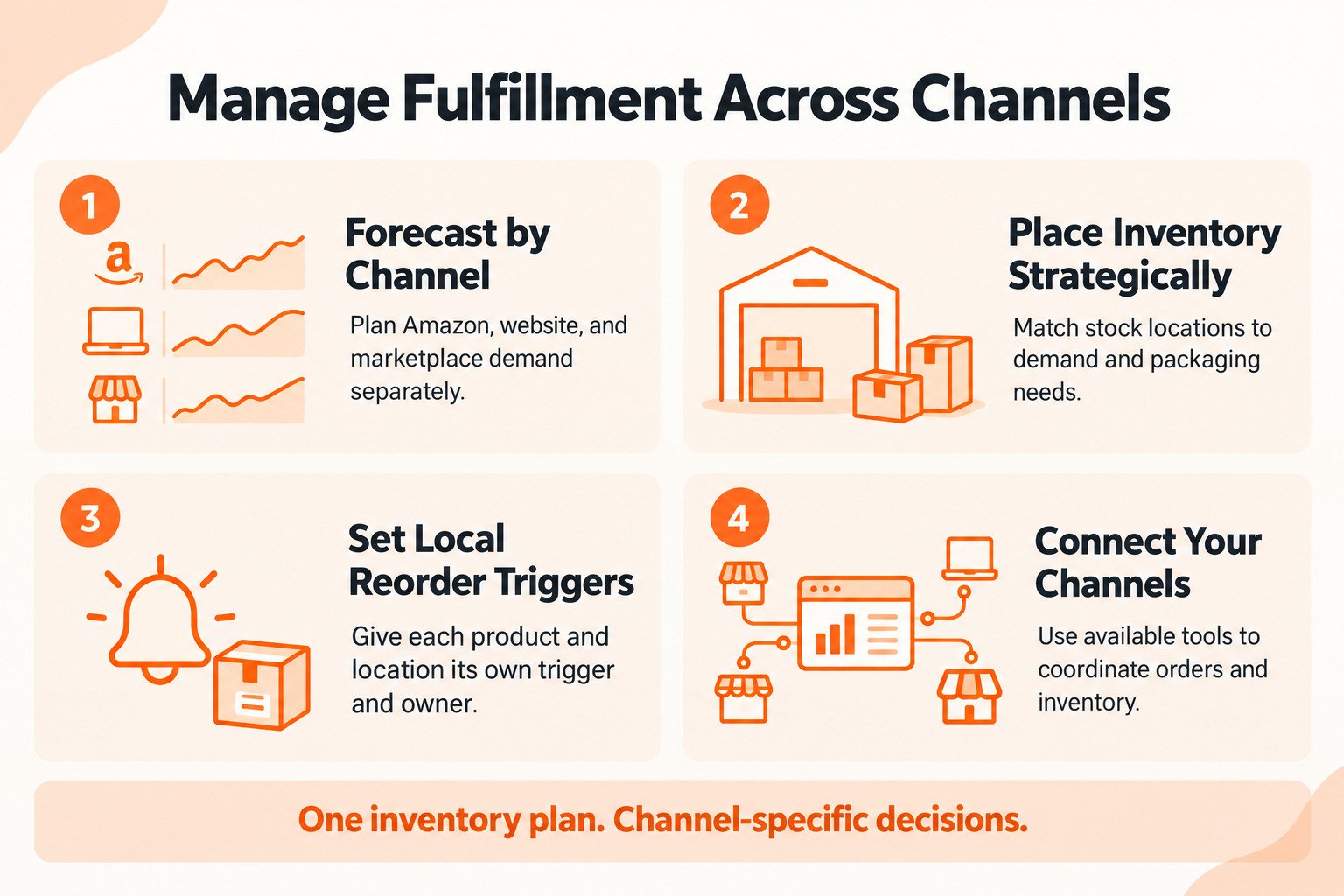
Forecast each channel separately, hold inventory where each channel’s demand actually sits, and set reorder points for each product at each location rather than one figure per product. Selling across Amazon, your own site, and other marketplaces creates a problem no single-channel guide addresses, because the same inventory has to serve demand curves that do not move together.
1. Forecast Each Channel Separately
Amazon demand moves with search ranking and advertising. Website demand moves with paid social and email. Treating website volume as a percentage of Amazon volume produces stockouts on whichever channel you underweighted.
2. Decide Where Each Product Lives
Hold enough in FBA to cover marketplace velocity with a buffer, and keep website inventory with a 3PL or in-house where you control packaging. Splitting evenly across channels is almost always wrong.
3. Set Channel-Specific Reorder Points
A stockout on your website does not appear in your FBA dashboard. Each location needs its own trigger and its own owner.
4. Amazon Is Now Building Multichannel Tools Into Seller Central
Amazon has started rolling out multichannel selling tools in Seller Central that let sellers connect eBay, Shopify, TikTok, and Walmart accounts and manage them alongside Amazon. The rollout is gradual, limited to US sellers at the time of writing, and carries no additional fee.
The part relevant to fulfillment is order routing. Orders from connected channels appear on a single screen, and a Shopify order can be fulfilled through Amazon with tracking flowing back to the buyer automatically. That is Multi-Channel Fulfillment with considerably less manual work around it.
If you are weighing which marketplaces to add alongside Amazon in the first place, our comparison of Walmart and Amazon covers that decision, and our Shopify store management services cover the direct channel side.
How Order Fulfillment Software Reduces Shipping Errors and Time
Order fulfillment software reduces errors mainly through barcode scan verification at packing, which confirms the item matches the order before the box closes. It reduces time through automated carrier selection, rules-based routing, inventory sync, and batch picking. Most fulfillment errors are not carelessness. They are the predictable result of people matching SKUs by eye under time pressure.
- Barcode scanning at pick and pack verifies the item against the order before the box closes, which sharply reduces mis-picks, one of the most common error types
- Automated carrier selection compares rates and delivery estimates per order rather than defaulting to one carrier
- Rules-based routing sends each order to the right location automatically when you hold inventory in more than one place
- Real-time inventory sync across channels prevents overselling stock you no longer have
- Batch picking groups orders so a picker walks the warehouse once instead of repeatedly
- Automated tracking updates remove the manual step where tracking numbers get mistyped or skipped
For many operations, the bigger gain is time rather than accuracy, because software removes the repeated manual data entry where fulfillment hours tend to disappear.
How to Choose Fulfillment Software for an Online Business
Start with where your orders break rather than with feature lists. If you are overselling, you need inventory sync. If you are shipping wrong items, you need scan verification. If you are slow, you need pick optimization. Buying a platform that solves a problem you do not have is the most common waste here.
Then check that it integrates natively with every channel you sell on, that it supports your 3PL if you use one, and that pricing scales in a way that still works at three times your current volume. Migration is painful enough that the second choice should last longer than the first.
What Does Ecommerce Fulfillment Cost?
Fulfillment costs break into four components across every model: storage, handling or pick and pack, shipping, and returns processing. Cost structures differ enough by model that direct comparison is harder than it looks, and ecommerce fulfillment shipping is only one of the four. Comparing providers on that line alone is how sellers end up paying more overall.
- Self-fulfillment: packaging materials, storage space, labor, and shipping, with the largest cost usually being time nobody has priced
- 3PL: receiving charges, monthly storage per pallet or bin, a per-order pick and pack fee, per-additional-item fees, and shipping, plus account minimums
- Dropshipping: no fulfillment fee, but the supplier’s margin is already removed from yours
- Marketplace fulfillment: per-unit fulfillment fees by size and weight, monthly storage, aged inventory surcharges on stock held past 181 days, and returns processing
Most ecommerce fulfillment services publish rate cards that bear little resemblance to a final invoice. Ask any prospective 3PL for a quote modeled on your actual order profile, including your average items per order, your return rate, and your seasonal peak, because the headline pick and pack fee rarely survives contact with a real catalog.
The number worth tracking is total fulfillment cost as a percentage of revenue, measured consistently month over month. It is the most useful figure for comparing different models, and it moves before the problem becomes visible anywhere else.
How to Improve Ecommerce Order Fulfillment
Improve order fulfillment by measuring your real error and on-time rates first, then reorganizing storage by velocity, adding scan verification at packing, and standardizing packaging. Before changing models entirely, there is usually meaningful room in the one you already have.
- Measure your actual error rate and on-time ship rate. Most sellers estimate both and most estimate optimistically.
- Reorganize storage by velocity, putting your fastest-moving SKUs closest to the packing station.
- Introduce scan verification at packing, which is usually the highest-return change for accuracy.
- Standardize packaging into a small number of box sizes to cut decision time and dimensional weight charges.
- Batch orders by picking route rather than processing them one at a time.
- Audit returns monthly for patterns, since a single product driving returns is a listing or quality problem rather than a fulfillment one.
- Set reorder points that account for supplier lead time and transit, not just current stock levels.
Ecommerce Fulfillment Mistakes That Cost Money
- Staying with self-fulfillment too long: The cost is invisible because it is your own time, and it compounds quietly as every other part of the business gets less attention.
- Choosing a 3PL on pick-and-pack price alone: Receiving fees, storage minimums, and per-item charges frequently make the cheapest headline rate the most expensive total.
- Treating FBA as all or nothing: Hybrid beats either extreme for most catalogs, and slow or oversized products rarely belong in FBA at all.
- Splitting inventory evenly across channels: Allocation should follow velocity per channel, not a convenient percentage split.
- Migrating during Q4: Peak season is the worst possible time to introduce a new provider, new processes, and new error modes.
- Ignoring returns in the cost model: Reverse logistics is where margin disappears in apparel, footwear, and anything size-dependent.
- Measuring shipping cost instead of total fulfillment cost: Shipping is one line. Storage, handling, packaging, labor, and returns are the rest of it, and together they often outweigh it.
Getting Fulfillment Right as You Grow
Ecommerce fulfillment is not a problem you solve once. The model that fits at 300 orders a month will not fit at 3,000, and the brands that handle this well are the ones that review the decision on a schedule rather than waiting for something to break.
Start by measuring what your current setup actually costs, including the hours nobody is pricing. Then look at where it limits you, whether that is delivery speed, capacity, packaging control, or your own attention. Change the model when the limit starts costing more than the switch would, and expect a difficult quarter when you do.
Most importantly, treat fulfillment as part of your growth strategy rather than a back-office function. It determines what you can promise a customer before they buy, and that promise shows up in your conversion rate, your advertising efficiency, and your marketplace competitiveness.