
Too busy to read? Listen to this article instead.
Two Amazon sellers enter Q4. Both sell in the same category. Both did $300K in October. By January, one is celebrating a $3M quarter and reinvesting in inventory for next year. The other is sitting on $800K in aged stock, staring at long-term storage fees, and wondering what went wrong.
The difference is not luck, product, or a bigger ad budget. It is a completely different Amazon Q4 strategy, one built around cash flow, systems, and a set of decisions the 6-figure sellers overlook.
If you are running $200K to $500K a month and want to know what top Amazon sellers do differently in Q4, this is not another inventory checklist. This is the operational gap between where you are now and where 7-figure sellers live.
What Do Successful Amazon Sellers Do Differently in Q4?
Successful Amazon sellers treat Q4 as a 90-day cash flow event, not a sales event. They start FBA prep in July, forecast inventory by ASIN at three demand tiers, front-load ad spend before Black Friday, and use Amazon DSP and Sponsored Display for retargeting through late December. They don’t rely on last-minute tactics but build systems and cash reserves.
How Top Amazon Sellers Scale During the Holiday Season Without Running Out of Cash
Amazon pays sellers on a DD+7 deferred payment schedule, meaning payouts land 7 days after the estimated delivery date of the last order in a settlement period. In Q4, that gap gets worse. Higher order volume, longer delivery estimates, and holiday reserve holds all push cash further out. A seller doing $500K in November may not see that cash until December, exactly when the next inventory reorder is due.
This is the trap. You are selling like fantastic on paper, but your bank account is empty, and your factory wants a 50 percent deposit for January production.
Here is what $1M sellers do differently:
- They line up inventory financing by August, not in a panic in October. Payability, Wayflyer, SellersFunding, or a traditional line of credit are all common tools.
- They negotiate 60 or 90-day terms with manufacturers instead of paying up front. In Q4, cash timing beats a 2 percent discount every time.
- They keep 60 to 90 days of operating cash in reserve heading into October.
- They set PPC pause thresholds tied to cash on hand, not just TACoS. When cash gets tight, ads throttle down automatically, not after a founder panic.
The single number they know cold is the cash conversion cycle. Meaning, how many days are there between paying for inventory and receiving cash from Amazon.
The Q4 Cash Flow Trap That Kills 6-Figure Sellers
The trap looks like this. October revenue is up 40 percent. You reinvest that cash into November ad spend and a bigger November reorder. November revenue is up 90 percent. But your payout for November lands on December 15. Meanwhile, your factory needs a $180K wire on December 10 for January production, and your ad budget is burning through the last of your cash reserve on Cyber Week retargeting.
You have three options at that point: pause ads (kill Q4 momentum), skip the factory wire (kill Q1 inventory), or take emergency financing at painful rates. None of them is good, but all of them are avoidable in July.
If you are ready to think seriously about jumping tiers, our full playbook on how to scale your Amazon business from $500K to $1M covers the financial base required.
SKU Level Strategy That Separates Top Amazon Sellers From Everyone Else in Q4
Sub-7-figure sellers usually depend on 1 to 3 hero SKUs. When one hero runs out or drops in rank, the whole month collapses.
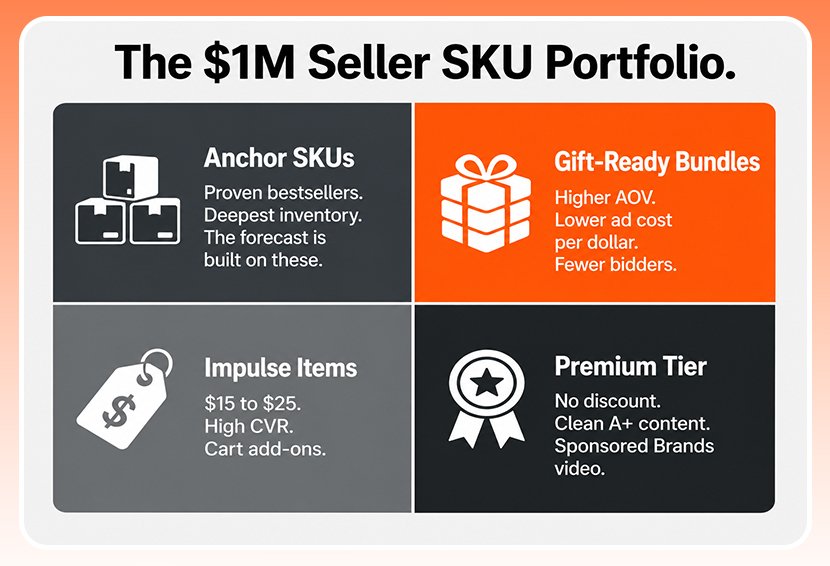
$1M sellers do not run hero SKU businesses in Q4. They run portfolios with four defined roles:
- Anchor SKUs: Proven bestsellers with the deepest inventory positions. These are the products the whole Q4 forecast is built around.
- Gift-ready bundles: Virtual bundles and physical multipacks priced higher than the base SKU. Higher AOV, lower ad cost per dollar of revenue, and fewer competitors bidding on the exact bundle keywords.
- Impulse-price items: Products in the $15 to $25 range. High conversion rates and easy add-on purchases when a shopper is finishing their gift budget.
- Premium or luxury tier: No discount, positioned as the “nice gift for someone specific” purchase. These do not need Lightning Deals. They need clean A+ content, a good hero image, and a Sponsored Brands video.
Bundle math is worth spelling out. A $47 bundle of three items has a higher AOV than any single unit, a lower ad cost per dollar, and a smaller pool of competitors bidding on bundle-specific keywords. Top sellers build 3 to 6 virtual bundles per hero SKU family before Q4 even starts.
They also submit Best Deal, 7-Day Deal, and Prime Exclusive Discount applications months in advance. The submission windows for Q4 deals typically close by August or September. Missing that window means paying for visibility with ads that a deal badge would have given you for free.
The SKU picking framework matters too. Top sellers do not put deals on their absolute bestsellers if inventory is tight. They put deals on the SKUs with deep inventory and healthy margin, and let the bestsellers ride organic and PPC. That way, a Lightning Deal does not blow through 40 percent of your Q4 inventory in a single afternoon.
Our post on Amazon pricing strategy goes deeper into how to protect margin while running promotions.
The 7 Figure Amazon Q4 Strategy for Advertising
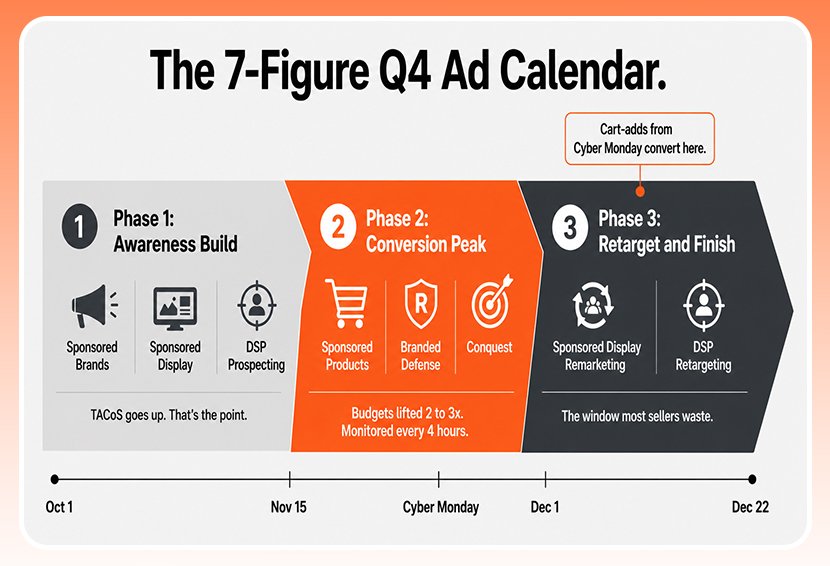
7-figure sellers do not just spend more on ads. They spend differently, on a calendar most sellers never build. The 3-phase Q4 ad calendar looks like this:
Phase 1: Awareness build (October 1 to November 15): Sponsored Brands, Sponsored Display, and DSP prospecting take priority. The goal is getting into carts, wishlists, and repeat-view audiences. TACoS goes up during this phase, and top sellers know it will. They are buying a position for the next 6 weeks.
Phase 2: Conversion peak (November 15 to Cyber Monday): Sponsored Products bids get aggressive. Branded defense campaigns run wide to protect against competitor bids. Conquest campaigns hit competitor ASINs. Daily budget caps get lifted 2 to 3x. Top sellers monitor budget pacing every 4 hours during Cyber Week, not once a day.
Phase 3: Retarget and finish (December 1 to December 22): This is the window most sub-7-figure sellers waste. They pull budgets after Cyber Monday to “protect margin,” and they miss the highest-intent gift shoppers of the year. Top sellers keep Sponsored Display remarketing and DSP retargeting running hard through December 22. The people who added to cart on Cyber Monday and did not check out are the ones who convert here.
After December 22, Sponsored Products get pulled back. Branded terms stay live through year-end. Branded term protection deserves its own note. In Q4, competitors bid on your brand name aggressively. If you are not running exact-match branded campaigns with priority bids, you are handing them the top of your own search results. This is table stakes at the $1M level.
There is also a measurement layer worth calling out. Amazon Marketing Cloud gives sellers access to cross-channel attribution, path-to-purchase analysis, and audience overlap data. Most $300K sellers do not use it. Most $1M sellers do, at least through an agency. The Q4 debrief in January is only as useful as the data you captured in November.
Our guides on winning strategies for Amazon Black Friday ads and 10 tips to lower Amazon PPC costs provide a solid pre-Q4 audit.
Amazon Seller Habits That Drive Q4 Growth Year After Year
Q4 is won by systems built in July and August. The distinguishing habits of 7-figure sellers with a successful Amazon Q4 strategy are:
- Inventory reviews: Weekly inventory review meeting starting in August, with reorder triggers documented per SKU. Not a spreadsheet nobody opens. A meeting on the calendar.
- Regular PPC review: Daily PPC review starting mid-October with pre-agreed bid ceilings, pause rules, and budget escalation rules. The founder does not make bidding decisions in the middle of Cyber Monday.
- Documented Q4 SOPs: Customer service response scripts, return handling flow, account health monitoring, listing update freeze rules. Everything a new hire could pick up and run with.
- Dedicated Q4 ops owner: Either an in-house operations lead or an agency team. The founder’s job in Q4 is decisions and cash, not inbox triage.
- Structured January post-mortem: Do a detailed audit with real data (GSC-style reporting on Amazon), not a vibes review.
Amazon Q4 Mistakes to Avoid If You Want to Scale Past 6 Figures
Most Q4 mistake lists read like generic warnings. Here are the ones that actually cost 6-figure sellers 7-figure quarters:
- Chasing top-line revenue instead of margin: A $1.2M Q4 at 3 percent net is worse than a $700K Q4 at 12 percent net. Top sellers optimize for cash generated, not GMV.
- Launching new SKUs in October: Q4 is the wrong time to test. New products have no ranking, no reviews, and no historical bid data. Save launches for February.
- Cosmetic listing updates during peak season: Any major title, bullet, or image swap after November 1 risks a re-index delay right when organic traffic is at its highest.
- Ignoring returns forecasting: December return rates run 20 to 30 percent higher than the annual average. Top sellers reserve cash for reimbursements and write Q1 returns into their P&L before Q4 even starts. Our post on how to reduce marketplace product returns helps you get ahead of this.
- Under-staffing customer service: Q4 customer service volume can be 3x the normal. Response time under 24 hours is what protects seller metrics and the Buy Box.
- Cutting ads too early after Cyber Monday: December 1 to December 20, is one of the highest-intent shopping windows of the year. Sellers who pull budgets to protect ROAS miss it entirely.
- No Q1 recovery plan: Top sellers use January for review harvest, listing refresh, FBA reimbursement claims, and the Q4 debrief. Our Amazon FBA reimbursement guide is where January cash recovery starts.
How Do 7-Figure Sellers Prepare for Black Friday?
Ask a $1M seller when Q4 planning starts, and you will not hear “September.” You will hear “the day the last one ended.” The FBA inbound calendar is the forcing function. Shipments for Black Friday need to be received at Amazon fulfillment centers by early November, which means they need to leave your 3PL or manufacturer weeks earlier. Halloween inventory needs to be in by mid-September. Christmas inventory by mid-November. Miss these windows and your product sits in a receiving queue while your competitor’s product sits in a customer’s cart.
Top sellers ship in waves starting in July and August, not in one massive shipment in October. They spread FC receiving load, avoid over-stuffing storage, and build in a buffer for the receiving delays Amazon has become famous for in Q4.
Their forecasting also looks different. Most $300K sellers use one flat demand forecast. Top sellers build three:
- Base case: what last Q4 did, adjusted for growth
- Aggressive case: if a hero SKU takes off or a competitor stocks out
- Sold-out case: the level they refuse to fall below
Then they order 20 to 40 percent more inventory than the base case. Yes, that means paying more in storage fees. They accept the fee because they know a stockout in late November wipes out the organic ranking that took a year to build, and that recovery cost is much higher than storage.
There is also a 2026-specific layer, which is tariff timing. Sellers importing from China have been pulling Q4 orders forward to lock in current rates before any adjustment. If you have not modeled tariff exposure into your landed cost, you are guessing at margin.
Quick math to run this week: If you sell 8,000 units in a normal month and expect a 2x to 3x lift in your peak Q4 month (November is usually the biggest, higher end of the range for seasonal categories like electronics, toys, and home goods), you need 16,000 to 24,000 units on hand by early November. Not “ordered.” On hand. Add a Cyber Week buffer on top of that for your fastest-moving SKUs, which can spike 2x to 4x daily volume during BFCM.
Fixing IPI ahead of Q4 is a good starting point, and we cover the exact steps in our guide on how to improve your Amazon Inventory Performance Index. The full 60-day Q4 prep plan provides all the deadlines for Amazon Q4 2026 and measures to build a solid inventory base.
The 2026 Layer Top Sellers Are Adding to Their Amazon Q4 Strategy
In May 2026, Amazon rolled Rufus and Alexa+ into a single assistant called Alexa for Shopping, now the default AI layer across the Amazon Shopping app and website. It is available to every US customer, no Prime membership or Echo device required. For sellers, this is a bigger shift than most realize, and the top ones have already rebuilt their listing playbook around it.
Here is what actually matters for Amazon Q4 strategy 2026:
- AI overviews now sit at the top of search results and on product detail pages: Alexa for Shopping surfaces a category summary before the buyer scrolls to individual ASINs. If your title, bullets, and A+ content are not structured to answer common category questions, the AI overview will not pull from you. Top sellers are rewriting A+ content in question-and-answer format and tightening bullet points into direct benefit statements the assistant can lift cleanly.
- Side-by-side product comparisons pull directly from search results: Buyers can now select multiple products from a search page and get an instant comparison of features, prices, and reviews. This means your listing is no longer competing on a single detail page. It is competing in a live comparison against 3 or 4 direct rivals. Weak bullet content, missing dimensions, or fuzzy feature language will lose you the comparison even when the product itself is better.
- One-year price history is now exposed to shoppers: Any buyer can tap “Price History” on a product detail page and see how the price has moved over the past year. This kills the fake-discount play. If you hiked prices in October to run a “50 percent off” Black Friday deal, the price history graph will show it, and Alexa for Shopping will flag it. Top sellers are pricing more honestly in Q3, so their Q4 discounts read as real.
- Scheduled Actions and Auto Buy change reorder behavior: Buyers can now tell Alexa to add specific products to their cart on a schedule, at a target price, or under conditional rules like “add this sunscreen if it drops to $10 and I have not bought it in 60 days.” This is subscription-like behavior for products that never joined Subscribe and Save. Sellers with consumables should be optimizing to become the default “regular” pick in a buyer’s account memory.
- Shop Direct and Buy for Me extend Amazon beyond Amazon: Alexa for Shopping can now buy on other retailer sites through the Buy for Me agentic feature. Off-Amazon strategy matters more, not less.
On the ad side, agentic AI tools like Perpetua, Pacvue, and Adtomic are handling bid management, budget pacing, and negative keyword mining at a scale a human PPC manager cannot match during Cyber Week. Sellers using these tools during Q4 are not just spending more efficiently, they are reacting to competitor bid changes in minutes instead of days.
What is not worth chasing in 2026 is generic ChatGPT-written listings and AI-generated hero images. Amazon has been actively cracking down on both, and Alexa for Shopping’s AI overview seems to weigh structured, specific, human-verifiable content more heavily than the vague marketing copy the first wave of AI-written listings produced.
For more on how to layer AI into your operation, our post on how Amazon sellers can leverage AI covers the practical stack. Our earlier piece on COSMO and Rufus explains the ranking infrastructure that Alexa for Shopping is now built on top of.
How to Have a $1M Q4 Month on Amazon: The Actual Math
A $1M month breaks down to roughly $33K per day. At a $35 AOV as an example, that is about 950 units per day, every day, for 30 days.
The context to hold in your head: Q4 typically drives 30 to 35 percent of annual seller revenue on Amazon, based on published industry aggregates. Amazon’s own third-party seller services grew roughly 24 percent from Q3 to Q4 in 2025. But that quarter-level number hides the real shape of Q4. Within the quarter, November is almost always the peak month for established sellers, and Cyber Week can pull 2x to 4x normal daily volume on top SKUs in seasonal categories. Electronics and home goods commonly see 60 to 80 percent Q4 lifts overall, beauty and personal care closer to 40 to 50 percent, with the bulk of that increase compressed into a 3 to 4 week window.
For a $200K to $500K per month seller, a $1M November is not a proportional scale-up of an average month. It is a peak-month capacity event that runs for roughly 30 days.
To hit $1M in a single Q4 month, you need three things aligned:
- Inventory depth: At 950 units per day, that is 28,500 units for the month, plus a safety buffer for the Cyber Week spike, which can hit 2x to 4x the daily average. Realistic on-hand inventory heading into November: 35,000 to 40,000 units for your top SKUs. Not ordered. On hand.
- Ad budget: Amazon CPC costs typically rise 40 to 60 percent during Q4 peak season. Top sellers plan for that inflation, front-load spend in October and early November before rates peak, and set daily budgets in dollar terms rather than as a percentage of revenue.
- Conversion volume: Your top SKUs need to convert at or above category norm. If your current CVR is meaningfully below your category benchmark, fix listings before Q4, not during.
The gap analysis every $200K to $500K per month, the seller should run this week:
- Take your current monthly revenue
- Multiply by 2 to 3 for the peak-month lift you can realistically expect in your category (lower end for stable categories, higher end for seasonal ones like electronics, toys, or home goods)
- Compare the result to $1M
A $300K per month seller at a 2.5x peak-month lift lands at $750K in November. A $400K seller at the same multiplier lands at $1M. A $200K seller would need a 5x lift, which is not realistic without either a category tailwind, a new SKU launch that hits, or a Lightning Deal that runs down to breakeven for the ranking push.
That gap tells you whether $1M is a capacity question, a category question, or a positioning question. Closing it means SKU expansion, higher AOV bundles, aggressive deal placement, or a bigger ad war chest to buy incremental traffic. It is not a growth hack question. It is a math question.
Final Thoughts
The difference between a $300K/month brand and a $1M/month brand usually isn’t better tactics. It’s having better systems, better planning, and making smarter decisions. The brands reaching 7 figures treat Q4 like a well-planned operation, not a last-minute sales rush.
If your brand is doing $200K–$500K per month and you want a more organized Q4, SPCTEK can help. We handle inventory forecasting, PPC planning, cash flow forecasting, deal submissions, and account health monitoring so you’re ready before the busy season begins.