
Too busy to read? Listen to this article instead.
If you’re running an Amazon business doing $200K to $500K a month, you’ve probably built a solid ecommerce strategy for exactly one platform, Amazon. That’s understandable, Amazon has been the obvious place to sell for over a decade. But there’s a real window open right now to add a second channel before this Q4 hits, and the numbers behind it are hard to ignore.
Walmart Marketplace has grown into a genuine growth lever, one still sitting mostly untouched by Amazon sellers who assume Walmart is either too small to bother with or too different to learn quickly. Neither is true anymore, and this guide walks through exactly why, along with the real dates you need to hit before Q4 locks in.
How Does Walmart’s Ecommerce Strategy Differ From Amazon’s?
The biggest difference is how each platform actually makes its money, and that shapes almost everything else about selling there. Amazon’s business runs heavily on advertising and fulfillment fees layered across a massive, saturated seller base. Walmart’s growth engine works differently. It leans on retail media (Walmart Connect, its advertising arm) combined with its physical store network, which lets it offer things Amazon structurally can’t, like local pickup and same-day delivery tied to actual Walmart stores.
The seller pool is also a lot smaller. Walmart Marketplace surpassed 200,000 active sellers in mid-2025, a fraction of Amazon’s seller base. Fewer sellers competing for the same buyer attention generally means an easier time getting visibility on a new listing, something that’s gotten much harder to do on Amazon without a big ad budget behind it.
Fees also work differently depending on category. Some categories carry lower referral fees on Walmart than the Amazon equivalent, though this varies enough by product type that it’s worth checking your specific category before assuming Walmart is automatically cheaper.
Is Walmart Ecommerce Profitable?
Yes, and the growth data backs that up better than most Amazon sellers realize. Walmart’s ecommerce revenue grew 27% year over year. That’s not a small gap. Marketplace GMV, the total value of goods sold by third-party sellers, has grown over 30% year over year for four straight quarters, and Walmart’s online sales overall have now grown more than 20% for five consecutive quarters heading into this year.
Profitability on any marketplace comes down to demand versus competition. Walmart currently sits at roughly 6.3% of total U.S. ecommerce sales, compared to Amazon’s roughly 37.8%, which sounds like a disadvantage until you flip it around. That gap means there’s real buyer demand on Walmart that isn’t being fought over by nearly as many sellers per product category. For a brand already doing $200K to $500K a month on Amazon, that’s exactly the kind of gap worth filling before more sellers catch on.
Walmart Ecommerce Growth: Why the Timing Matters Right Now
Walmart ecommerce growth shows up in specific mechanics that actually drive sales right now, and each one comes with a real reason the timing matters for anyone building a Walmart ecommerce strategy this year.
Fulfillment Timing: The “Fast & Free” Badge Won’t Stay a Differentiator
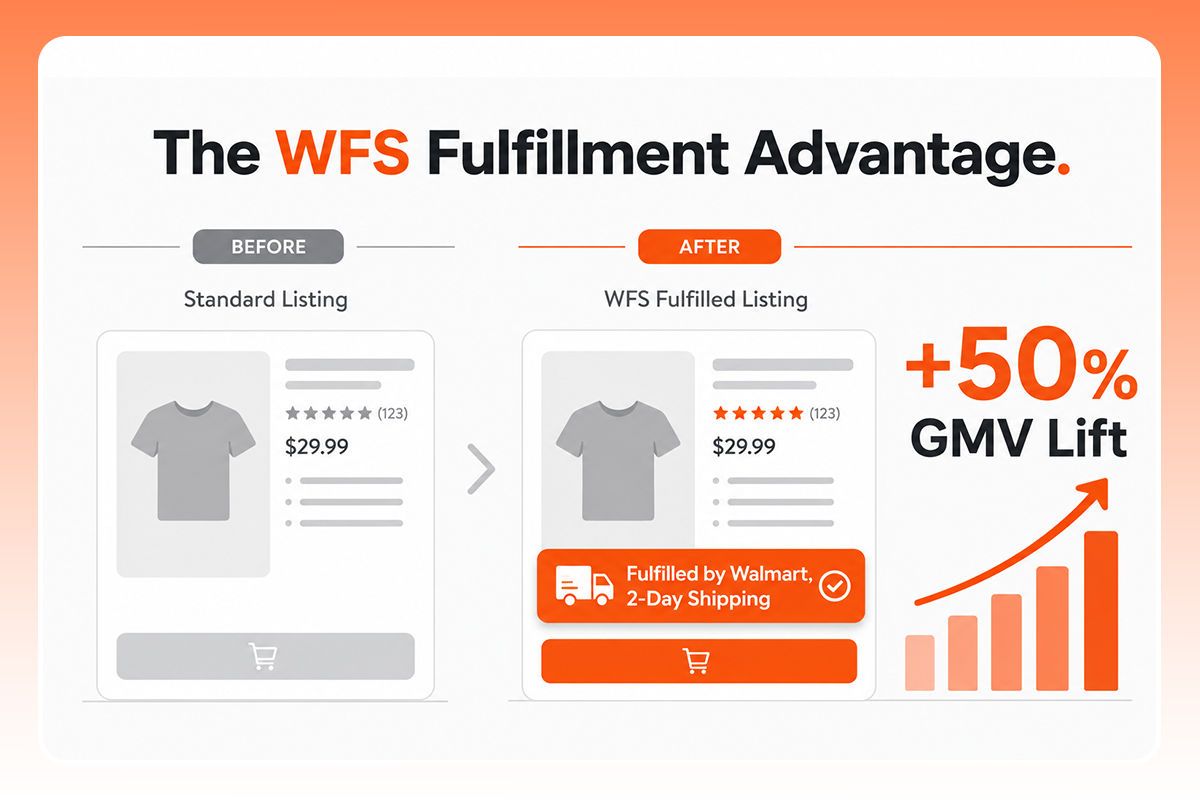
Sellers using Walmart Fulfillment Services, WFS, get a “Fast & Free” shipping badge on their listings. Buyers actively filter for that badge, and listings with it consistently convert better than merchant-fulfilled listings. More directly, items tagged “Fulfilled by Walmart” with 2-Day Shipping see a 50% GMV lift compared to listings without it. That advantage only exists because plenty of sellers still don’t have the badge yet; once enrollment becomes the norm rather than the exception, it stops setting anyone apart.
Advertising Timing: Walmart Connect Costs Won’t Stay This Low
Walmart Connect’s ad revenue has been growing 30%+ per quarter, reaching 37% global growth and 44% growth excluding VIZIO in Q1 FY2027, which shows Walmart actively investing in tools to help sellers get discovered rather than treating advertising as an afterthought. More importantly for cost, the platform is still early enough that ad prices haven’t caught up to Amazon’s saturated, decade-old auction system. Every marketplace’s ad costs climb as more sellers compete for the same clicks, and Walmart is simply earlier in that curve than Amazon, which is exactly the kind of gap a solid Walmart ecommerce strategy should be built around while it still exists.
Seller Growth Timing: The Competitive Gap Is Already Closing
Both advantages above exist only because Walmart’s seller base is still smaller than it’s about to become. Walmart Marketplace added roughly 30% more sellers in just the first five months of 2025 alone, a faster pace than at almost any point before it. Every new seller joining is competing for the same badge and the same ad placements described above, which is the actual mechanism behind why this window keeps getting smaller.
What Are Walmart Q4 Key Dates 2026?
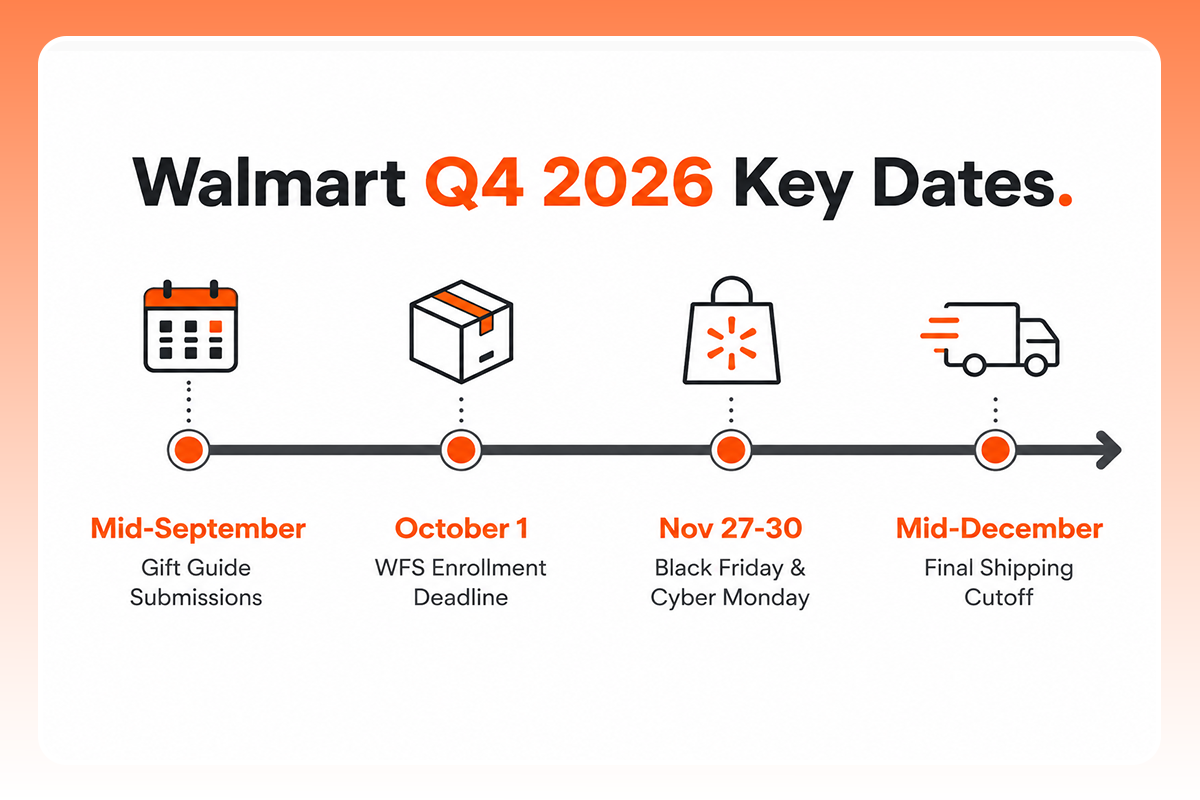
This is where timing actually becomes urgent. A few dates on the calendar determine whether your products are even eligible for Walmart’s biggest shopping events this year.
- Mid September: This is your window to submit products for Walmart’s holiday gift guides and homepage placements. Miss this, and you lose the editorial visibility Walmart hands out to sellers who plan ahead, even if your products are perfectly eligible otherwise.
- October 1: The date that matters most. This is the deadline to add products to Walmart Fulfillment Services with guaranteed inventory capacity for the holiday season. Miss it, and you risk losing the “Fast & Free” badge exactly when buyers are relying on it most, right as Black Friday and Cyber Monday traffic hits.
- November 27 through November 30: Black Friday through Cyber Monday, Walmart’s two biggest sales days of the year, back to back.
- December 19: The final cutoff for guaranteed holiday delivery. After this date, buyer urgency shifts toward expedited shipping options, and that pressure holds right up through Christmas Day before the season winds down.
If you’re new to Walmart, September and October are the two months that decide how your Q4 actually goes, not November. By the time Black Friday arrives, the sellers who enrolled in WFS and submitted for gift guides back in September are already positioned. Sellers who wait until November are starting from behind.
How to Get Started With Selling on Walmart?
Starting on Walmart is more straightforward than most Amazon sellers assume, especially if you already have your product data organized. Here’s the actual sequence for getting a Walmart ecommerce strategy off the ground with the least wasted time.
- Apply for a Walmart Seller Account: This requires a registered U.S. business entity with an EIN, along with a W-9 or W-8 tax form and documents verifying your business name and address. You’ll also need existing UPC or GTIN codes, which you likely already have from your Amazon catalog, and Walmart specifically looks for a demonstrated track record of e-commerce success on platforms like Amazon, eBay, or Shopify, which works in your favor if you’re already running an established Amazon business.
- Decide on Your Fulfillment Plan Before Applying: Walmart requires either enrollment in Walmart Fulfillment Services or a U.S.-based warehouse capable of handling returns and meeting its shipping standards. Given the advantages WFS provides, covered above, most Amazon sellers expanding to Walmart are better off planning for WFS from the start rather than treating fulfillment as an afterthought.
- Adapt Your Listings Instead of Copy-Pasting Them: Once approved, resist the urge to just move your Amazon listings over as-is. Walmart’s search and buyer behavior differ enough from Amazon’s that your product content is worth reviewing and adjusting for the new platform, not just copied over exactly as it runs on Amazon.
- Prioritize WFS Enrollment Early: Prioritize WFS enrollment early, especially given the October 1 deadline covered above. Getting your best-selling ASINs into WFS before that date is the single highest-leverage move available to a new Walmart seller heading into Q4, since it’s what unlocks the ‘Fast & Free’ badge that drives the conversion lift discussed earlier.
- Set Your Pricing With Parity Rules in Mind From Day One: Walmart expects your price there to stay competitive with what you charge elsewhere, including your own Amazon listings, so it’s worth deciding your pricing strategy across both platforms before you go live rather than adjusting after the fact.
- Layer in Sponsored Products Once Listings Are Live: Organic visibility alone takes longer to build on a newer platform than most sellers expect, since your account has no sales history or reviews yet to lean on. A modest ad budget in the first few weeks does a lot of the early heavy lifting that organic ranking would otherwise take months to build on its own.
Following this order matters more than doing everything at once. Sellers who try to launch a full catalog, run ads, and chase every feature in week one usually end up managing chaos instead of learning the platform. Getting the account approved, a handful of best-sellers into WFS, and pricing sorted first gives your business a stable base to expand your Walmart ecommerce strategy once Q4 traffic actually arrives.
Conclusion
The case for building a real Walmart ecommerce strategy this year isn’t abstract. The growth numbers are real and verifiable, the competition is genuinely lighter than Amazon right now, and the October 1 deadline means the decision to act needs to happen in the next few weeks, not sometime next quarter.
Every advantage covered here, the fulfillment badge, the cheaper ad auction, the smaller seller pool exists because Walmart is still relatively early in its growth curve. None of it stays this way indefinitely, and the sellers who move before this Q4 are the ones who get to use these advantages while they’re still real.