
Paid traffic costs more every year. Ad auctions get more crowded, marketplaces take a growing share of each sale, and the cost of acquiring a customer climbs while margins stay flat. Organic search is the one acquisition channel where the opposite happens, because a page you publish today keeps bringing in visitors next year at no additional cost.
Ecommerce SEO is the process of optimizing an online store so its category pages, product pages, and supporting content rank for the terms buyers actually search. Unlike general SEO, the work centers on commercial pages rather than blog posts, and it is judged on revenue rather than traffic alone.
However, ecommerce SEO is harder to execute than the standard advice suggests. You are not optimizing twelve pages. You are managing a catalog that generates thousands of URLs, most of them thin, many of them duplicates of copy every competitor already published, and a meaningful share pointing at products you no longer stock.
This guide explains what ecommerce SEO involves, how to research and map keywords, how to optimize category and product pages, which technical issues matter most, how AI search changes the work, and what to do differently if you also sell on a marketplace.
What Is Ecommerce SEO?
Ecommerce SEO is the practice of improving an online store’s visibility in organic search results so that category pages, product pages, and related content appear when buyers search for products you sell.
The goal is not traffic alone. It is traffic that converts, which is why the work concentrates on commercial pages rather than informational content. A blog post that ranks and does not sell is still useful. A product page that ranks and does not sell is a failure.
In practice, ecommerce SEO covers five connected areas:
- Keyword research and mapping, which means finding the terms buyers use and assigning each one to a specific page
- On-page optimization across titles, headings, descriptions, images, and structured data
- Technical health, including crawling, indexing, duplicate content, site speed, and how filters generate URLs
- Content that captures demand before the purchase decision
- Authority signals that make search engines trust your pages over identical listings elsewhere
One caveat before investing. Ecommerce SEO rewards brands with staying power. If your catalog turns over every few months, your margins cannot absorb a six month payback period, or you need revenue inside the current quarter, paid acquisition is the better use of budget.
How Is Ecommerce SEO Different From Regular SEO?
The standard SEO playbook assumes a manageable number of pages, each written deliberately. Ecommerce breaks that assumption in several specific ways.
1. Scale
A store with 800 products and 40 categories can generate tens of thousands of crawlable URLs once filters, sorts, and variants are counted. No team is hand-optimizing that volume, which means systems matter more than individual page work.
2. Duplicate Content by Default
Manufacturer descriptions arrive in the product feed and get published word for word by every retailer carrying that item. Search engines have to choose one version, and it is rarely the smallest store.
3. Faceted Navigation
Filters for size, color, price, and brand multiply URLs quickly. Left unmanaged, they consume crawl budget and flood the index with near-identical pages that compete against each other.
4. Inventory Churn
Products sell out, get discontinued, or disappear seasonally. Every one of those events is an SEO decision about a page that may already hold rankings you paid to earn.
5. Conversion Pressure
A category page filled with 800 words of keyword copy above the product grid might rank well and sell nothing, because shoppers scroll past a wall of text looking for products. The constraint shapes every tactic that follows.
How Do You Do Keyword Research for an Ecommerce Site?
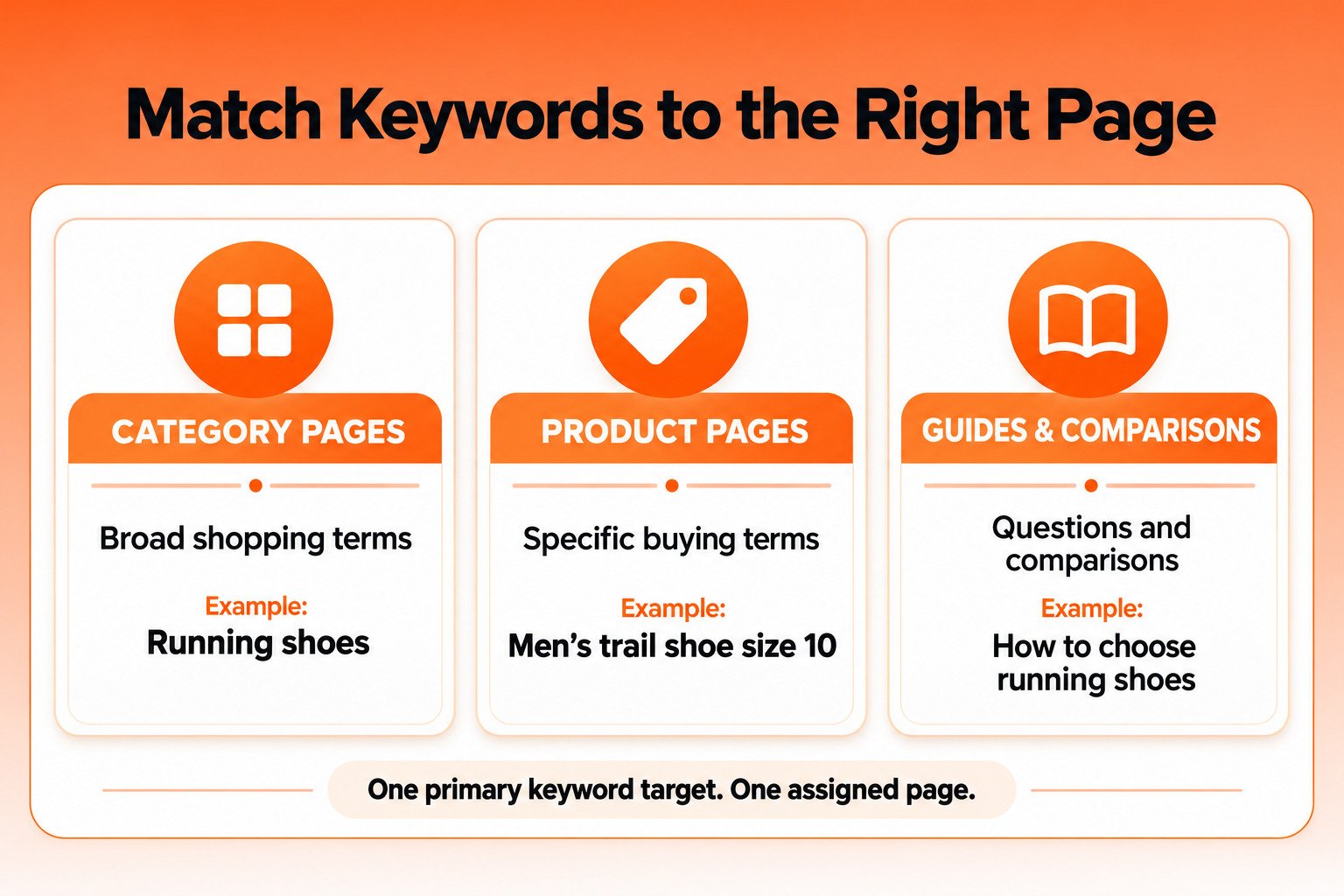
Keyword research for a store is really an exercise in matching intent to page type. Get the mapping wrong and you end up competing with yourself, or building a blog post to target a term only a category page could win.
1. Category Keywords
These are broad, high volume, and highly competitive. Terms like running shoes, leather sofas, or espresso machines belong on category pages and represent the bulk of available traffic.
2. Product Keywords
These are specific and lower volume, with much higher intent. Model names, SKUs, and variation terms belong on product pages and convert at the highest rate of any keyword type.
3. Research and Comparison Keywords
Questions and comparisons happen before a buyer knows what they want. Terms like how to choose a running shoe for flat feet belong on content pages, not commercial pages.
4. Map Every Keyword to One Page
Mapping is the actual deliverable. Build a sheet listing every target keyword, the page type that should own it, the assigned URL, and the current ranking position.
Without that document, two problems appear. Multiple pages start competing for the same term, and high-value terms end up with no page assigned at all.
Commercial modifiers deserve a separate pass. Words like best, cheap, for, versus, alternative, and near me each signal a different stage and often a different page type. Competitor gap analysis is where the fastest wins usually hide, and the same competitive discipline that drives keyword ranking on marketplaces applies to your own site.
How Should You Structure Category Pages for SEO?
Architecture determines what search engines can find and how much authority reaches your commercial pages. It is the least visible part of ecommerce SEO and the one most often quietly broken.
Category pages are usually your highest-value asset. They target terms with far more volume than any individual product, and they tend to hold positions longer. A store that invests in product pages while leaving category pages as bare grids is optimizing the wrong layer.
1. Keep Click Depth Shallow
Any page more than three or four clicks from the homepage gets crawled less often and receives less internal link equity. On large catalogs, entire product ranges become effectively invisible because they sit five levels deep behind a filter nobody links to.
2. Add Content Without Burying Products
The pattern that works is a short introduction of 100 to 200 words above the grid explaining what the category covers, then a longer section below the products holding a buying guide, FAQ, or comparison table. Shoppers see products immediately and search engines still get substantive content.
3. Decide When to Split a Subcategory
Split a category when the subcategory has real search volume and enough products to justify a page. Consolidate when you would be creating pages with four products and no demand behind them, because thin category pages hurt more than they help.
4. Use Descriptive URLs and Breadcrumbs
Descriptive paths tell both users and crawlers what a page covers. Avoid parameter strings and numeric identifiers in primary paths, keep casing consistent, and do not nest deeper than the hierarchy requires. Breadcrumbs reinforce the structure and earn breadcrumb markup in search results.
What Makes an Ecommerce Product Page Rank?
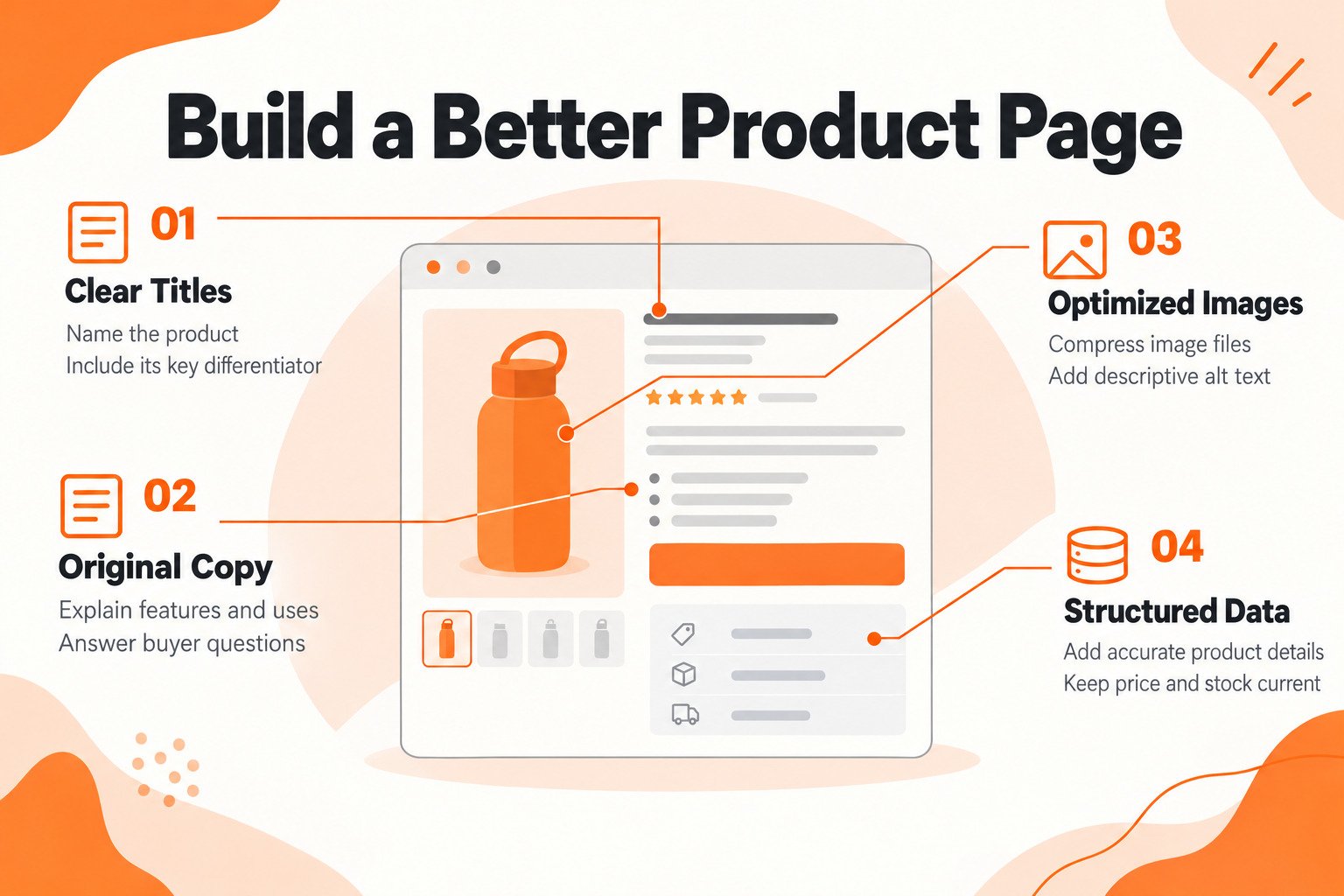
Product pages are now ranking assets rather than conversion pages alone. The bar for a complete page has risen, and thin pages built straight from supplier feeds no longer compete.
1. Title Tags and Headings
Follow a predictable pattern of brand, product name, key differentiator, and category where it fits under 60 characters. The H1 can run slightly longer and read more naturally. Do not write different titles and H1s purely to force in extra keywords.
2. Original Product Descriptions
This is the single highest-leverage change most stores can make. Manufacturer copy appears identically on every retailer selling the product, so search engines have no reason to prefer your version.
Writing your own copy caps how many products you can cover, so prioritize by revenue and start with your top 20 percent. Ignore advice suggesting descriptions must run 1,000 words or more. Length is not the ranking factor, completeness is.
3. Images
Use descriptive file names, write alt text that describes the image rather than repeating the keyword, compress aggressively, and lazy load anything below the fold. On image-heavy pages this is usually the fastest route to better Core Web Vitals.
4. Customer Reviews
Reviews add fresh, unique text to a page that otherwise never changes, and they cover phrasing your copywriter would never think to use. Building review volume is an SEO investment as much as a conversion one, which is why leveraging customer reviews belongs in the SEO plan.
5. Out-of-Stock and Discontinued Products
These need a standing policy rather than case-by-case decisions. If the product is returning, keep the page live and show alternatives. If it is gone permanently, redirect to the nearest equivalent or the parent category. Deleting the page discards rankings and creates a 404 where a buyer used to land.
6. Product Schema
Product, Offer, AggregateRating, and BreadcrumbList markup in JSON-LD format produce the rich results that win clicks, and the same structured data feeds the AI systems covered below. Our guide to product descriptions that convert covers the copy side in detail.
What Technical SEO Issues Affect Ecommerce Sites?
Technical problems cap what every other effort can achieve. A store with excellent content and broken crawl paths will underperform a mediocre store that gets the fundamentals right.
1. Crawl Budget
Search engines allocate a finite amount of crawling to each site. When filters and parameters generate tens of thousands of low-value URLs, that budget gets spent on pages nobody should see while genuine product pages go unvisited for weeks. Server log analysis is the reliable way to find the waste.
2. Faceted Navigation
The usual approach combines canonical tags pointing filtered URLs back to the parent category, noindex directives on filter combinations with no search demand, and parameter handling rules. A small number of high-demand filter combinations deserve indexable pages of their own. The rest should stay out of the index.
3. Duplicate Content
Three sources cause most of it: manufacturer descriptions, product variants published as separate URLs, and pagination. Canonicals solve the variant problem, original copy solves the manufacturer problem, and pagination is usually best handled by keeping paginated pages indexable with self-referencing canonicals.
4. Site Speed and Core Web Vitals
These are table stakes rather than a competitive edge. On ecommerce sites, the usual culprits are uncompressed hero images, third-party scripts from apps and tracking tools, and layout shift from lazy-loaded elements without reserved space.
5. XML Sitemaps
Segment sitemaps by page type. Separate files for categories, products, and content let you see indexing rates per type in Search Console. When 60 percent of your product pages are not indexed, a single combined sitemap hides that fact entirely.
6. Internal Linking at Scale
Related product modules, recently viewed items, category cross-links, and hub pages distribute authority automatically. Manual internal linking does not survive a catalog of any meaningful size.
What Content Should an Ecommerce Site Publish?
Commercial pages capture people who already know what they want. Content captures everyone earlier in the process, which is a far larger group.
Four content types do most of the work:
- Buying guides that target research-stage terms with real search volume
- Comparison content covering versus queries that competitors frequently ignore
- Problem-first content reaching buyers who do not yet know your product category exists
- Video and user-generated content, which supports rankings and conversion at the same time
The step most stores skip is linking content back to commercial pages. A buying guide that never links to the relevant category page captures interest and then loses it. Our piece on UGC and AI video covers the production side, and the relationship between content marketing and social distribution matters because content nobody sees rarely earns links.
How Do You Build Links to an Ecommerce Site?
Links remain a ranking factor, and ecommerce sites carry a structural disadvantage. Nobody links to a product page voluntarily, because publishers link to resources, research, and stories rather than listings.
Four approaches produce consistent results:
- Digital PR and original data, including customer surveys or trends only your sales data could reveal
- Supplier and stockist relationships, since manufacturers often maintain dealer directories
- Genuinely useful guides that become the reference for a category
- Converting existing unlinked brand mentions into links
Internal links are the only link type you fully control. Before chasing external links, make sure your own authority flows to the pages that need it, because most stores have homepage authority pooling uselessly instead of reaching category pages.
Avoid paid link networks and mass guest posting. The risk profile has not improved, and a manual action on a revenue-generating store costs far more than any ranking gain is worth.
How Do You Optimize an Ecommerce Site for AI Search?
Search results for commercial queries increasingly include AI-generated summaries, and shoppers increasingly ask assistants directly rather than typing keywords. This is no longer an emerging trend, and most serious competitors already account for it.
AI systems pull from structured, specific content. Pages with clean schema markup, clear specifications, and direct answers to common questions get cited. Pages built on vague marketing language do not, regardless of how well they rank conventionally.
Getting product pages cited comes down to three things: complete structured data, specifications stated plainly rather than buried in prose, and question-and-answer content matching how buyers actually phrase things.
Generative engine optimization differs from classic SEO in what it optimizes for. Traditional SEO competes for a position in a list, while GEO competes to be the source a model quotes. Our breakdown of GEO versus traditional SEO covers the distinction, the practical tactics sit in our guide to growing brand AI visibility, and we cover where assistants buy on a shopper’s behalf in our piece on agentic commerce.
For brands that want this handled properly rather than bolted on afterward, our AI SEO services are built around exactly this problem.
How Does Ecommerce SEO Lower Customer Acquisition Costs?
This is the argument that matters most to anyone running a store at scale, and it is rarely made properly.
Paid and organic have opposite cost curves. Paid acquisition gets more expensive as competitors enter the auction, and cost per click rises regardless of what you do. Organic works in reverse, because a page that ranks costs nothing additional to serve and its cost per visitor falls every month it keeps working.
Blended acquisition cost is the number to watch. Organic traffic does not replace paid traffic, it lowers the average across all channels, which means you can hold paid spend flat while total acquisition cost drops.
The honest timeline is six to twelve months before organic contributes meaningfully, and longer in competitive categories. Technical fixes can show movement in eight to twelve weeks, but content and authority take considerably more. Anyone promising faster results on a competitive catalog is either overselling or planning something risky.
SEO is the wrong investment when margins are too thin to absorb a long payback, when your catalog turns over before pages mature, or when the business needs revenue this quarter to survive.
Measure leading indicators before revenue arrives. Indexed page count, crawl frequency on commercial pages, impressions growth, and ranking movement in positions 11 to 30 all move months before organic revenue does.
Organic traffic only lowers acquisition cost if you keep the customer, which makes retention part of the same calculation. Pairing SEO with email marketing is what turns a cheaper first purchase into a genuinely lower cost per customer, and our guide to lowering advertising costs covers the paid side of the same equation.
How Does SEO Work If You Also Sell on Amazon or Walmart?
Almost every guide on this topic assumes your website is your only sales channel. For a large share of brands, that is not true, and running SEO without accounting for marketplace presence leads to predictable mistakes.
Your marketplace listing will often outrank your own product page, because marketplace domains carry authority no independent store can match. This is not a failure, and trying to beat Amazon for your own product name is usually wasted effort.
The better approach is deciding which terms to concede and which to contest:
- Concede generic product searches that will go to marketplaces regardless
- Contest your own brand terms, because a marketplace outranking you for your brand means paying referral fees on customers looking specifically for you
- Contest category-level terms where marketplaces show mixed results
- Own research-stage content entirely, since marketplaces rarely compete there
Duplicate descriptions across channels are a real risk. Publishing identical copy on your site and your marketplace listings means competing against yourself with the same text on a stronger domain.
The margin case is straightforward. A sale through your own site avoids the marketplace referral fee entirely, and organic traffic is the cheapest version of that sale. For brands building that channel properly, our Shopify store management services cover the operational side, and our comparison between Walmart and Amazon helps if you are weighing which marketplaces to prioritize.
Does Your Ecommerce Platform Affect SEO?
Platform choice matters less than most people assume, though it does matter somewhat.
- Shopify offers strong defaults for speed and structured data, with a fixed URL structure as the main constraint. Most Shopify SEO problems come from app bloat rather than platform limits.
- WooCommerce gives maximum flexibility and maximum responsibility, since you control URL structure, templates, and schema completely and nothing is handled for you.
- BigCommerce provides a solid technical foundation with fewer structural constraints than Shopify and a smaller app ecosystem.
- Magento and Adobe Commerce are built for large catalogs and complex requirements, and they need dedicated technical ownership to perform.
The honest conclusion is that platform matters less than whether someone on your team actually owns the technical details. A well-managed WooCommerce store outperforms a neglected Shopify store, and the reverse holds equally.
How Is SEO Different for B2B and Wholesale Ecommerce?
B2B ecommerce receives almost no coverage in standard SEO guides, which is strange given how much commerce runs through it. The differences are substantial enough that consumer tactics transfer poorly.
1. Buying Cycles Run Months, Not Minutes
A buyer researching industrial supplies may read a dozen pages across several weeks before contacting anyone. That makes research-stage content far more valuable than it is in consumer ecommerce, where product pages carry most of the load.
2. Gated Catalogs Create a Ranking Problem
If prices sit behind a login, search engines cannot index them and your pages lose a significant relevance signal. The workaround is publishing everything that is not commercially sensitive, including specifications, applications, compatibility, and certifications. Keep pricing gated if you must, but do not gate the information that earns the ranking.
3. Wholesale Keyword Families Are Separate
Bulk, wholesale, minimum order quantity, case pack, distributor, and trade terms represent demand that consumer-focused keyword research never surfaces. These terms carry lower volume and dramatically higher value per visit.
4. Multiple Decision Makers Search Differently
The engineer searches specifications, the procurement manager searches suppliers and terms, and the executive searches outcomes. One page rarely serves all three, which argues for content built around roles rather than products alone. Our B2B SEO services are built for exactly this structure.
Common Ecommerce SEO Mistakes
Most ecommerce SEO programs underperform for reasons that have nothing to do with effort. These are the patterns that come up most often.
1. Optimizing Product Pages While Ignoring Category Pages: Category pages hold higher-volume terms and more durable rankings, yet most stores invest in the opposite order and wonder why traffic stays flat.
2. Letting Faceted Navigation Run Unchecked: Filters generate URLs faster than search engines can crawl them, and the resulting index bloat suppresses the pages that actually matter.
3. Publishing Manufacturer Descriptions Verbatim: You are asking a search engine to prefer your copy of a text that exists identically on a hundred stronger domains.
4. Deleting Discontinued Products: Those pages hold rankings and links. Redirect them to the nearest equivalent product or parent category instead of creating 404s.
5. Running SEO and Paid Search in Separate Silos: They share keyword data, landing pages, and conversion insights. Teams that do not talk duplicate work and miss the cheapest wins available.
6. Measuring Rankings Instead of Revenue: A page in position three that nobody buys from is a worse outcome than position eight on a term that converts.
7. Expecting Results Inside One Quarter: The most common reason SEO programs get cancelled is that they were evaluated against a timeline the channel cannot meet. If you are weighing what outside support costs before committing, our breakdown of what account management actually costs gives honest numbers to benchmark against.
Getting Your Store Found
Ecommerce SEO is mostly a structure problem rather than a keyword problem. Stores that win organic traffic have clean architecture, category pages built to rank, product pages with original content, and technical foundations that let search engines crawl what matters.
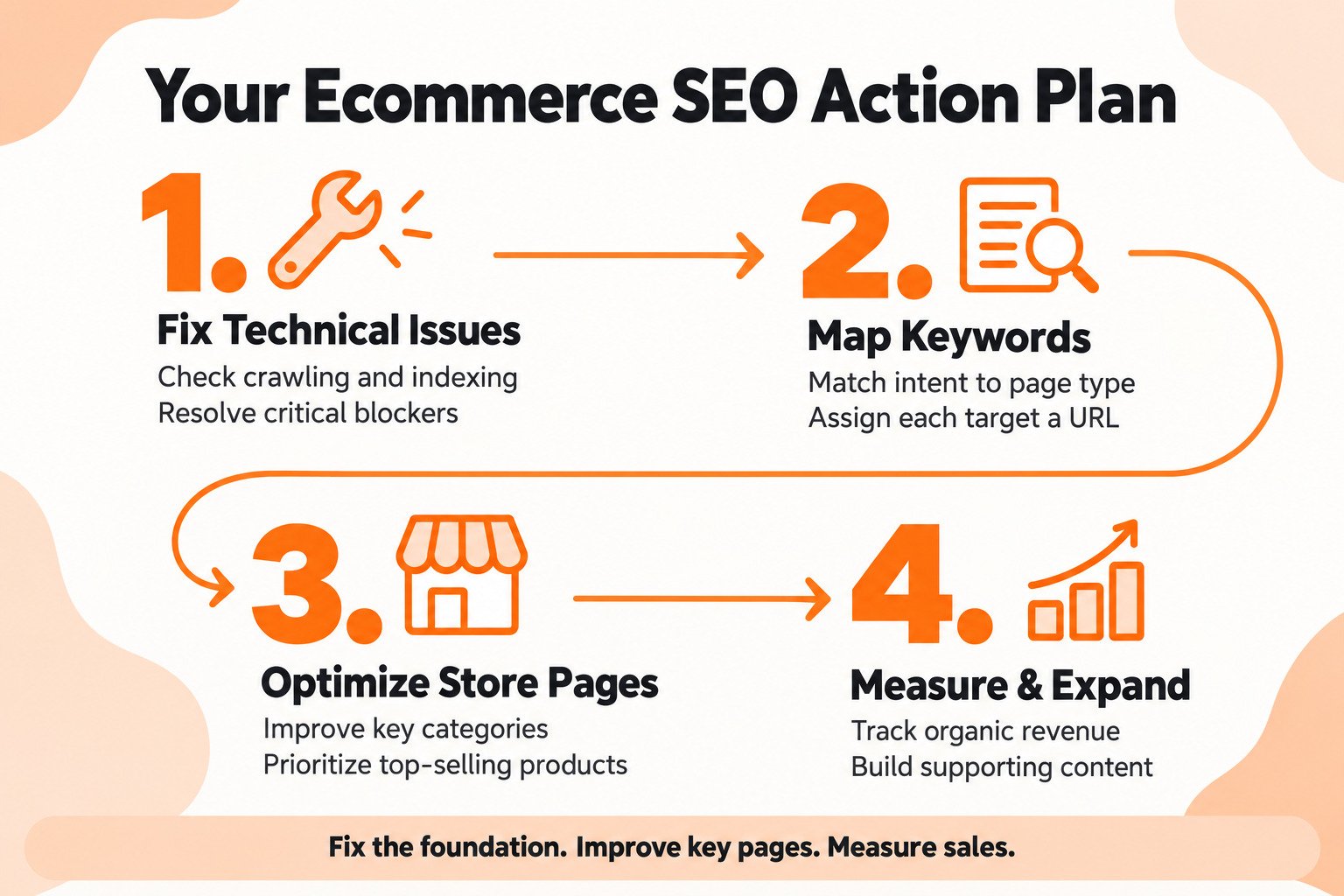
If you are starting from scratch, work in order. Run a technical audit and fix anything blocking commercial pages from being crawled. Build the keyword map and assign every term to a specific page. Then optimize your top category pages and highest-revenue product pages before expanding into content and authority work.
Most brands reach a point where this stops being something the team can absorb alongside everything else. The technical foundation, AI visibility work, and content program each require sustained attention, and progress stalls when all three compete for the same few hours a week.