
Too busy to read? Listen to this article instead.
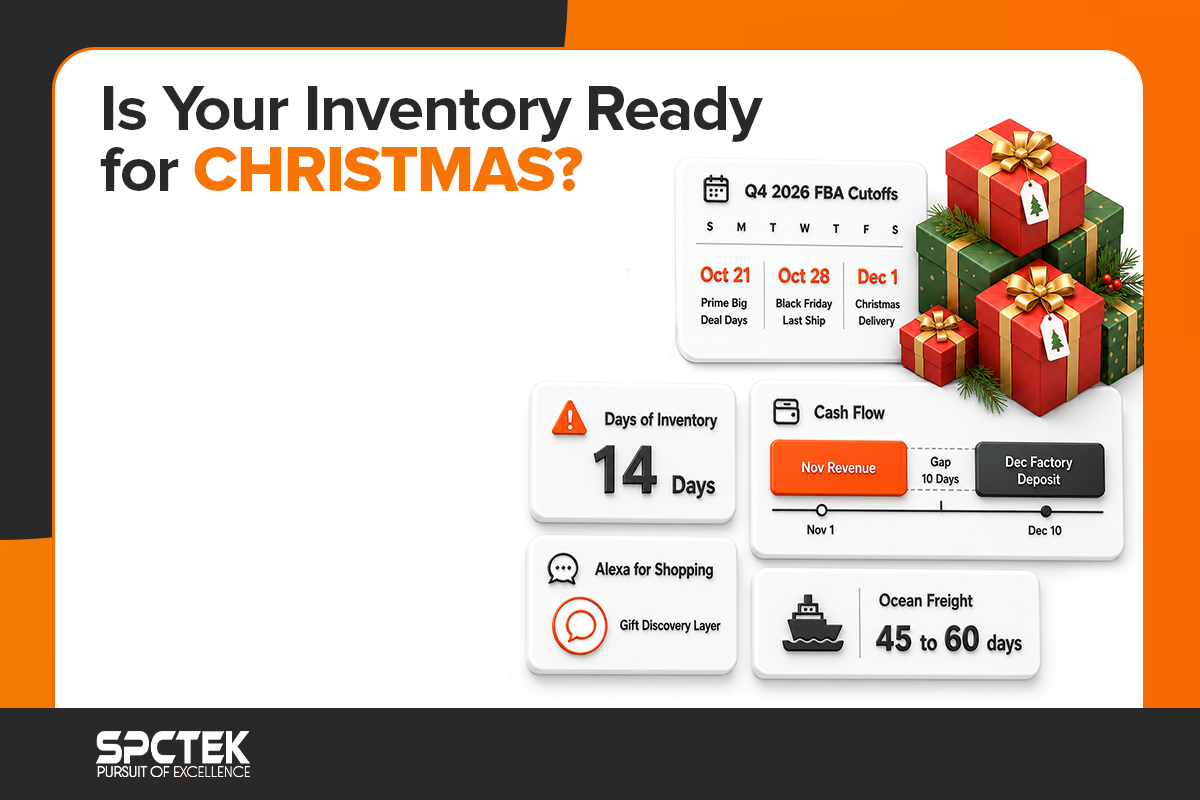
If you are reading this in July or August 2026, you have roughly two to three weeks left to place manufacturing orders that will actually arrive in time for Christmas. Chinese factories close for Golden Week from October 1 to 7. Ocean freight from China to a US port runs 45 to 60 days on average. Amazon needs another 7 to 14 days to receive and check in your inventory. The math is unforgiving once you write it down.
Christmas ecommerce is not a fourth quarter project. It is a third quarter project that shows up in the fourth quarter’s revenue. The strongest Amazon sellers place orders by mid-August, ship by late September, and confirm FBA check-in by late October, which leaves November free for actual selling rather than crisis management. If you have not started yet, this post will get you back on schedule and cover the parts of Christmas ecommerce most sellers get wrong: cash flow discipline, listing readiness in the Alexa for Shopping era, and inventory allocation between Amazon and Shopify.
How Should Amazon Sellers Plan Christmas Ecommerce Inventory in 2026?
Amazon sellers should place manufacturer orders for Christmas ecommerce inventory by mid-August 2026, ship to FBA in two waves for the October 21 and October 28 BFCM cutoffs, and target the expected December 1 Christmas inbound cutoff as a secondary window for late orders. Cash flow planning matters as much as unit forecasting, since Amazon’s DD+7 payout schedule delays November revenue into December, which is exactly when Q1 factory deposits come due.
Amazon FBA Christmas Inventory Deadline: The Working-Backward Timeline
Every Christmas prep blog leads with a calendar. This one leads with the decisions those dates force you to make, since the dates themselves are already public.
Amazon has confirmed the 2026 FBA inbound cutoffs for Black Friday and Cyber Monday through its Q4 2026 Playbook:
- Amazon Warehousing and Distribution (AWD) deadline: October 14, 2026
- FBA shipments using minimal shipment splits: October 21, 2026
- FBA shipments using Amazon-optimized shipment splits: October 28, 2026
For sellers also planning around Prime Big Deal Days in October, Amazon confirmed those deadlines earlier in the summer:
- AWD deadline for Prime Big Deal Days: September 2, 2026
- FBA minimal splits for Prime Big Deal Days: September 9, 2026
- FBA optimized splits for Prime Big Deal Days: September 16, 2026
The Christmas FBA inbound deadline is a separate, later cutoff. Based on Amazon’s consistent multi-year pattern, expect the 2026 Christmas cutoff to land around December 1. This gives sellers a second window to get gift-shopping inventory received in time for Prime-eligible Christmas delivery.
Two other dates matter for pricing and promotions during this window. Peak fulfillment fees begin October 15, 2026, adding a per-unit surcharge to every FBA and MCF order through mid-January 2027. And the BFCM deal submission window closes October 20, 2026, with an early submission discount available for applications filed by September 5.
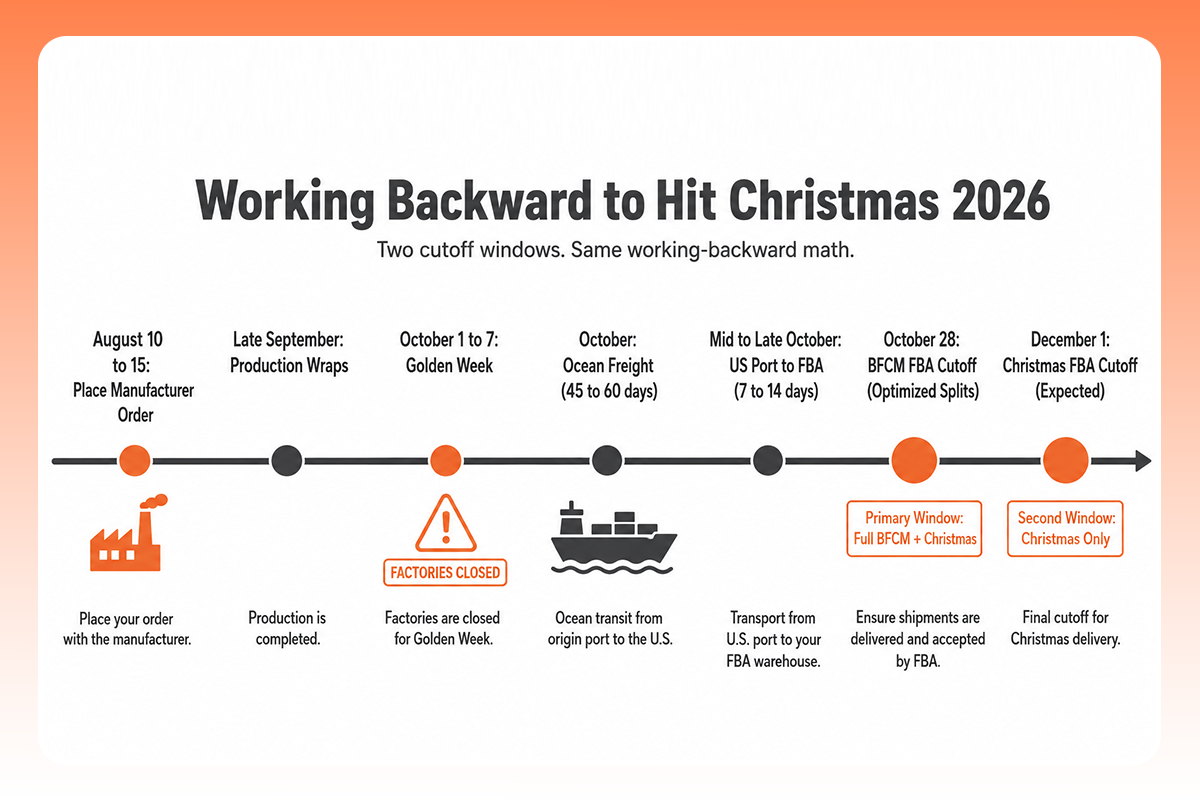
Working backward from October 28 for inventory sourced from China, the timeline looks like this. Domestic freight and FBA check-in adds 7 to 14 days at peak season. Ocean freight from a Chinese port to a US port runs 45 to 60 days. Golden Week shuts down production from October 1 to 7, and many factories extend closures on either side of those dates. Your manufacturer order needs to be placed and paid by mid-August, ideally August 10 to 15, so production wraps before Golden Week and cargo departs on time.
What to Do If You Are Already Past the August Window
The recovery options get expensive fast. Air freight from China runs roughly 4 to 6 times the per-unit cost of ocean freight, though it cuts transit time from weeks to days. Domestic sourcing or US-based fulfillment partners can bridge the gap for some categories, though usually at a lower margin. A common middle path for sellers who are late is a small air-freight shipment for peak-week coverage paired with a larger ocean-freight follow-up for Christmas week and post-Christmas demand.
One thing worth knowing if you are already behind: missing the October BFCM cutoffs does not automatically mean missing Christmas. The Christmas FBA inbound deadline sits later, at an expected December 1, which gives late orders a second window to hit the gift-shopping traffic even if they miss the BFCM revenue peak.
Whichever recovery path you choose, decide before you commit. The most expensive Christmas inventory mistake is ordering ocean-freight quantities on an air-freight timeline and then paying for both.
Why Optimized Splits Buys You an Extra Week
The FBA cutoff difference between minimal and optimized shipment splits is a full week (October 21 versus October 28), which represents a meaningful buffer during a peak season when receiving delays are common. The trade-off is control. Optimized splits lets Amazon distribute your inventory across multiple fulfillment centers, which reduces your direct visibility but earns the later cutoff. For most sellers heading into 2026 Christmas, the extra week of receiving buffer is worth the loss of routing control. Our 60-day Q4 prep plan walks through the shipment split decision in more detail.
The Christmas Inventory Cash Trap Most Sellers Do Not See Coming
Every Christmas inventory guide talks about how much stock to order. Almost none talk about how you will pay for the next round. This is where most 6-figure sellers stall in early Q1.
Amazon pays sellers on DD+7, meaning payouts land 7 days after the estimated delivery date of the last order in each settlement period. In Q4, the gap gets worse. Higher order volume, longer delivery estimates, and holiday reserve holds push cash further out. A seller doing $500K in November revenue may not see that cash land in their bank account until mid-to-late December, exactly when the factory needs a wire for Q1 production.
The scenario plays out something like this. October revenue is up 40 percent. You reinvest into November ad spend and a bigger November reorder. November revenue is up 90 percent. But your November payout does not arrive until December 15. Meanwhile, your factory needs a $150K deposit on December 10, and your ad budget is burning through cash on Cyber Week retargeting. At that point you have three options, none of them good: pause ads and lose Q4 momentum, skip the factory wire and delay Q1 inventory, or take emergency financing at painful rates.
Top sellers avoid the trap by making these moves in August, not December:
- Line up inventory financing (Payability, Wayflyer, SellersFunding, or a traditional line of credit) before Q4 begins
- Negotiate 60 or 90-day payment terms with manufacturers, so factory deposits do not compete with October ad spend for cash
- Keep 60 to 90 days of operating cash in reserve heading into October, not December
- Model the full cash conversion cycle, including expected returns and reserve holds, before placing the Christmas order
Our post on DD+7 deferred payments breaks down the payout mechanics in more depth, and our playbook on how to scale your Amazon business from $500K to $1M covers the financial structure that separates sellers who survive Q4 from sellers who thrive in Q1.
How to Forecast Christmas Inventory When Everything Shifts
Standard forecasting advice is easy to find. Pull last year’s Q4 velocity by SKU. Adjust for year-over-year growth. Factor in category seasonality. Add your planned ad budget. Every competitor blog covers this and every serious inventory tool automates it. The forecast itself is table stakes.
What separates disciplined operators from everyone else is the recovery decision. What happens when the forecast breaks, which it usually does?
Four things typically go wrong between August and December. Ocean freight slips 10 to 14 days and now the FBA cutoff is at risk. A hero SKU stocks out at the supplier and the substitute arrives late. Ad performance drops because Q4 CPCs inflate 40 to 60 percent in November. A competitor stocks out unexpectedly and demand shifts to your listing faster than your inventory can handle.
When those situations show up, top sellers already know the answers because they decided in advance:
- Which SKUs get emergency air freight budget if ocean slips: The instinct is to protect top-revenue SKUs. The better call is highest-margin SKUs with the deepest existing FBA position, since those recover ranking fastest with the fewest units.
- Which SKUs get ad budget pulled first if inventory tightens: The SKUs with the longest lead time to restock, since a stockout on those costs the most in ranking recovery.
- Which SKUs do you push if a competitor stocks out: Only the SKUs where your inventory can actually cover the incremental demand for at least three weeks. Chasing spillover demand you cannot fulfill triggers a stockout of your own.
The pre-commitment matters more than the framework. Set an air freight recovery budget in August, in specific dollars, before you know if you will need it. Assign it to specific SKU tiers. Decisions made in advance are decisions you can execute quickly. Decisions made under pressure in October usually get made poorly.
How to Avoid Stockouts During Christmas on Amazon
Late FBA check-in is the leading cause of Christmas stockouts, not underbuying. Receiving delays commonly stretch to 5 to 7 days during peak season, versus 1 to 3 days in September. Six practical defenses reduce that exposure:
- Ship your products in 2 or 3 smaller shipments instead of one big shipment. This reduces the risk of delays if one shipment gets held up during receiving
- Use AWD for reserve inventory that can trigger FBA transfers on demand
- Confirm carton labeling and prep requirements before goods leave the factory, since prep errors cause the longest check-in delays
- Set Days of Inventory alerts at 14, 10, and 7 days of cover, with a documented response at each threshold
- Reserve emergency freight budget for air shipments, so recovery is a wire transfer rather than a negotiation
- Adjust your ad spend based on the inventory stock levels, since burning PPC budget on a listing that will stock out in five days is worse than pulling back early
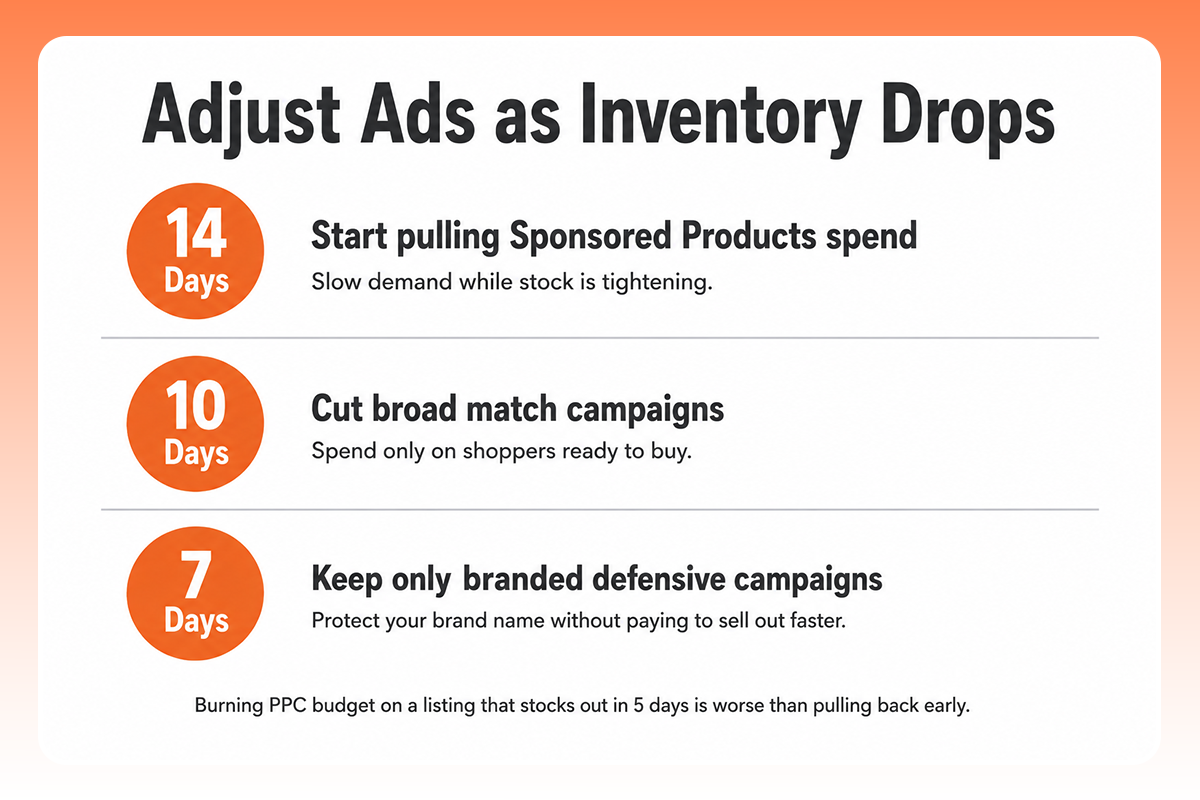
The ad-to-inventory coupling is where most sellers leak money. A working rule is to start pulling Sponsored Products spend when a SKU hits 14 Days of Inventory, cut broad-match campaigns at 10, and keep only branded defensive campaigns running at 7. That way you stop paying to accelerate demand you cannot fulfill. Our guide on 10 strategies for Amazon inventory management covers the operational side in more detail.
How Christmas Shoppers Actually Discover Products in 2026
The single biggest change to Amazon shopping in 2026 happened in May, when Amazon rolled Rufus and Alexa+ into a single assistant called Alexa for Shopping. It is now the default AI layer across the Amazon Shopping app, website, and Echo Show, and it is available to every US customer without a Prime membership or Echo device required.
Christmas is the season where this shift matters most. Gift shoppers ask conversational questions much more than category shoppers do. Queries like “find me a gift for a coffee drinker under $40” or “what is a good starter camera for a teenager” are exactly the kind of prompts Alexa for Shopping is built to answer. If your listing is not structured to be pulled into those answers, you do not appear in the discovery layer that most gift shoppers now hit before any traditional search.
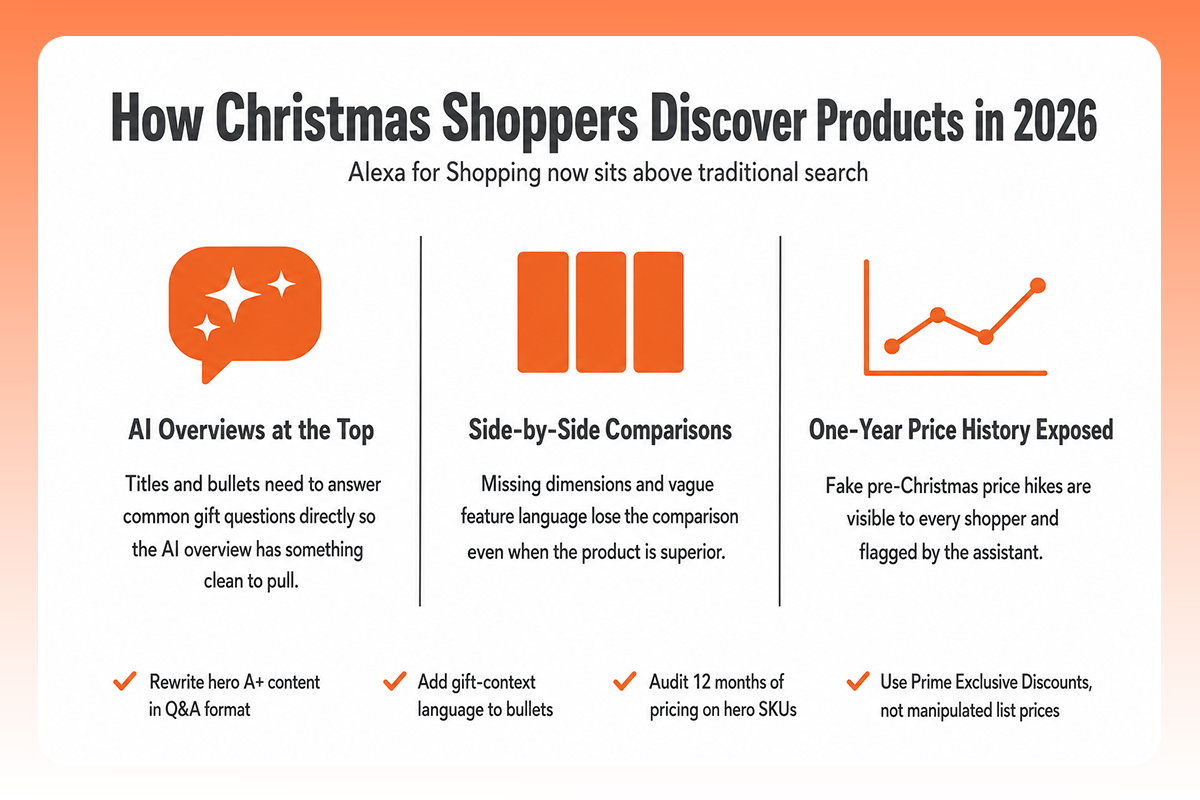
Three specific listing behaviors affect gift discovery this Christmas:
AI overviews appear at the top of search results: Alexa for Shopping surfaces a category summary before the buyer scrolls to individual listings. Titles and bullets need to answer common gift questions directly so the AI overview has something clean to pull.
Side-by-side comparisons run against 3 to 4 direct rivals: Shoppers can compare products from the search page in a single view. Missing dimensions, vague feature language, or generic bullets lose the comparison even when the product itself is superior.
One-year price history is exposed on every product page: Any shopper can now see how a product’s price has moved over the last 12 months. Fake pre-Christmas price hikes to enable “50 percent off” claims are visible to everyone, and Alexa for Shopping flags them. Honest Q3 pricing is required if you want Q4 discounts to convert.
The practical prep list before Christmas hits:
- Rewrite hero SKU A+ content in question-and-answer format for common gift queries in your category
- Add gift-context language to bullets, since phrases like “great gift for coffee lovers” and “ships in gift-ready packaging” match how shoppers now search
- Audit the last 12 months of pricing on hero SKUs so any Q4 discount reads as a real discount
- Consider Prime Exclusive Discounts (which surface as real deals in Alexa for Shopping) instead of manipulated list prices
Our earlier post on COSMO and Rufus explains the underlying ranking infrastructure that Alexa for Shopping now runs on top of, and our guide on leveraging Amazon seller AI covers the practical AI tool stack for sellers.
Christmas Ecommerce Inventory Across Amazon and Shopify
Sellers running both Amazon and Shopify tend to allocate 90 percent of their inventory to FBA and then wonder why they stock out on Shopify during peak. The two channels have different demand curves, and each one needs its own forecast.
Top sellers running both channels do a few things differently:
- Forecast Shopify demand separately based on planned paid social spend, since Shopify velocity moves with ad budget in a way Amazon velocity does not
- Reserve a dedicated Shopify inventory pool in a 3PL or through Amazon’s Multi-Channel Fulfillment (MCF)
- Set channel-specific reorder points, since a stockout on Shopify does not automatically show up in your FBA dashboard
- Use Amazon Attribution links on all Shopify and paid social traffic that drives Amazon sales, so those conversions qualify for the Brand Referral Bonus
Multi-Channel Fulfillment is the most convenient bridge, since it uses your existing FBA inventory to ship Shopify orders. The trade-off is per-unit fees run higher than most 3PLs, and default packaging arrives with Amazon branding unless you enable the unbranded option in your MCF settings. For larger Shopify volumes during Christmas, a dedicated 3PL usually delivers better economics and full control over branded inserts and packaging.
The channels support each other during Christmas when set up properly. Shopify captures gift-list traffic, email signups, and early-season research. Then the same audience converts on Amazon closer to shipping cutoffs, since Prime delivery becomes the deciding factor for anyone buying in the last two weeks. Our Shopify store management services cover the setup and ongoing management of this coordinated approach.
Christmas Inventory Management After December 25
Do not treat December 26 as the end of Q4. Gift card redemption and self-purchase behavior run strong through mid-January, and the shoppers arriving in that window buy differently from December gift shoppers.
Messaging shifts from “gift for them” to “treat yourself” or “New Year setup.” Categories that spike include fitness equipment, organizational products, kitchen tools, and home improvement, driven by resolution shoppers. Sellers who liquidate all inventory by December 24 miss the Q5 window entirely.
Amazon assesses the aged inventory surcharge on the 15th of every month on any FBA inventory sitting for 181 days or longer. The first tier hits at 181 days. The surcharge jumps significantly at 271 days and climbs again at 365 days, so Christmas inventory that sits through Q1 can compound quickly. Clearance discounts of 20 to 30 percent typically clear aged Christmas inventory before the surcharge tiers stack up.
Two more January moves matter. File FBA reimbursement claims for damaged, lost, or fee-overcharged inventory while the paperwork is fresh, since our Amazon FBA reimbursement guide walks through what to claim and how. Then run a structured Q4 debrief with actual versus forecast numbers by SKU, so Christmas 2027 forecasting starts from real data rather than optimism.
The 2026 Christmas Ecommerce Checklist by Month
Here is a compressed month-by-month view of what needs to happen between now and Christmas. Use it as a working checklist rather than a plan.
July and August
- Complete Christmas inventory forecast by SKU, with base and aggressive cases
- Place manufacturer orders by August 15, before Golden Week disrupts production
- Confirm ocean freight bookings and pre-committed air freight recovery budget
- Line up inventory financing or manufacturer payment terms
- Submit Prime Big Deal Days deal applications by August 5 for the early submission discount
- Audit current Inventory Performance Index and clear aged stock
September
- Pre-shipment inspection at the factory to confirm quality and prep compliance
- Ship PBDD inventory to hit deadlines: AWD by September 2, minimal splits by September 9, optimized splits by September 16
- Submit BFCM deal applications by September 5 for the early submission discount
- Finalize A+ Content, listing images, and video content for hero SKUs
- Rewrite bullets and A+ content for Alexa for Shopping gift discovery
- Audit last 12 months of pricing on hero SKUs
- Freeze all major listing changes going into October
October
- Ship first FBA wave by October 21 (minimal splits) or October 28 (optimized splits)
- Send AWD inventory by October 14
- Peak fulfillment fees begin October 15, so update margin models to account for the surcharge
- BFCM deal submission window closes October 20 (final deadline for standard applications)
- Monitor FBA check-in daily from October 15 forward
- Launch Prime Big Deal Days participation
- Begin awareness-stage ad build (Sponsored Brands, Sponsored Display, DSP)
November
- Confirm all Christmas-eligible inventory shipped to hit the expected December 1 FBA inbound cutoff
- Peak ad budgets during Thanksgiving week
- Monitor stockout risk on top SKUs every 4 hours during Cyber Week
- Freeze account changes (banking, listings, new SKU launches) starting November 1
- Track Days of Inventory alerts at 14, 10, and 7 thresholds
December
- Watch daily velocity through the December 18 to 20 shipping cutoff
- Prepare New Year clearance strategy for excess inventory
- Set up removal orders or clearance discounts on any SKU projected to sit past mid-January
- Continue Sponsored Products spend through December 22
- Keep branded defensive campaigns live through year-end
January
- Run Q5 messaging (self-purchase, New Year setup, gift card redemption)
- File FBA reimbursement claims for the full Q4 period
- Complete Q4 debrief by SKU
- Adjust Q1 forecasts based on actual return rates
- Begin Christmas 2027 forecast draft
Final Thoughts
The sellers who have a strong Christmas placed manufacturer orders in August, shipped by late September, confirmed FBA check-in by late October, and spent November running ads instead of chasing inventory. The sellers who had a difficult Christmas hoped things would work out and started the process too late.
If you want your Christmas ecommerce operation optimized, including data-driven inventory forecasting, cash flow planning, and inventory allocation between Amazon and Shopify, SPCTEK’s AI-driven inventory forecast and audit is your perfect solution. Book a strategy call now, while there is still time to affect the orders that determine your November and December.